


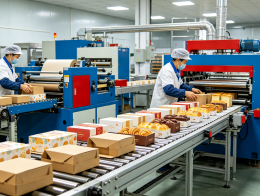
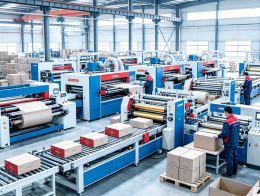
 Adapt to packaging factories and ecommerce supporting carton processing factories.
Matching production speed to paper weight, box style, and job complexity is one of the ongoing challenges in corrugated box gluing. When speed control cannot keep pace with these variables, the result is often paper misalignment, jamming, or inconsistent gluing quality. Variable frequency speed control addresses this by giving the folder gluer stepless, real-time speed adjustment rather than a fixed or segmented setting.
Older folder gluer designs typically rely on mechanical gearboxes or pulley systems to change running speed. Adjusting speed this way usually means physically swapping gears or belts, which is slow, imprecise, and dependent on whoever is doing the changeover. Because these systems tend to offer only a few fixed speed steps, they cannot fine-tune output in response to paper weight or box complexity in real time.
Another common limitation is the absence of proper acceleration and deceleration control. When a machine starts or stops abruptly, the sudden change in mechanical load tends to shift paper position at the feed or folding stage, increasing the risk of misfeeds and jams. Over time, this kind of repeated mechanical shock also adds wear to belts, bearings, and drive components, shortening service intervals and pushing up maintenance frequency.
Job changeovers on these systems tend to take longer as well, since correct speed settings are often a matter of operator experience rather than a repeatable, recorded parameter. Two operators running the same job on the same machine may end up with different results, simply because they adjusted speed slightly differently. On the production floor, this shows up as higher reject rates, more frequent stoppages for readjustment, and speed-related wear that adds to long-term maintenance cost.
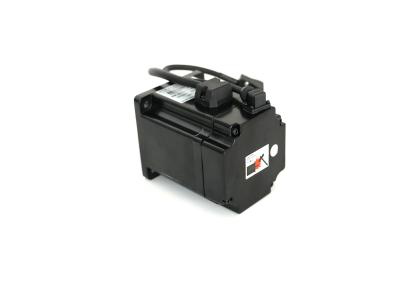
A variable frequency drive, commonly referred to as an inverter, adjusts motor speed by changing the frequency of the electrical current supplied to the motor rather than through mechanical gear changes. This allows the folder gluer to move through a continuous range of speeds instead of jumping between fixed steps, so the running speed can be matched more closely to the actual job requirements.
In practice, speed control is not applied to a single motor in isolation. The feeding, folding, gluing, and counting-ejecting sections of the machine need to move in coordination, so the frequency control logic links these stages together rather than adjusting each one independently. This keeps the overall production line synchronized as speed changes, which matters as much for output consistency as the speed setting itself.
Acceleration and deceleration curves are a further part of this control logic. Instead of starting or stopping abruptly, the drive ramps speed up and down gradually, which reduces mechanical shock on the machine and lowers the chance of paper shifting out of position during start-up or shutdown. This is one of the more direct ways that frequency control contributes to fewer misfeeds and less cumulative wear.
The motor and drive configuration used to deliver this control also matters for long-term reliability. A frequency converter from an established supplier such as Schneider is typically paired with a main drive motor for primary power output, an adjusting motor for fine speed regulation, and, where higher precision is required, a servo motor for stages that need faster response and tighter control. The splicing section is a good example of where this matters in practice: independent dual servo motor drive allows the splicing edge to be positioned and adjusted more accurately than a shared mechanical linkage would allow, while photoelectric sensing helps keep the splicing register consistent as paper properties vary. We select these components with long-term reliability in mind rather than treating specifications as a standalone selling point, which is why our machines pair Schneider frequency converters with Delta servo motors and PLC control as standard.
Bringing variable frequency control into the folding, gluing, and pressing sections addresses several of the problems described above in a fairly direct way. Continuous speed adjustment allows running speed to be tuned to paper weight and box style rather than forced through a fixed setting, which helps reduce the misalignment and jamming that come from speed mismatches. Soft start and soft stop control lowers the mechanical shock that would otherwise contribute to paper shifting and accelerated component wear.
Touchscreen and PLC-based control, built around components such as a Delta PLC and an HMI panel, allows speed parameters to be set, saved, and recalled for specific jobs. This reduces how much a changeover depends on individual operator experience, since a stored parameter set can be reloaded rather than re-established from scratch each time. In practical terms, this tends to shorten changeover time and make output more consistent across different operators and shifts, though actual results will vary with paper stock, box design, and how the equipment is maintained.
Speed control also does not operate independently of the rest of the machine's precision. A folding section, for example, performs more consistently when the belts feeding into it are running at a speed properly matched to the fold timing, which is part of why we treat frequency control and folding accuracy as connected design considerations rather than separate features. The same logic applies to the gluing and pressing stages downstream, where consistent infeed speed supports more even adhesive application and pressing contact.
The reliability of a variable frequency speed control system depends heavily on the quality of its individual components, not just the control logic itself. Our folder gluer machines use linear guide rails from NSK or Hualon, a Delta PLC and HMI for the control interface, Omron relays, Schneider contactors, and a Schneider frequency converter as the core of the speed control system. Main, adjusting, and servo motors are sourced from established suppliers such as Maili and Delta, and the machine frame is built from 16mm cold-treated steel plate to a recognized international standard. This is a deliberate approach to component selection: we prioritize parts with a track record of reliable long-term operation over simply listing the highest available specification.
As a folder gluer manufacturer, we see the speed control system as one part of a broader precision design that also includes the folding section, splicing section, and gluing stages working together. Whether you are running standard box styles or need a configuration adapted to a specific production line, our engineering team can walk through motor and drive configuration options based on your actual paper specifications and output requirements. To review full technical parameters for our folder gluer models or to arrange a demonstration, feel free to reach out to our engineering team directly.
'%3e%3cg%20id='Group%201315'%3e%3cg%20id='Group'%20opacity='0.5'%3e%3cpath%20id='Vector'%20d='M387.997%200L232.635%20265.605L58.6579%2086.8843L285.379%200H387.997Z'%20fill='url(%23paint0_linear_821_1490)'/%3e%3c/g%3e%3cg%20id='Group_2'%20opacity='0.5'%3e%3cg%20id='Group%201314'%3e%3cpath%20id='Vector_2'%20d='M376.103%2012.2625L298.38%20330L10.1988%20240.481L298.38%2012.2625H376.103Z'%20fill='url(%23paint1_linear_821_1490)'/%3e%3c/g%3e%3c/g%3e%3c/g%3e%3c/g%3e%3c/g%3e%3cdefs%3e%3clinearGradient%20id='paint0_linear_821_1490'%20x1='319.349'%20y1='11.6627'%20x2='157.133'%20y2='145.876'%20gradientUnits='userSpaceOnUse'%3e%3cstop%20stop-color='%23D2DFFF'/%3e%3cstop%20offset='1'%20stop-color='%23D2DFFF'%20stop-opacity='0.01'/%3e%3c/linearGradient%3e%3clinearGradient%20id='paint1_linear_821_1490'%20x1='253.685'%20y1='25.1395'%20x2='74.5789'%20y2='173.327'%20gradientUnits='userSpaceOnUse'%3e%3cstop%20stop-color='%23D2DFFF'/%3e%3cstop%20offset='1'%20stop-color='%23D2DFFF'%20stop-opacity='0.01'/%3e%3c/linearGradient%3e%3c/defs%3e%3c/svg%3e)
'/%3e%3cpath%20id='Rectangle%20455'%20d='M0%2012H6L24%2056H0V12Z'%20fill='%23CE221D'/%3e%3c/g%3e%3cdefs%3e%3clinearGradient%20id='paint0_linear_769_2773'%20x1='0'%20y1='28'%20x2='432.5'%20y2='28'%20gradientUnits='userSpaceOnUse'%3e%3cstop%20stop-color='%23153B8A'/%3e%3cstop%20offset='1'%20stop-color='%23153B8A'%20stop-opacity='0'/%3e%3c/linearGradient%3e%3c/defs%3e%3c/svg%3e) Adapt to packaging factories and ecommerce supporting carton processing factories.
Adapt to packaging factories and ecommerce supporting carton processing factories.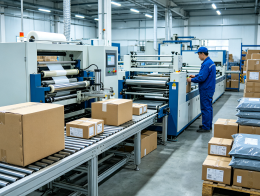 The printing and packaging factory produces molded paper boxes.
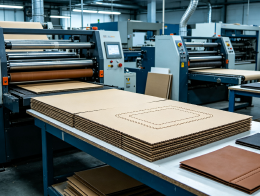 Production of two-piece packaging boxes for large household appliances with butt joint bonding.
 Pre-apply double-sided tape to the packaging of electronic products.
 Automatic Carton Forming Technology
 Double-sided tape applicator
Two-layer systems are designed for operational efficiency and ease of use. With automated synchronization and reduced ...
Each carton factory has different carton sizes, cardboard types, output capacity and workshop conditions. Please fill in the left form with your detailed production demands. Our technical team will tailor the most suitable machine configuration and professional production solution for you, providing free one-on-one technical guidance and customized support.