


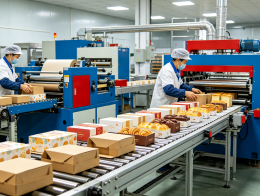
 Adapt to packaging factories and ecommerce supporting carton processing factories.
Corrugated box converters are under pressure to run shorter jobs, more box styles, and tighter delivery windows than ever before. As order patterns shift toward smaller batches and faster turnarounds, the machine sitting at the center of the folding and gluing process has to keep up. For many plants, the drive system inside the folder gluer — not the frame, not the belts, but the way each section is actually driven — has become the difference between a line that adapts and one that falls behind.
Most folder gluers built around a traditional mechanical layout rely on a single master shaft to synchronize feeding, folding, pressing, and conveying. Every moving section is linked back to that shaft through gears, cams, and chains, which means the entire machine moves as one connected system rather than as independent, adjustable stations.
That design has served the industry well for decades, and it still works reliably for plants running one or two box styles at high volume. The trouble shows up when order mix starts to change. Adjusting a fold parameter often means swapping physical stops, changing gear sets, or manually recalibrating linkages — work that can easily eat thirty minutes or more of production time on every changeover. For converters filling short-run, custom, or e-commerce packaging orders, that lost time adds up fast across a shift.
Precision is the second pressure point. Because the folding sections in a gear-driven machine move at a fixed ratio to the master shaft, there is little room to fine-tune one side independently of the other. On longer or irregularly shaped blanks, this rigidity tends to produce the familiar "fish-tail" misalignment, where the leading and trailing edges of a fold drift out of parallel. Mechanical wear compounds the issue over time: as gears, cams, and chains age, backlash creeps in, and the tolerances the machine once held start to slip, requiring more frequent mechanical maintenance just to hold the line.
The result is a machine that performs well within a narrow operating window but struggles as soon as flexibility becomes the priority — which, for a growing share of corrugated converters, it now is.
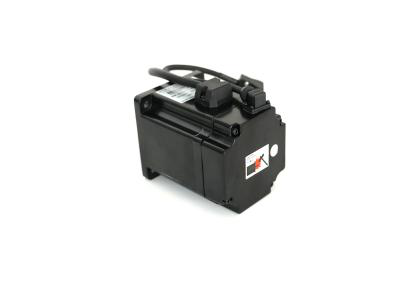
An independent servo-driven folder gluer takes a different approach to the same problem. Instead of one shaft driving every section through mechanical linkage, each functional section — feeding, alignment, folding, pressing, conveying — runs on its own servo motor, coordinated digitally through a PLC and HMI rather than through gears and cams.
The practical effect starts with changeovers. Because job parameters are stored and recalled electronically, adjusting fold width, belt speed, or section timing no longer requires swapping physical parts. Operators load a saved setting and the sections move to it automatically, which is why converters that switch from gear-driven to servo-driven equipment typically describe changeover times dropping from the better part of an hour down to a matter of minutes.
Precision improves for a related reason: each folding section can be tuned independently. Left and right folding belts can run at slightly different speeds when a job calls for it, which helps prevent the fish-tail effect that gear-driven machines struggle to avoid on longer or asymmetric blanks. Because there's no mechanical linkage introducing backlash, the machine also tends to run more smoothly and quietly, with less vibration transmitted through the frame.
Servo drive systems also widen the range of material the same machine can handle well. Thin single-wall board and heavier double-wall stock respond differently under pressure and speed, and independently adjustable sections make it easier to dial in the right settings for E, F, C, B, and AB flute — or mixed flutes — without reconfiguring the machine mechanically. Maintenance shifts in a similar direction: with fewer wear-prone mechanical linkages in the system, servo-driven machines rely more on electronic diagnostics, which can flag developing issues before they cause unplanned downtime.
None of this is a proprietary concept unique to one builder. Independent servo drive has become a fairly standard specification across the corrugated machinery industry precisely because it solves a problem that gear-driven designs were never built to handle: production environments where the next order on the schedule rarely looks like the last one.
We design our corrugated folder gluer line around this same principle, applying independent servo drive to the sections where it has the most direct impact on changeover speed and fold accuracy — feeding, alignment, folding, and conveying — rather than treating it as a single add-on feature.
Rather than relying on a single mechanical spec sheet, our machines are built from components we've selected specifically for long-duty-cycle corrugated production. Servo motors and PLC control come from Delta, linear guide rails are sourced from HIWIN and Hiwin's domestic equivalent, bearings are NSK, the human-machine interface runs on WECON, and electrical components such as relays and contactors are supplied by Omron and Schneider. Frequency converters come from SINEE, and main drive motors are supplied by MAILI. We chose this combination because each component has a track record in industrial corrugated equipment, not because it's the cheapest option available — a distinction that matters once a machine is running multiple shifts a day.
This approach carries across our folder gluer range, which spans different working widths and feeding sizes to match the volume and box styles a given production line actually runs. Because each section is servo-driven rather than mechanically linked, converters working with us can move between box styles without the changeover penalty that comes with gear-driven equipment, while still holding consistent fold accuracy across long runs. For plants handling a broader mix of order sizes, that combination of speed and repeatability tends to matter more than raw top-end output.
The shift toward independent servo-driven sections reflects a broader change in how corrugated converters need their equipment to perform: fast changeovers, consistent fold quality, and the flexibility to run a wider range of box styles without retooling the machine. It's a drive-system decision as much as it is a purchasing decision, and it shapes how a folder gluer performs long after installation.
If you're evaluating a folder gluer for a line that's running more box styles, shorter runs, or tighter delivery schedules, our engineering team can walk you through which configuration in our range fits your feeding sizes, flute range, and target speed. Reach out to request detailed specifications for our current folder gluer models or to arrange a closer look at how independent servo drive performs on our machines.
'%3e%3cg%20id='Group%201315'%3e%3cg%20id='Group'%20opacity='0.5'%3e%3cpath%20id='Vector'%20d='M387.997%200L232.635%20265.605L58.6579%2086.8843L285.379%200H387.997Z'%20fill='url(%23paint0_linear_821_1490)'/%3e%3c/g%3e%3cg%20id='Group_2'%20opacity='0.5'%3e%3cg%20id='Group%201314'%3e%3cpath%20id='Vector_2'%20d='M376.103%2012.2625L298.38%20330L10.1988%20240.481L298.38%2012.2625H376.103Z'%20fill='url(%23paint1_linear_821_1490)'/%3e%3c/g%3e%3c/g%3e%3c/g%3e%3c/g%3e%3c/g%3e%3cdefs%3e%3clinearGradient%20id='paint0_linear_821_1490'%20x1='319.349'%20y1='11.6627'%20x2='157.133'%20y2='145.876'%20gradientUnits='userSpaceOnUse'%3e%3cstop%20stop-color='%23D2DFFF'/%3e%3cstop%20offset='1'%20stop-color='%23D2DFFF'%20stop-opacity='0.01'/%3e%3c/linearGradient%3e%3clinearGradient%20id='paint1_linear_821_1490'%20x1='253.685'%20y1='25.1395'%20x2='74.5789'%20y2='173.327'%20gradientUnits='userSpaceOnUse'%3e%3cstop%20stop-color='%23D2DFFF'/%3e%3cstop%20offset='1'%20stop-color='%23D2DFFF'%20stop-opacity='0.01'/%3e%3c/linearGradient%3e%3c/defs%3e%3c/svg%3e)
'/%3e%3cpath%20id='Rectangle%20455'%20d='M0%2012H6L24%2056H0V12Z'%20fill='%23CE221D'/%3e%3c/g%3e%3cdefs%3e%3clinearGradient%20id='paint0_linear_769_2773'%20x1='0'%20y1='28'%20x2='432.5'%20y2='28'%20gradientUnits='userSpaceOnUse'%3e%3cstop%20stop-color='%23153B8A'/%3e%3cstop%20offset='1'%20stop-color='%23153B8A'%20stop-opacity='0'/%3e%3c/linearGradient%3e%3c/defs%3e%3c/svg%3e) Adapt to packaging factories and ecommerce supporting carton processing factories.
Adapt to packaging factories and ecommerce supporting carton processing factories.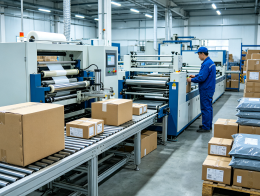 The printing and packaging factory produces molded paper boxes.
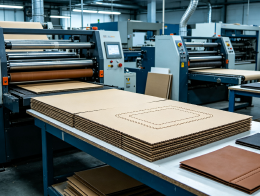 Production of two-piece packaging boxes for large household appliances with butt joint bonding.
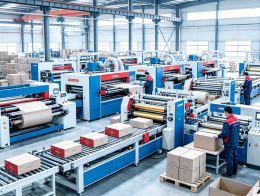 Pre-apply double-sided tape to the packaging of electronic products.
 Automatic Carton Forming Technology
 Double-sided tape applicator
Two-layer systems are designed for operational efficiency and ease of use. With automated synchronization and reduced ...
Each carton factory has different carton sizes, cardboard types, output capacity and workshop conditions. Please fill in the left form with your detailed production demands. Our technical team will tailor the most suitable machine configuration and professional production solution for you, providing free one-on-one technical guidance and customized support.