


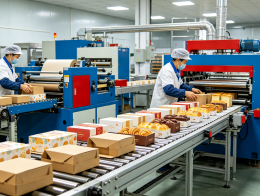
 Adapt to packaging factories and ecommerce supporting carton processing factories.
Floor space rarely gets the same attention as speed or throughput when a plant chooses new equipment, but it often ends up costing more over the life of a production line. When we sit down with customers to plan a new line, one of the first questions is not how fast the equipment runs, but how much floor it takes up once gluing and stitching are both accounted for. That question is what led us to build the Fully Automatic High-Speed Folder Gluer-Stitcher Machine as a single line rather than two separate ones.
A gluing machine and a stitching machine are, in most plants, two distinct pieces of equipment, each occupying its own stretch of the production line. Between them sits space that is easy to overlook during initial planning but adds up quickly once the line is running. Semi-finished boxes need a buffer area or a transfer path to move from the gluing stage to the stitching stage, whether that transfer happens by hand or by conveyor. That buffer zone is floor space that produces nothing on its own; it exists purely to bridge the gap between two machines that were never designed to work as one line.
Each machine also needs its own operating area and maintenance access, which means those zones are effectively duplicated rather than shared. If the two machines come from different manufacturers or different equipment generations, their footprint dimensions, mounting requirements, and foundation bolt patterns rarely match, which makes it harder to standardize a layout or retrofit an existing plant without significant rework.
The cumulative effect shows up at the plant level. A longer combined footprint stretches the overall production line, which in turn lengthens the distance material has to travel and complicates the logistics path between feeding, forming, and finishing. For plants designing a new facility, or for those working within a leased building where floor area is fixed, this extra length can become the limiting factor in how many lines fit on the floor. And because more equipment means more area to cover, the infrastructure supporting it, including climate control, dust extraction, and power distribution, has to extend across a larger footprint as well, adding to operating costs that are not always accounted for when the layout is first drawn up.
We approached this from the layout side of the problem rather than only the production side. A fully automatic high-speed folder gluer-stitcher machine brings automatic belt suction feeding, automatic gluing, autofolding, automatic calibration, and automatic stitching together on one continuous line, which means the plant no longer needs to reserve separate zones for gluing and stitching in the first place.
The practical benefit for facilities planning is having one fixed number to design around. The machine occupies a footprint of roughly 14000 by 4000 by 2000 millimeters, and that figure covers the entire sequence from sheet feeding through to finished box output. Engineering and facilities teams can plan around a single, known set of dimensions instead of adding together two separate machine footprints plus an unpredictable buffer zone whose size depends on how the plant chooses to move material between stages.
Because gluing and stitching modes run on the same line, switching between them does not require a physical transfer of material from one machine to another. There is no intermediate staging area, no separate transfer conveyor, and no need to plan floor space around a handoff point that exists only to connect two machines. The gluing mode handles carton sizes from roughly 170 by 420 millimeters up to about 1200 by 2600 millimeters at a mechanical speed of up to 180 meters per minute, while the stitching mode covers box sizes from around 300 by 800 millimeters up to 2600 millimeters with a stitch distance adjustable between 30 and 120 millimeters. Both size ranges run through the same physical footprint, so the plant is not carrying the floor space cost of two separate size-specific machines.
Optional features such as a flap-folding attachment or automatic counting and stacking are built into the same line as well, so they do not require additional floor area beyond the machine's stated footprint. A facility planning around this equipment is planning around one continuous zone, not a main line plus a growing list of auxiliary stations.
| Planning Item | Fully Automatic Folder Gluer-Stitcher Machine |
|---|---|
| Machine Footprint | Approx. 14,000 × 4,000 × 2,000 mm |
| Feeding & Processing | Automatic feeding, gluing, folding, calibration, and stitching |
| Gluing Mode | Approx. 170 × 420 to 1,200 × 2,600 mm; up to 180 m/min |
| Stitching Mode | Approx. 300 × 800 to 2,600 mm; stitch distance 30–120 mm |
| Production Layout | One continuous production line |
| Transfer Area | No separate material transfer or intermediate staging area |
| Optional Functions | Flap folding, automatic counting, and stacking integrated into the line |
| Space Planning Benefit | One fixed footprint instead of separate gluing and stitching machine zones |
For a plant being designed from the ground up, this changes what the layout drawing actually needs to account for. Rather than sketching two machine footprints connected by an assumed transfer path, the engineering team can work from a single fixed envelope and design the surrounding material flow, storage, and access aisles around that one section of the line. That tends to simplify the overall drawing and reduces the number of assumptions the layout depends on before construction begins.
For plants upgrading an existing line, the calculation runs the other way. Replacing a separate gluing machine and stitching machine with one consolidated line frees up the space those two machines and their connecting buffer zone previously occupied. That recovered floor area can go toward an additional production line, extra material storage, or simply more room around existing equipment for safer material handling. In facilities where every square meter is already accounted for, this kind of consolidation is often the most direct way to gain usable space without expanding the building itself.
The same logic applies to plants running multiple production lines side by side. A smaller, more predictable footprint per line means more lines can fit into the same total floor area, which has a direct effect on how much output a facility can support without adding square footage. Over time, that difference compounds as a plant scales production or adds new equipment around its existing layout.
We design and build our fully automatic high-speed folder gluer-stitcher machine with the realities of factory planning in mind, not only the performance numbers on a spec sheet. It was developed with the understanding that equipment selection is also a floor space decision, and that the amount of area a line occupies affects a plant's layout options for years after installation.
Every stage of the line, from feeding through folding, gluing, calibration, and stitching, is engineered to share one footprint rather than requiring separate zones stitched together after the fact. That is what allows the machine to offer a single, dependable set of dimensions that a facilities team can design around with confidence, whether the project is a new plant build or an upgrade to an existing production floor.
If your plant is planning a new line or reworking an existing layout, it is worth reviewing how much floor space is currently tied up in the gap between separate gluing and stitching machines. We build this equipment to consolidate that space directly, and we are glad to share detailed dimension drawings to help your team plan the layout before equipment arrives on site.
'%3e%3cg%20id='Group%201315'%3e%3cg%20id='Group'%20opacity='0.5'%3e%3cpath%20id='Vector'%20d='M387.997%200L232.635%20265.605L58.6579%2086.8843L285.379%200H387.997Z'%20fill='url(%23paint0_linear_821_1490)'/%3e%3c/g%3e%3cg%20id='Group_2'%20opacity='0.5'%3e%3cg%20id='Group%201314'%3e%3cpath%20id='Vector_2'%20d='M376.103%2012.2625L298.38%20330L10.1988%20240.481L298.38%2012.2625H376.103Z'%20fill='url(%23paint1_linear_821_1490)'/%3e%3c/g%3e%3c/g%3e%3c/g%3e%3c/g%3e%3c/g%3e%3cdefs%3e%3clinearGradient%20id='paint0_linear_821_1490'%20x1='319.349'%20y1='11.6627'%20x2='157.133'%20y2='145.876'%20gradientUnits='userSpaceOnUse'%3e%3cstop%20stop-color='%23D2DFFF'/%3e%3cstop%20offset='1'%20stop-color='%23D2DFFF'%20stop-opacity='0.01'/%3e%3c/linearGradient%3e%3clinearGradient%20id='paint1_linear_821_1490'%20x1='253.685'%20y1='25.1395'%20x2='74.5789'%20y2='173.327'%20gradientUnits='userSpaceOnUse'%3e%3cstop%20stop-color='%23D2DFFF'/%3e%3cstop%20offset='1'%20stop-color='%23D2DFFF'%20stop-opacity='0.01'/%3e%3c/linearGradient%3e%3c/defs%3e%3c/svg%3e)
'/%3e%3cpath%20id='Rectangle%20455'%20d='M0%2012H6L24%2056H0V12Z'%20fill='%23CE221D'/%3e%3c/g%3e%3cdefs%3e%3clinearGradient%20id='paint0_linear_769_2773'%20x1='0'%20y1='28'%20x2='432.5'%20y2='28'%20gradientUnits='userSpaceOnUse'%3e%3cstop%20stop-color='%23153B8A'/%3e%3cstop%20offset='1'%20stop-color='%23153B8A'%20stop-opacity='0'/%3e%3c/linearGradient%3e%3c/defs%3e%3c/svg%3e) Adapt to packaging factories and ecommerce supporting carton processing factories.
Adapt to packaging factories and ecommerce supporting carton processing factories.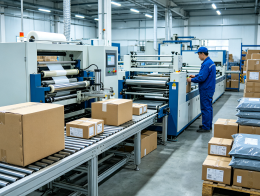 The printing and packaging factory produces molded paper boxes.
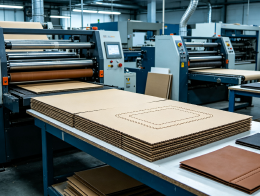 Production of two-piece packaging boxes for large household appliances with butt joint bonding.
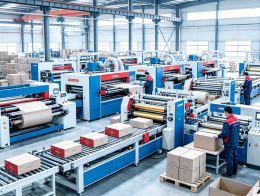 Pre-apply double-sided tape to the packaging of electronic products.
 Automatic Carton Forming Technology
 Double-sided tape applicator
Two-layer systems are designed for operational efficiency and ease of use. With automated synchronization and reduced ...
Each carton factory has different carton sizes, cardboard types, output capacity and workshop conditions. Please fill in the left form with your detailed production demands. Our technical team will tailor the most suitable machine configuration and professional production solution for you, providing free one-on-one technical guidance and customized support.