


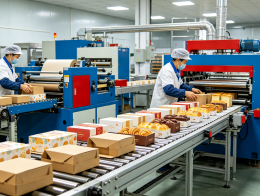
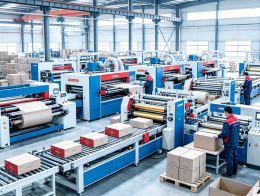
 Adapt to packaging factories and ecommerce supporting carton processing factories.
Food packaging places demands on corrugated boxes that most other industries do not face in the same way. Boxes need to hold a reliable seal, resist structural stress during stacking and transport, and meet hygiene expectations throughout the supply chain, since any failure at the seam or fold can compromise product safety. Within this environment, the folder gluer machine plays a role that goes well beyond simply folding and gluing cardboard — its precision has a direct bearing on whether a food packaging box performs as intended once it leaves the production line.
Two issues tend to surface most often when folder gluer equipment is not built with food packaging requirements in mind.
The first is inconsistent glue application. Mechanical gluing structures with limited precision often struggle to control glue volume evenly across the seam, which leads to sections with too little adhesive or, in some cases, glue that spreads beyond the intended contact area. For most packaging categories, this kind of inconsistency is a quality issue. For food packaging specifically, it becomes a safety and shelf-life concern, since a seam that is not properly sealed can allow moisture, contamination, or physical damage during transport, particularly on longer supply routes or in humid storage conditions.
The second issue is folding accuracy. When the folding section relies on manual adjustment or a lower-precision drive mechanism, angle deviation and uneven crease lines become common, especially as production speed increases. Folding accuracy is not just a cosmetic matter — it determines how well a box carries load. Food packaging is frequently stacked several layers high in warehouses and during transport, so any weakness introduced by an inconsistent fold tends to show up as box deformation or collapse under sustained pressure, which can affect both product integrity and how the packaging is perceived by retailers and end customers.
A related, though less discussed, challenge is changeover speed. Food packaging producers often work with a range of box sizes and specifications depending on the product line, and equipment that is slow to reconfigure between runs limits how quickly a facility can respond to varying order requirements. This does not directly affect a single box's structural quality, but it does shape how consistently that quality can be maintained across different production batches.
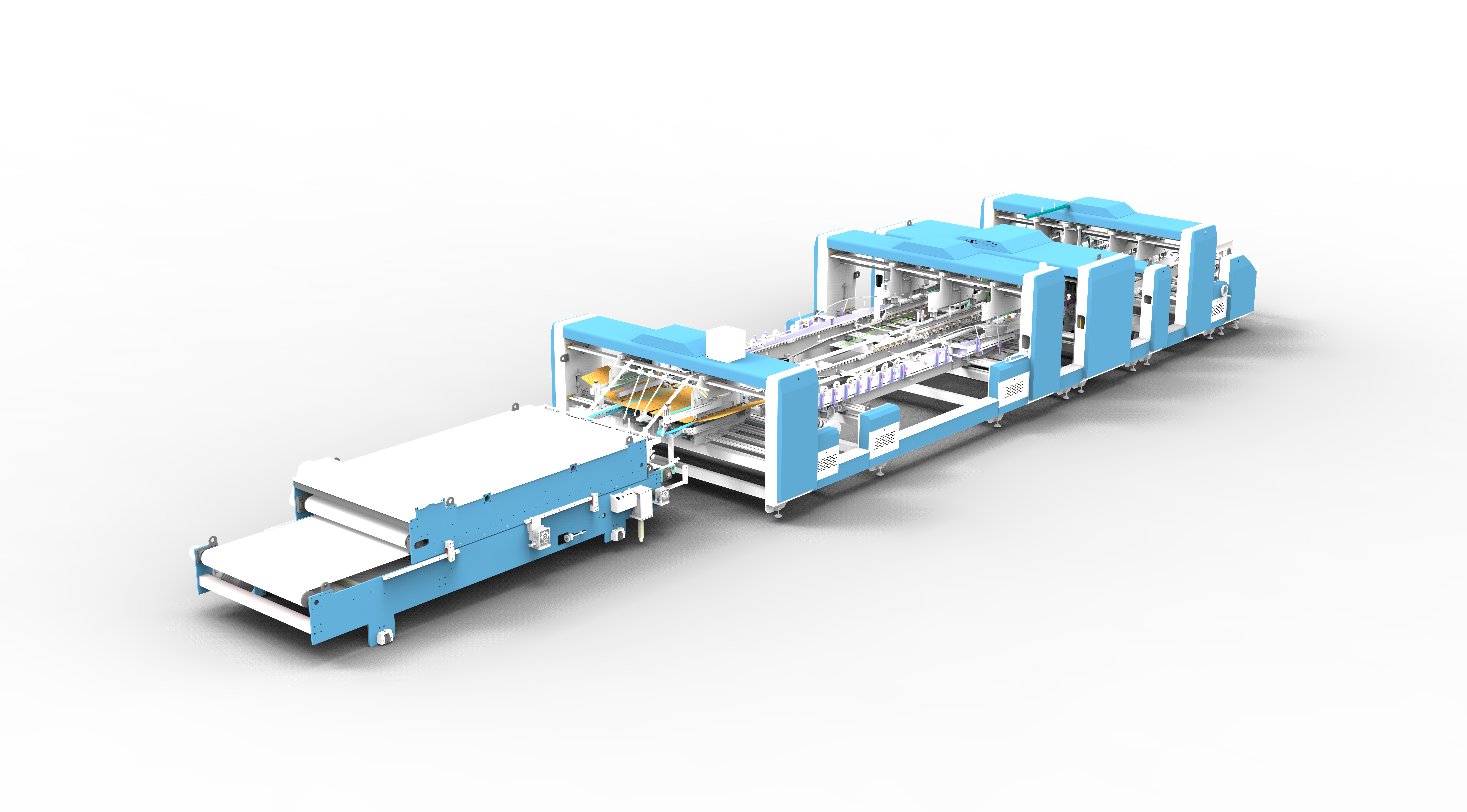
Rather than treating sealing and structural reliability as issues to catch during quality inspection, we approach them as outcomes that should be built into the machine's core systems from the start. Two areas of our equipment design are particularly relevant to food packaging production.
The first is our gluing system, which uses a mechanical roller-style structure supporting both cold and hot glue application methods, with an optional spray gluing system available depending on production needs. This flexibility allows the bonding method to be matched to the specific board weight, glue type, and line speed a food packaging run requires, rather than forcing every job through a single fixed process. More importantly, the roller-based application is designed to distribute glue evenly along the seam, which reduces the likelihood of localized under-application or excess spread that leads to sealing gaps. Consistent glue coverage translates directly into a more dependable seal, which matters most in the applications where packaging failure carries the highest cost.
The second area is our folding and splicing structure. The folding section is driven by independent motors capable of completing multiple fold lines with precision, and the left and right turning points are equipped with stepless variable speed adjustment, allowing fold angles and crease consistency to be fine-tuned rather than fixed at a single setting. On the splicing side, a photoelectric sensing device times the splicing action accurately, which helps prevent misalignment or insufficient bonding strength at the joint. Together, these systems are built to hold consistent folding angles and splicing strength across long production runs, which is what ultimately gives the finished box the load-bearing capacity needed for multi-layer stacking and extended transport.
These core systems are supported by an underlying drive and control architecture — including a Delta PLC, SINEE frequency converter, and industrial-grade bearings and guide rails — that keeps motion control stable as production speed and volume increase. This layer of the machine does not require special attention in most conversations about food packaging, but it is what allows the gluing and folding precision described above to remain consistent hour after hour rather than only under ideal conditions.
None of this suggests that any folder gluer machine can guarantee a perfectly sealed box on every single unit — packaging quality always depends on a combination of machine setup, material consistency, and proper maintenance. What a well-engineered machine can offer is a meaningfully narrower range of variation, so that glue coverage, fold angles, and splicing strength stay within a predictable and repeatable range across a production run. For food packaging specifically, that kind of consistency is what allows a facility to meet its own internal quality standards and, in many cases, the packaging specifications required by food safety certifications or retail partners.
Viewed this way, the folder gluer machine is not a peripheral piece of equipment on a food packaging line — it is one of the points in the process where sealing reliability and structural strength are actually determined, before the box ever reaches a filling line or a warehouse shelf.
Our approach to folder gluer design starts from the understanding that food packaging applications carry a different set of stakes than general corrugated packaging. From the flexibility of our cold and hot glue systems to the precision of our independently driven folding section and photoelectric-controlled splicing, every part of the machine is engineered with sealing reliability and structural consistency as a priority, not an afterthought. For food packaging producers evaluating folder gluer equipment, these are the details worth examining closely during the selection process. We work with manufacturers to configure machines that match their specific box specifications and production volumes, drawing on our experience in corrugated box folder gluer design to support packaging lines that need to perform reliably, run after run.
'%3e%3cg%20id='Group%201315'%3e%3cg%20id='Group'%20opacity='0.5'%3e%3cpath%20id='Vector'%20d='M387.997%200L232.635%20265.605L58.6579%2086.8843L285.379%200H387.997Z'%20fill='url(%23paint0_linear_821_1490)'/%3e%3c/g%3e%3cg%20id='Group_2'%20opacity='0.5'%3e%3cg%20id='Group%201314'%3e%3cpath%20id='Vector_2'%20d='M376.103%2012.2625L298.38%20330L10.1988%20240.481L298.38%2012.2625H376.103Z'%20fill='url(%23paint1_linear_821_1490)'/%3e%3c/g%3e%3c/g%3e%3c/g%3e%3c/g%3e%3c/g%3e%3cdefs%3e%3clinearGradient%20id='paint0_linear_821_1490'%20x1='319.349'%20y1='11.6627'%20x2='157.133'%20y2='145.876'%20gradientUnits='userSpaceOnUse'%3e%3cstop%20stop-color='%23D2DFFF'/%3e%3cstop%20offset='1'%20stop-color='%23D2DFFF'%20stop-opacity='0.01'/%3e%3c/linearGradient%3e%3clinearGradient%20id='paint1_linear_821_1490'%20x1='253.685'%20y1='25.1395'%20x2='74.5789'%20y2='173.327'%20gradientUnits='userSpaceOnUse'%3e%3cstop%20stop-color='%23D2DFFF'/%3e%3cstop%20offset='1'%20stop-color='%23D2DFFF'%20stop-opacity='0.01'/%3e%3c/linearGradient%3e%3c/defs%3e%3c/svg%3e)
'/%3e%3cpath%20id='Rectangle%20455'%20d='M0%2012H6L24%2056H0V12Z'%20fill='%23CE221D'/%3e%3c/g%3e%3cdefs%3e%3clinearGradient%20id='paint0_linear_769_2773'%20x1='0'%20y1='28'%20x2='432.5'%20y2='28'%20gradientUnits='userSpaceOnUse'%3e%3cstop%20stop-color='%23153B8A'/%3e%3cstop%20offset='1'%20stop-color='%23153B8A'%20stop-opacity='0'/%3e%3c/linearGradient%3e%3c/defs%3e%3c/svg%3e) Adapt to packaging factories and ecommerce supporting carton processing factories.
Adapt to packaging factories and ecommerce supporting carton processing factories.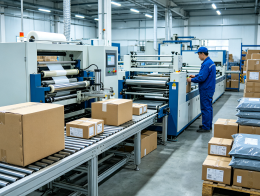 The printing and packaging factory produces molded paper boxes.
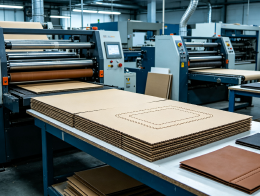 Production of two-piece packaging boxes for large household appliances with butt joint bonding.
 Pre-apply double-sided tape to the packaging of electronic products.
 Automatic Carton Forming Technology
 Double-sided tape applicator
Two-layer systems are designed for operational efficiency and ease of use. With automated synchronization and reduced ...
Each carton factory has different carton sizes, cardboard types, output capacity and workshop conditions. Please fill in the left form with your detailed production demands. Our technical team will tailor the most suitable machine configuration and professional production solution for you, providing free one-on-one technical guidance and customized support.