


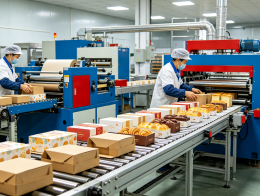
 Adapt to packaging factories and ecommerce supporting carton processing factories.
Feeding accuracy is one of the first factors that determines how well a corrugated box folder gluer machine performs downstream. Before a sheet is ever folded or glued, it has to be picked up, separated, and positioned correctly — and any weakness at this stage tends to show up later as misalignment, weak seams, or inconsistent box shapes. As a manufacturer that designs and builds folder gluer machines for corrugated packaging producers, we spend a disproportionate amount of engineering time on this single stage of the process, because so much of what happens later on the line depends on getting it right. In this article, we share how we think about feeding — the problems we've seen customers run into with older equipment, how our suction feeding system is built to address them, and what that means in practical terms for a production line running a corrugated box folder gluer machine day in and day out.
Many folder gluer machines still rely on mechanical linkages, chains, or cam-driven feed rollers to move sheets from the stack into the folding section. Over time, these components wear down, and the clearances that once kept feeding tight begin to loosen. The practical result is positioning drift: sheets enter the machine slightly off from cycle to cycle, which forces operators to run tighter tolerances elsewhere just to compensate.
Double feeding is another recurring issue, particularly with thinner corrugated board or in production environments where static buildup causes sheets to cling together. When a friction-based feeder lacks a reliable separation mechanism, two sheets can enter the line at once, leading to jams or defective boxes that have to be pulled and scrapped.
Side guide adjustment is a more operational than mechanical problem, but it affects the same outcome. On machines where the side flaps are adjusted manually, changeovers between job sizes take longer than they need to, and inconsistent manual settings introduce their own small variances in sheet alignment.
Longer sheet stock adds a further complication. Without adequate support toward the rear of the feed stack, longer or heavier corrugated blanks can sag or shift before they are picked up, which is especially noticeable on cassette-type feeders handling extended cartons. Each of these issues is manageable in isolation, but together they explain why feeding is often the section operators troubleshoot most.
These issues rarely stay contained to the feeder itself. A line that stops every so often to clear a double-fed sheet or realign a stack loses cycle time that is difficult to recover later in the shift, and the operator attention spent monitoring the feeder is attention taken away from other parts of the line. Over months of production, the cumulative effect of small feeding inefficiencies — a slightly longer changeover here, an extra sheet of scrap there — tends to be larger than any single incident suggests, which is part of why we treat feeding as a design priority rather than a secondary component.
A suction feeder addresses these problems by replacing pure friction-based pickup with controlled air pressure, giving the machine more consistent control over how each sheet is separated and moved into the line.
On a well-engineered corrugated box folder gluer machine, the feeder is driven by a servo motor operating independently from the rest of the machine's drive train. This independent drive allows feed timing to be adjusted precisely to the running speed of the job, rather than being fixed to a single mechanical ratio. It also reduces the wear-related drift that comes with older cam and chain systems, since servo control does not depend on physical linkages losing tolerance over time.
Separation quality is handled through a double-piece suction design, where air suction is used specifically to lift and separate sheets before they are drawn into the feed line. This approach is intended to reduce the double-feeding issue described above, since sheets are picked individually by controlled suction rather than relying on friction alone to peel one sheet away from the next.
Side flaps that adjust in the width direction allow the feeder to be set for a new job size without manual disassembly, which shortens changeover time and keeps alignment consistent from one run to the next. For longer cassette-type sheet stock, a retractable rear support extends to hold the back of the stack in place, preventing the sagging that can otherwise throw off pickup timing on extended board.
Together, these elements are designed to work as a coordinated system rather than as isolated upgrades: servo-driven timing, suction-based separation, adjustable side guides, and extendable rear support all contribute to keeping sheets entering the machine at a consistent position, cycle after cycle.
Air pressure within the suction system is also a factor worth noting, since it needs to be matched to the board being run rather than left at a single fixed setting. Lighter single-wall board and heavier double-wall board respond differently to suction force, and a feeder that lets pressure be adjusted alongside the mechanical settings gives operators one more way to fine-tune the process for a given job, rather than accepting a compromise setting that works adequately across all board types but well for none of them. From a maintenance standpoint, suction-based separation also places less physical stress on the sheet edges than aggressive friction feeding can, which tends to be relevant for printed or laminated board where surface marking is a concern.
It is worth stepping back to explain why feeding gets this much attention in the first place. Every downstream process on a corrugated box folder gluer machine — pre-folding alignment, creasing, glue application, and final compression — assumes that the sheet arrived in a known, repeatable position. When feeding is inconsistent, that assumption breaks down, and the machine's folding and gluing stations end up compensating for variation they were never designed to correct.
This is why feeding precision correlates fairly directly with finished box quality. A sheet that enters slightly skewed is more likely to produce a box with uneven flaps or a glue line that misses its target area. Over a production run, even small, recurring feeding errors add up to a measurable share of scrap or rework. Improving feeding accuracy, in other words, is less about the feeder itself and more about protecting the accuracy of every station that follows it.
As a manufacturer of corrugated box folder gluer machines, we design the suction feeding section as an integrated part of the overall machine, not as a bolt-on accessory. The servo-driven feeder, suction separation system, adjustable side guides, and retractable rear support are engineered to work together with the folding, gluing, and delivery sections so that feeding accuracy carries through the rest of the process rather than being lost at the next station.
Our engineering team develops and tests each feeding configuration against the range of corrugated board types and box formats our customers actually run in production, including longer cassette-style cartons that place extra demand on rear support. Machines leave our facility after functional testing under production-representative conditions, and our technical support team remains available to help customers fine-tune feeder settings for specific board weights and job sizes after installation.
Because feeding requirements differ from one customer's product mix to another, we also work directly with buyers during the specification stage to confirm which configuration fits their board range and typical run lengths, rather than shipping a single fixed setup for every order. This includes reviewing sample board, discussing typical job-change frequency, and, where useful, running test sheets through the feeder before the machine is finalized for production. Customers who later shift their product mix — moving into longer cartons, for instance, or a heavier board grade — can usually be supported with adjusted settings or minor component changes rather than a full feeder replacement, which keeps the machine relevant as production needs evolve.
For manufacturers weighing equipment options, feeding performance is a practical, testable factor — one that can be observed directly during a machine demonstration or discussed against the specifications of a particular production line. We are glad to walk through the suction feeding system in more detail, share technical documentation, or arrange a demonstration for teams evaluating a corrugated box folder gluer machine for their facility. Reach out to our team to discuss how this feeding technology fits your current production requirements.
'%3e%3cg%20id='Group%201315'%3e%3cg%20id='Group'%20opacity='0.5'%3e%3cpath%20id='Vector'%20d='M387.997%200L232.635%20265.605L58.6579%2086.8843L285.379%200H387.997Z'%20fill='url(%23paint0_linear_821_1490)'/%3e%3c/g%3e%3cg%20id='Group_2'%20opacity='0.5'%3e%3cg%20id='Group%201314'%3e%3cpath%20id='Vector_2'%20d='M376.103%2012.2625L298.38%20330L10.1988%20240.481L298.38%2012.2625H376.103Z'%20fill='url(%23paint1_linear_821_1490)'/%3e%3c/g%3e%3c/g%3e%3c/g%3e%3c/g%3e%3c/g%3e%3cdefs%3e%3clinearGradient%20id='paint0_linear_821_1490'%20x1='319.349'%20y1='11.6627'%20x2='157.133'%20y2='145.876'%20gradientUnits='userSpaceOnUse'%3e%3cstop%20stop-color='%23D2DFFF'/%3e%3cstop%20offset='1'%20stop-color='%23D2DFFF'%20stop-opacity='0.01'/%3e%3c/linearGradient%3e%3clinearGradient%20id='paint1_linear_821_1490'%20x1='253.685'%20y1='25.1395'%20x2='74.5789'%20y2='173.327'%20gradientUnits='userSpaceOnUse'%3e%3cstop%20stop-color='%23D2DFFF'/%3e%3cstop%20offset='1'%20stop-color='%23D2DFFF'%20stop-opacity='0.01'/%3e%3c/linearGradient%3e%3c/defs%3e%3c/svg%3e)
'/%3e%3cpath%20id='Rectangle%20455'%20d='M0%2012H6L24%2056H0V12Z'%20fill='%23CE221D'/%3e%3c/g%3e%3cdefs%3e%3clinearGradient%20id='paint0_linear_769_2773'%20x1='0'%20y1='28'%20x2='432.5'%20y2='28'%20gradientUnits='userSpaceOnUse'%3e%3cstop%20stop-color='%23153B8A'/%3e%3cstop%20offset='1'%20stop-color='%23153B8A'%20stop-opacity='0'/%3e%3c/linearGradient%3e%3c/defs%3e%3c/svg%3e) Adapt to packaging factories and ecommerce supporting carton processing factories.
Adapt to packaging factories and ecommerce supporting carton processing factories.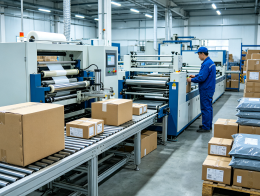 The printing and packaging factory produces molded paper boxes.
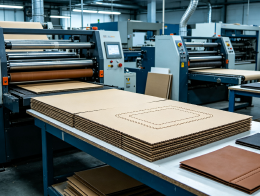 Production of two-piece packaging boxes for large household appliances with butt joint bonding.
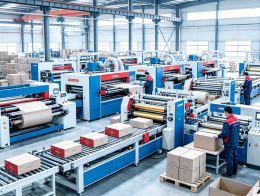 Pre-apply double-sided tape to the packaging of electronic products.
 Automatic Carton Forming Technology
 Double-sided tape applicator
Two-layer systems are designed for operational efficiency and ease of use. With automated synchronization and reduced ...
Each carton factory has different carton sizes, cardboard types, output capacity and workshop conditions. Please fill in the left form with your detailed production demands. Our technical team will tailor the most suitable machine configuration and professional production solution for you, providing free one-on-one technical guidance and customized support.