


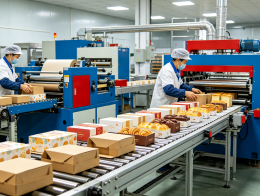
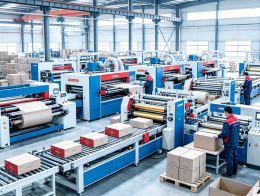
 Adapt to packaging factories and ecommerce supporting carton processing factories.
Running a folder gluer in two-sheet mode is one of the most common ways to increase output on a multi-station line, but when the cartons being processed are long, keeping two sheets feeding in sync becomes noticeably harder. Long board tends to expose weaknesses in feeding structures that work well enough at standard sizes — misalignment, timing gaps between the two sheets, and length inconsistency start to show up in ways that directly affect folding accuracy and splicing quality further down the line.
Two issues tend to explain why long carton feeding becomes unreliable in two-sheet production.
The first is fixed feeding stack positioning. Many traditional two-sheet feeding structures set both stacking positions at a single, unadjustable configuration. This works reasonably well when board dimensions stay within a narrow, predictable range, but longer cartons change the spacing and timing requirements between the two feed positions. When the structure cannot adjust to match actual board length, the two sheets often stop feeding in sync, and even small discrepancies in timing or spacing become magnified once the sheets reach the folding and splicing sections, where consistency between the two pieces matters most.
The second issue is fixed-length feeder knives. The feeder knife section controls how sheets are separated and released at the start of the feeding process, and on many machines, all four knives are set to a uniform length regardless of the sheet being processed. This becomes a problem when board dimensions are asymmetric, or when a facility switches between significantly different carton sizes. A feeder knife length that does not match the actual sheet geometry tends to reduce feeding angle accuracy and separation precision, which increases the likelihood of sheets drifting off line or the two pieces in a two-sheet run becoming misaligned relative to each other.
A related, often overlooked factor is dust and scrap accumulation during high-speed feeding. Long cartons generate more surface contact and friction as they move through the feeding section, and if paper dust and byproduct are not cleared efficiently, this buildup can interfere with feeding consistency over an extended production run, even when the core feeding structure itself is functioning correctly.
Rather than treating long carton feeding as an edge case to be managed around, we design our feeder section to handle it as a standard part of two-sheet operation, not an exception that requires extra caution or reduced speed. Two aspects of our feeder design are directly relevant here.
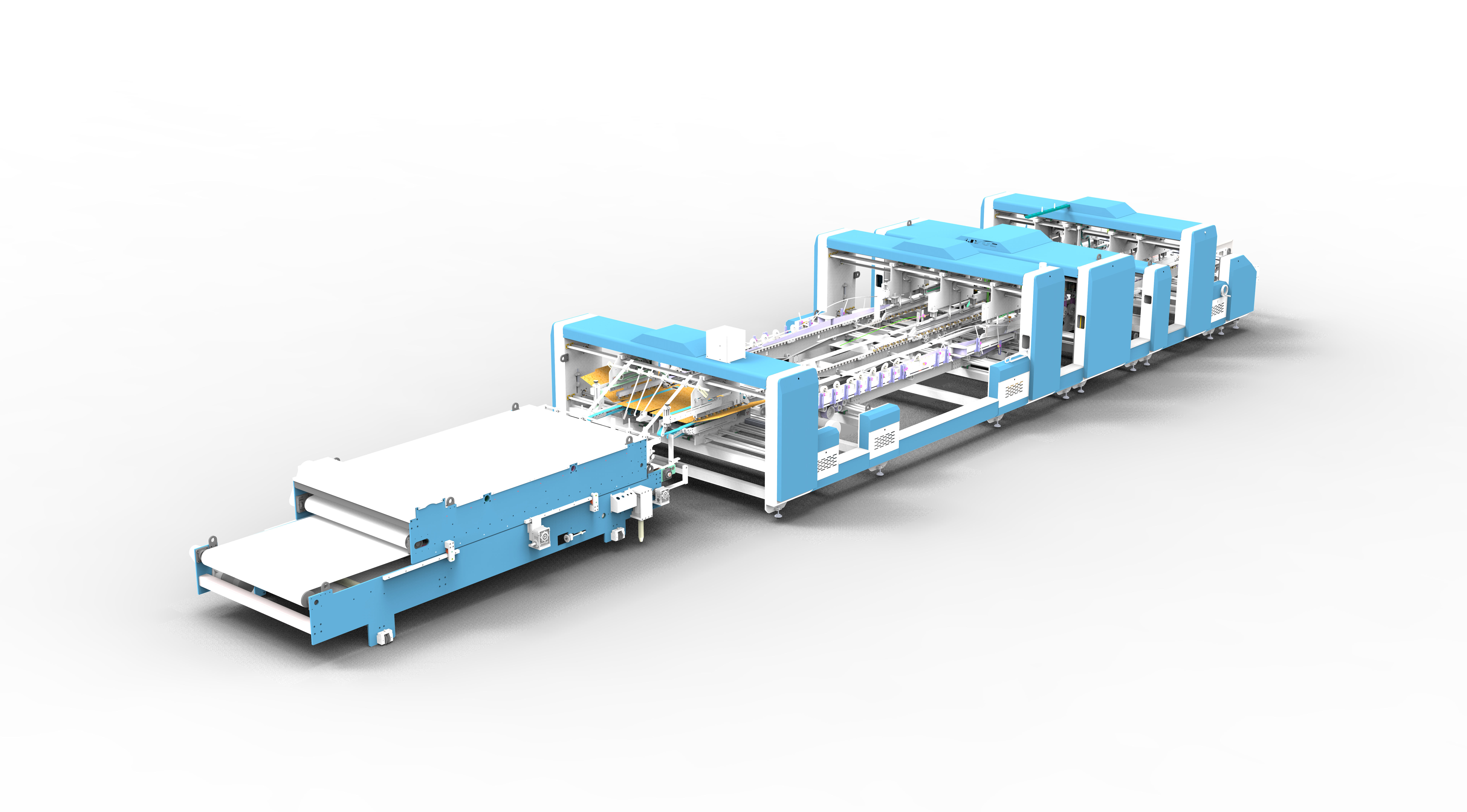
The first is independently adjustable stacking positions for two-sheet feeding. Our feeder part is configured with two separate cardboard stacking positions, and rather than fixing both at a single setting, each position can be adjusted independently to match the actual dimensions of the board being run. This is paired with eight 60mm-wide rubber feeding belts, driven by independent dual servo motors, with each feeding position operating under its own drive control. This independence matters specifically for long carton two-sheet production, because it allows both feed positions to maintain synchronized timing even when board length pushes the limits of what a fixed, single-position structure could reliably handle.
The second is adjustable, asymmetric feeder knife length. Rather than setting all four feeder knives to a single uniform length, our feeder allows the knives to be adjusted to asymmetric lengths based on the actual sample being processed. This directly targets the feeding angle and separation accuracy issues that arise with long or irregularly proportioned board, since the knife configuration can be matched to the sheet geometry rather than forcing every carton size through the same fixed setup. This is supported by a downward suction structure that improves the accuracy and efficiency of paper output while reducing scrap generation, along with a downward suction vortex fan that helps maintain stable paper conveying and consistent suction frequency during extended high-speed runs.
These feeder-level adjustments are supported by the machine's broader control system, including the frequency converter and PLC, which help keep feeding rhythm coordinated with the rest of the production sequence. This background coordination matters more in two-sheet mode than in single-sheet operation, since any drift in timing between the two feed positions has a compounding effect as sheets move further into the machine. It's this kind of attention to how subsystems work together, rather than any single component in isolation, that we believe separates a genuinely reliable two-sheet feeder from one that only performs well under ideal, standard-size conditions.
None of these adjustments guarantee flawless alignment on every carton size or eliminate the need for careful setup when switching between significantly different board dimensions — feeding precision always depends on correct configuration as well as machine capability. What independently adjustable stacking positions and asymmetric feeder knife length actually provide is a feeding structure with a meaningfully wider effective range, so that long or irregularly sized cartons do not have to be forced through a setup designed primarily for standard dimensions.
For a production facility running mixed carton sizes, this flexibility has a practical effect on changeover time and scrap rates. Rather than accepting reduced feeding accuracy as an unavoidable trade-off when processing longer board, a feeder that can be adjusted at both the stacking position and knife length level allows two-sheet mode to maintain closer alignment between the two pieces across a broader range of carton dimensions. This tends to reduce the frequency of misfeeds and splicing misalignment that would otherwise require manual correction or result in scrapped output.
This kind of adjustability also has a secondary benefit worth noting: it reduces how often production teams need to choose between running in two-sheet mode for efficiency and switching to single-sheet mode for reliability when long cartons are involved. A feeder built to handle length variation directly makes two-sheet mode a more consistently viable option across a wider portion of a facility's product mix — which, in practical terms, means more of your order book can run at full two-sheet efficiency instead of being routed around the machine's limitations.
Long carton feeding in two-sheet mode exposes the limitations of fixed-position, fixed-knife feeding structures more clearly than most other production scenarios, which is exactly why we treat feeder design as a core engineering focus rather than a fixed, one-size-fits-all module. Our feeder sections combine independently adjustable stacking positions with dual servo drive and asymmetric feeder knife adjustment, supported by a downward suction system tuned for high-speed accuracy, so that two-sheet mode stays reliable across a broader range of carton dimensions than a standard feeder setup would allow.
If long or mixed-size cartons are a regular part of your production mix, the feeder is one of the first places worth scrutinizing when comparing folder gluer suppliers — it's often the difference between a machine that runs your full product range smoothly and one that quietly limits what you can produce. We've built our feeder systems around exactly this kind of real-world variation, and we work closely with each customer to configure the feeding, stacking, and knife setup around their actual carton dimensions and production volumes rather than a generic default. If you're evaluating equipment for long carton or two-sheet production, we'd welcome the chance to walk through your specific board sizes and show you how our feeder design handles them — reach out to our team to discuss a configuration built around your production line, not around a catalog spec sheet.
'%3e%3cg%20id='Group%201315'%3e%3cg%20id='Group'%20opacity='0.5'%3e%3cpath%20id='Vector'%20d='M387.997%200L232.635%20265.605L58.6579%2086.8843L285.379%200H387.997Z'%20fill='url(%23paint0_linear_821_1490)'/%3e%3c/g%3e%3cg%20id='Group_2'%20opacity='0.5'%3e%3cg%20id='Group%201314'%3e%3cpath%20id='Vector_2'%20d='M376.103%2012.2625L298.38%20330L10.1988%20240.481L298.38%2012.2625H376.103Z'%20fill='url(%23paint1_linear_821_1490)'/%3e%3c/g%3e%3c/g%3e%3c/g%3e%3c/g%3e%3c/g%3e%3cdefs%3e%3clinearGradient%20id='paint0_linear_821_1490'%20x1='319.349'%20y1='11.6627'%20x2='157.133'%20y2='145.876'%20gradientUnits='userSpaceOnUse'%3e%3cstop%20stop-color='%23D2DFFF'/%3e%3cstop%20offset='1'%20stop-color='%23D2DFFF'%20stop-opacity='0.01'/%3e%3c/linearGradient%3e%3clinearGradient%20id='paint1_linear_821_1490'%20x1='253.685'%20y1='25.1395'%20x2='74.5789'%20y2='173.327'%20gradientUnits='userSpaceOnUse'%3e%3cstop%20stop-color='%23D2DFFF'/%3e%3cstop%20offset='1'%20stop-color='%23D2DFFF'%20stop-opacity='0.01'/%3e%3c/linearGradient%3e%3c/defs%3e%3c/svg%3e)
'/%3e%3cpath%20id='Rectangle%20455'%20d='M0%2012H6L24%2056H0V12Z'%20fill='%23CE221D'/%3e%3c/g%3e%3cdefs%3e%3clinearGradient%20id='paint0_linear_769_2773'%20x1='0'%20y1='28'%20x2='432.5'%20y2='28'%20gradientUnits='userSpaceOnUse'%3e%3cstop%20stop-color='%23153B8A'/%3e%3cstop%20offset='1'%20stop-color='%23153B8A'%20stop-opacity='0'/%3e%3c/linearGradient%3e%3c/defs%3e%3c/svg%3e) Adapt to packaging factories and ecommerce supporting carton processing factories.
Adapt to packaging factories and ecommerce supporting carton processing factories.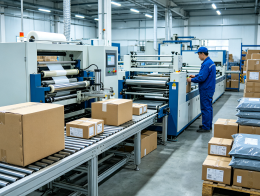 The printing and packaging factory produces molded paper boxes.
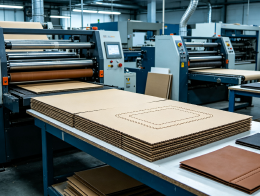 Production of two-piece packaging boxes for large household appliances with butt joint bonding.
 Pre-apply double-sided tape to the packaging of electronic products.
 Automatic Carton Forming Technology
 Double-sided tape applicator
Two-layer systems are designed for operational efficiency and ease of use. With automated synchronization and reduced ...
Each carton factory has different carton sizes, cardboard types, output capacity and workshop conditions. Please fill in the left form with your detailed production demands. Our technical team will tailor the most suitable machine configuration and professional production solution for you, providing free one-on-one technical guidance and customized support.