


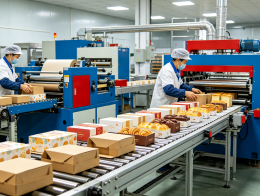
 Adapt to packaging factories and ecommerce supporting carton processing factories.
Motor selection rarely gets the attention it deserves when facilities compare folder gluer equipment, since power ratings and price are easier to line up side by side than drive architecture. Yet the difference between a servo motor and a conventional motor setup shapes something far more fundamental than raw output — it determines how precisely each station on the machine responds, how well it adapts to different production conditions, and how consistently it performs over years of continuous use.
Two limitations tend to surface most clearly when conventional motors are used to drive the core stations on a folder gluer.
The first is response lag, particularly on machines where a conventional motor drives multiple stations through belts, gears, or other mechanical linkages. Starting, stopping, and changing speed all involve a delay before the motor's actual output catches up with the commanded setting, and on stations like folding or patting — where precise timing between mechanical actions is essential — this lag translates into small but real deviations. Many traditional machines compensate for this with additional mechanical limit stops or manual fine-tuning, which can bring performance into an acceptable range but does so by working around the drive system's limitations rather than resolving them at the source.
The second limitation is a narrower practical speed range. Conventional motors typically operate efficiently within a fairly fixed band, and adjusting outside that band tends to come at the cost of either torque or stability. When a facility switches between paper thicknesses or carton specifications, this limited adjustment range means the machine often needs repeated trial runs after changeover before settling into a stable operating rhythm, which adds time and material waste to every changeover rather than allowing a quick, confident reconfiguration.
A quieter but persistent issue is that conventional motors running outside their ideal load range for extended periods tend to experience faster mechanical wear, since the motor and connected drive components are working harder than their design point to deliver the required output. This doesn't show up immediately, but it accumulates as reduced component life and more frequent maintenance over the equipment's working life.
Servo motors address these two limitations in a fundamentally different way, not by compensating for imprecision after the fact, but by improving the accuracy of the drive itself.
On our machines, key stations — including the folding section and the feeding section — are driven by independent servo motors rather than a shared conventional motor working through mechanical linkages. This independence allows each station to complete its motion, including multiple fold lines in sequence, with response timing that keeps pace with the actual command rather than lagging behind it. Because each station's servo motor operates independently, the precision of the fold or feed action is built into the drive itself, which reduces how much a machine needs to lean on mechanical limit stops or manual adjustment to hold consistent timing across a production run.
The second area where servo drive changes the equation is stepless speed adjustment. Rather than being limited to a handful of fixed speed settings, sections such as the left and right turning points in the folding line are equipped with stepless variable speed control, with servo motor configuration available where finer adjustment matters most. Combined with independent adjustment capability on stations like the patting and conveying sections, this gives the machine a considerably wider effective operating range. In practical terms, this means that after a changeover to a different paper specification or carton size, the machine can reach a stable running rhythm more directly, without the repeated trial-and-error cycles that a fixed-speed conventional drive typically requires.
These servo-driven stations don't operate in isolation — they work in coordination with the machine's frequency converter and PLC control system, which help synchronize timing across stations so that the precision gained at each individual point in the process is preserved as sheets move through the full production sequence rather than being lost at the handoff between stations.
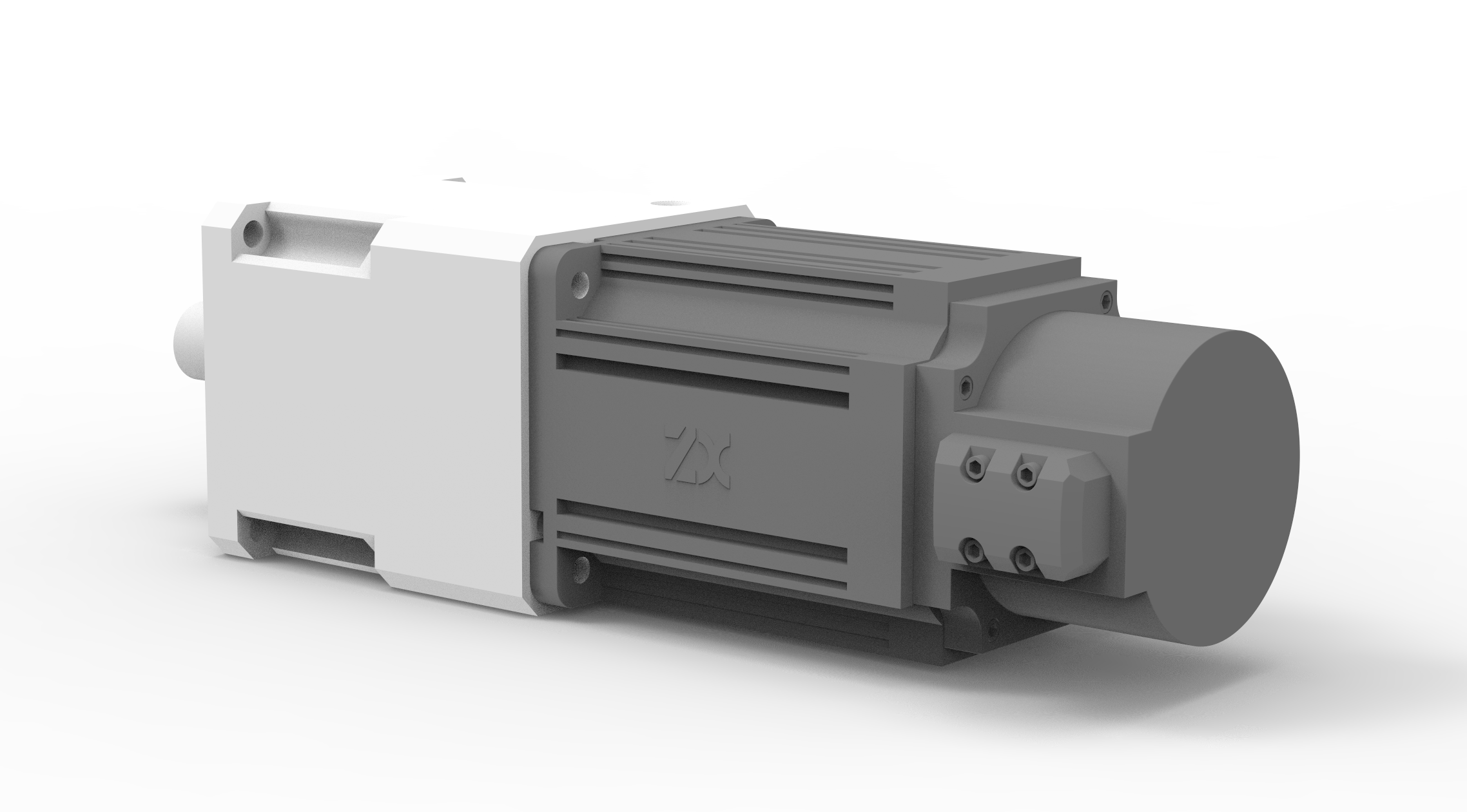
None of this means conventional motors are unsuitable for every application, or that servo drive removes every source of variation in a production run — motor type is one factor among several that determine overall machine performance, alongside frame rigidity, control system quality, and proper maintenance. What servo drive does provide, consistently, is a more direct relationship between commanded motion and actual mechanical response, which is the foundation that folding accuracy, feeding synchronization, and changeover speed are all built on.
This distinction becomes especially relevant for facilities running a varied product mix, where frequent changeovers between carton sizes and paper specifications are routine rather than occasional. A drive system that reaches stable operation quickly after changeover, and that holds tighter timing precision during normal running, has a compounding effect across many production runs — even when the difference on any single run seems modest, the cumulative reduction in trial-and-error setup time and scrap during changeover adds up meaningfully over months of operation.
For facilities evaluating folder gluer equipment, this is why motor type deserves more scrutiny than it typically receives during procurement. Two machines with similar total power ratings can behave very differently on the floor if one relies on a conventional motor working through mechanical linkages and the other uses independent servo drive at the stations where precision matters most.
We treat motor selection as one of the more consequential engineering decisions on our machines, not a line item to minimize for cost. Independent servo motors drive our folding and feeding sections specifically because these are the points in the process where timing precision has the most direct effect on finished product quality, and stepless variable speed adjustment is built into key sections like the folding line's turning points so that changeover doesn't mean starting from scratch on machine tuning. This is paired with a Delta PLC and SINEE frequency converter to keep coordination tight across every servo-driven station on the machine.
For packaging producers comparing folder gluer options, we'd suggest looking past the horsepower figures on a spec sheet and asking specifically which stations are servo-driven and which rely on conventional, linked drive systems — that distinction tends to explain far more about real-world folding accuracy and changeover speed than total power alone. We're happy to walk through exactly how our drive architecture is configured on any of our machines and how it applies to your specific carton range and production volume. Reach out to our team, and we can help you evaluate what the right drive system actually looks like for the work your line needs to do.
'%3e%3cg%20id='Group%201315'%3e%3cg%20id='Group'%20opacity='0.5'%3e%3cpath%20id='Vector'%20d='M387.997%200L232.635%20265.605L58.6579%2086.8843L285.379%200H387.997Z'%20fill='url(%23paint0_linear_821_1490)'/%3e%3c/g%3e%3cg%20id='Group_2'%20opacity='0.5'%3e%3cg%20id='Group%201314'%3e%3cpath%20id='Vector_2'%20d='M376.103%2012.2625L298.38%20330L10.1988%20240.481L298.38%2012.2625H376.103Z'%20fill='url(%23paint1_linear_821_1490)'/%3e%3c/g%3e%3c/g%3e%3c/g%3e%3c/g%3e%3c/g%3e%3cdefs%3e%3clinearGradient%20id='paint0_linear_821_1490'%20x1='319.349'%20y1='11.6627'%20x2='157.133'%20y2='145.876'%20gradientUnits='userSpaceOnUse'%3e%3cstop%20stop-color='%23D2DFFF'/%3e%3cstop%20offset='1'%20stop-color='%23D2DFFF'%20stop-opacity='0.01'/%3e%3c/linearGradient%3e%3clinearGradient%20id='paint1_linear_821_1490'%20x1='253.685'%20y1='25.1395'%20x2='74.5789'%20y2='173.327'%20gradientUnits='userSpaceOnUse'%3e%3cstop%20stop-color='%23D2DFFF'/%3e%3cstop%20offset='1'%20stop-color='%23D2DFFF'%20stop-opacity='0.01'/%3e%3c/linearGradient%3e%3c/defs%3e%3c/svg%3e)
'/%3e%3cpath%20id='Rectangle%20455'%20d='M0%2012H6L24%2056H0V12Z'%20fill='%23CE221D'/%3e%3c/g%3e%3cdefs%3e%3clinearGradient%20id='paint0_linear_769_2773'%20x1='0'%20y1='28'%20x2='432.5'%20y2='28'%20gradientUnits='userSpaceOnUse'%3e%3cstop%20stop-color='%23153B8A'/%3e%3cstop%20offset='1'%20stop-color='%23153B8A'%20stop-opacity='0'/%3e%3c/linearGradient%3e%3c/defs%3e%3c/svg%3e) Adapt to packaging factories and ecommerce supporting carton processing factories.
Adapt to packaging factories and ecommerce supporting carton processing factories.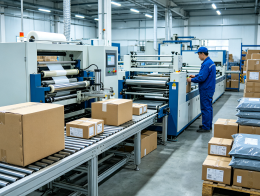 The printing and packaging factory produces molded paper boxes.
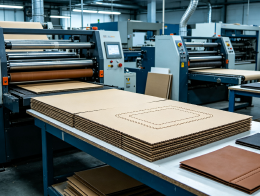 Production of two-piece packaging boxes for large household appliances with butt joint bonding.
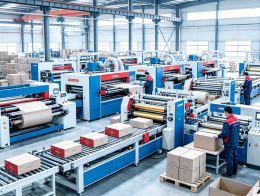 Pre-apply double-sided tape to the packaging of electronic products.
 Automatic Carton Forming Technology
 Double-sided tape applicator
Two-layer systems are designed for operational efficiency and ease of use. With automated synchronization and reduced ...
Each carton factory has different carton sizes, cardboard types, output capacity and workshop conditions. Please fill in the left form with your detailed production demands. Our technical team will tailor the most suitable machine configuration and professional production solution for you, providing free one-on-one technical guidance and customized support.