


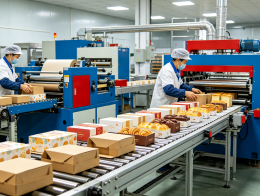
 Adapt to packaging factories and ecommerce supporting carton processing factories.
Hiring and keeping skilled operators has become one of the harder parts of running a corrugated box plant. Labor costs continue to climb, experienced workers are not easy to replace once they leave, and a production line built around manual judgment can lose consistency the moment staffing changes. How much a piece of equipment depends on people to run it well is now as important a factor as its rated speed, and it is worth looking closely at where that dependency actually sits on a typical gluing and stitching line.
On many gluing and stitching lines, several stages still rely on people to keep things running smoothly. Sheets often need to be loaded or moved by hand, particularly at the transfer point between a separate gluing machine and a separate stitching machine, where a sheet has to be picked up from one line and set onto another. Someone has to be there to manage that handoff every time the line runs.
Parameter settings are another place where manual work carries a lot of weight. Glue volume, fold angle, and stitch distance are frequently adjusted by eye and by feel, based on an operator's experience rather than a fixed, repeatable setting. Getting those adjustments right takes time to learn, and getting them wrong, even slightly, shows up later as inconsistent cartons. Two separate machines also typically mean two people are needed to watch over them, since a problem on one line does not automatically get caught by whoever is stationed at the other. When something does go wrong, tracking it down often means checking each station by hand rather than reading it off a single connected system. Where counting and stacking are not automated, that stage adds another set of hands to the line as well.
The cost of relying on this much manual input compounds over time. Wages for skilled operators keep rising in most markets, and training a new hire to the point where they can reliably judge glue coverage or fold alignment takes real time, not a single shift. When someone leaves, that judgment leaves with them, and the line's output can shift until a replacement is trained up to the same standard. More manual steps also means more chances for a missed check, a mistimed adjustment, or a damaged sheet, simply because people get tired or distracted over a long shift. In regions where hiring is difficult or turnover is high, a line that depends heavily on manual work becomes harder to staff and harder to keep running at a predictable output. In practical terms, a line with more manual steps is a line where more of its output depends on whoever happens to be working that day, rather than on the equipment itself.
We designed our fully automatic high-speed folder gluer-stitcher machine around reducing exactly these dependency points, rather than treating automation as an add-on to an otherwise manual process. Automatic belt suction feeding removes the need for a dedicated worker to load sheets one at a time by hand, which is often one of the more repetitive and labor-intensive roles on a traditional line.
The clearest example of where this matters is calibration. Instead of relying on an operator to check alignment by eye and stop the line to make corrections, automatic calibration runs continuously as the sheet moves through feeding, folding, and gluing or stitching. That single change removes a large share of the judgment call that experienced operators would otherwise need to make repeatedly throughout a shift, and it does so without depending on how alert or experienced the person watching the line happens to be at that moment.
Because gluing mode and stitching mode run on the same line, switching between the two carton types does not require reassigning staff to a different machine or retraining anyone on a separate control panel. The same operators who run the line in gluing mode, at mechanical speeds up to around 180 meters per minute, can run it in stitching mode as well, where the average stitching speed is around 80 meters per minute with a stitch distance adjustable between 30 and 120 millimeters. One team covers both production modes instead of needing separate crews trained on separate equipment. Automatic counting and stacking at the end of the line handles the finished cartons directly, so that stage no longer needs a dedicated worker moving output by hand either.
| Production Aspect | Traditional Manual Line | Fully Automatic Folder Gluer-Stitcher Machine |
|---|---|---|
| Sheet Feeding | Manual sheet loading and handling | Automatic belt suction feeding |
| Calibration | Manual inspection and adjustment | Automatic continuous calibration |
| Gluing & Stitching | Separate machines may require separate operators | Gluing and stitching integrated in one line |
| Labor Requirement | More operators for different stages | Fewer operators needed for the production line |
| Parameter Adjustment | Relies more on operator experience | Automated and coordinated machine settings |
| Finished Cartons | Manual counting and stacking | Automatic counting and stacking |
| Production Consistency | More affected by fatigue and operator differences | More consistent automated workflow |
| Production Speed | Depends on equipment and manual handling | Up to 180 m/min in gluing mode; around 80 m/min in stitching mode |
The most immediate effect is a smaller crew needed to run the same output. A plant no longer has to keep hiring and training additional operators just to hold current capacity steady, which matters in markets where finding and keeping skilled labor is genuinely difficult.
Automation also takes over much of the work that used to depend on an operator's judgment. Continuous calibration, consistent feeding, and coordinated gluing or stitching reduce the quality swings that come from staff turnover, fatigue, or simple inconsistency between one operator's technique and another's. A line that depends less on individual judgment tends to hold its output steadier from one shift to the next, regardless of who is on duty.
In an environment where wages are rising and hiring reliable workers is not guaranteed, how automated a line is becomes a direct factor in how stable a plant's output can stay. Adding more workers is one way to try to keep up with demand, but it is not the only lever available, and it is often the least predictable one. A more automated line offers a way to hold capacity steady that does not depend on the local labor market cooperating. None of this comes at the expense of speed either, since the same automated sequence that reduces manual work is also what allows the line to run at its rated mechanical speeds in both gluing and stitching modes.
We build our fully automatic high-speed folder gluer-stitcher machine on the idea that reducing dependency on manual work is not about replacing people, but about giving a plant's output less exposure to staffing changes it cannot always control. Continuous automatic calibration, automated feeding, and a shared line for both gluing and stitching modes are the parts of the design that carry the most weight in that effort.
If staffing pressure is already shaping how your plant plans capacity, it is worth reviewing which stages of your current line still depend on manual judgment and where that dependency could be designed out instead. We are glad to walk through how our equipment handles that transition, or to arrange a demonstration of the line in operation.
'%3e%3cg%20id='Group%201315'%3e%3cg%20id='Group'%20opacity='0.5'%3e%3cpath%20id='Vector'%20d='M387.997%200L232.635%20265.605L58.6579%2086.8843L285.379%200H387.997Z'%20fill='url(%23paint0_linear_821_1490)'/%3e%3c/g%3e%3cg%20id='Group_2'%20opacity='0.5'%3e%3cg%20id='Group%201314'%3e%3cpath%20id='Vector_2'%20d='M376.103%2012.2625L298.38%20330L10.1988%20240.481L298.38%2012.2625H376.103Z'%20fill='url(%23paint1_linear_821_1490)'/%3e%3c/g%3e%3c/g%3e%3c/g%3e%3c/g%3e%3c/g%3e%3cdefs%3e%3clinearGradient%20id='paint0_linear_821_1490'%20x1='319.349'%20y1='11.6627'%20x2='157.133'%20y2='145.876'%20gradientUnits='userSpaceOnUse'%3e%3cstop%20stop-color='%23D2DFFF'/%3e%3cstop%20offset='1'%20stop-color='%23D2DFFF'%20stop-opacity='0.01'/%3e%3c/linearGradient%3e%3clinearGradient%20id='paint1_linear_821_1490'%20x1='253.685'%20y1='25.1395'%20x2='74.5789'%20y2='173.327'%20gradientUnits='userSpaceOnUse'%3e%3cstop%20stop-color='%23D2DFFF'/%3e%3cstop%20offset='1'%20stop-color='%23D2DFFF'%20stop-opacity='0.01'/%3e%3c/linearGradient%3e%3c/defs%3e%3c/svg%3e)
'/%3e%3cpath%20id='Rectangle%20455'%20d='M0%2012H6L24%2056H0V12Z'%20fill='%23CE221D'/%3e%3c/g%3e%3cdefs%3e%3clinearGradient%20id='paint0_linear_769_2773'%20x1='0'%20y1='28'%20x2='432.5'%20y2='28'%20gradientUnits='userSpaceOnUse'%3e%3cstop%20stop-color='%23153B8A'/%3e%3cstop%20offset='1'%20stop-color='%23153B8A'%20stop-opacity='0'/%3e%3c/linearGradient%3e%3c/defs%3e%3c/svg%3e) Adapt to packaging factories and ecommerce supporting carton processing factories.
Adapt to packaging factories and ecommerce supporting carton processing factories.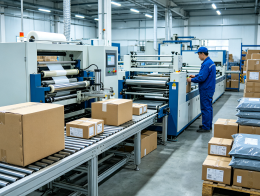 The printing and packaging factory produces molded paper boxes.
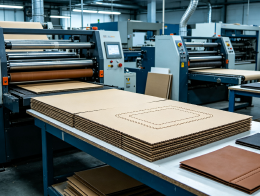 Production of two-piece packaging boxes for large household appliances with butt joint bonding.
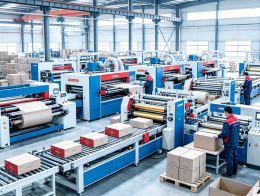 Pre-apply double-sided tape to the packaging of electronic products.
 Automatic Carton Forming Technology
 Double-sided tape applicator
Two-layer systems are designed for operational efficiency and ease of use. With automated synchronization and reduced ...
Each carton factory has different carton sizes, cardboard types, output capacity and workshop conditions. Please fill in the left form with your detailed production demands. Our technical team will tailor the most suitable machine configuration and professional production solution for you, providing free one-on-one technical guidance and customized support.