


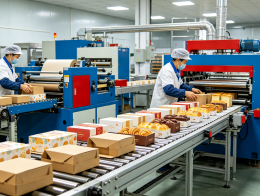
 Adapt to packaging factories and ecommerce supporting carton processing factories.
A gift box order gets rejected during final inspection, and the reason has nothing to do with structural strength. A faint glue mark shows up on a foil-stamped panel, or a crease line has cracked the coating just enough to catch light at the wrong angle. On a standard shipping carton, either issue would likely go unnoticed. On a high-end gift box, where the surface is the product's first impression, either one is often enough to fail the batch. This is the gap that separates general corrugated box production from gift box work: the tolerance for visible imperfection is almost zero, and that tolerance runs straight through a corrugated box folder gluer machine's gluing and folding sections.
Most folder gluer configurations are built around structural boxes, where the glued seam sits on an interior surface that never gets seen once the box is assembled. A fixed glue volume and a fixed application path work fine in that context, because a small amount of excess adhesive squeezing past the seam has no visual consequence. Gift boxes flip that assumption. Printed panels, laminated surfaces, and foil-stamped finishes are frequently positioned right up to the glue line, sometimes with the seam itself designed to be visible as part of the finished look. When glue volume or placement isn't tightly controlled, adhesive that bleeds even slightly past the intended line shows up directly on a surface the customer is meant to see. On a structural carton, that same variance would be invisible. On a gift box, it's often the single defect that gets an entire piece rejected during inspection.
The second issue sits at the folding section, and it's specific to the materials gift boxes are usually made from. Laminated stock, UV-coated board, and specialty finish papers respond differently to folding pressure than uncoated structural board does. A folding mechanism built around one fixed angle and one fixed pressure setting handles standard kraft or test liner board without difficulty, but the same setting applied to a coated or laminated surface can produce a whitened crease line at the fold — sometimes referred to as crease cracking — or in more severe cases, a visible split in the coating itself. This is part of why a production line that handles standard corrugated orders reliably can start producing a noticeably higher defect rate the moment a gift box order with coated stock comes through. The board isn't weaker structurally; it's simply more sensitive to a folding process tuned for a different kind of material.
We designed the gluing and folding sections on our corrugated box folder gluer machines with this specific gap between structural and surface-critical production in mind.
On the gluing side, mechanical roller gluing supports both hot and cold dipping methods, giving finer control over how adhesive is applied depending on the material and finish involved. A secondary positioning system built into the gluing unit addresses the panel-drift issue that often causes glue placement to shift slightly after application, which is one of the more common sources of adhesive appearing where it shouldn't on a finished panel. This is the combination that lets the machine take on visible-seam work with confidence: the roller system controls how much adhesive goes down, and the secondary positioning keeps it there once the panel moves into the fold. For orders where even tighter control over glue path and volume matters, an optional spray gluing configuration is available, extending the range of precision beyond what roller gluing alone can offer on especially sensitive surfaces — giving plants a genuine option for foil-stamped and laminated panels rather than a workaround borrowed from structural production.
On the folding side, the left and right deflection belts use stepless speed adjustment, with a servo motor configuration available for finer control. Rather than running every material through the same fixed folding rhythm, this allows folding force and timing to be adjusted according to board thickness and surface treatment, which is the direct response to the crease-cracking issue described above. A laminated or coated panel can be folded at a setting suited to that material, rather than being run through the same parameters used for uncoated structural board — which is precisely what separates a machine that can be dialed in for gift box work from one that can only run standard corrugated stock reliably.
For a plant trying to trace a defect back to its source, the location and pattern of the flaw is usually the fastest indicator of which section needs adjustment. Glue-related defects tend to appear as discoloration or a raised line running along or near the seam itself, often visible only from certain angles under light. Folding-related defects show up specifically at the crease line and follow the fold's full length, appearing as a lighter streak in a coated finish or, in more pronounced cases, a fine visible split. Because these two defect types come from different stages of the process, correcting one won't resolve the other, which is why identifying which category a given defect falls into matters before adjusting machine settings.
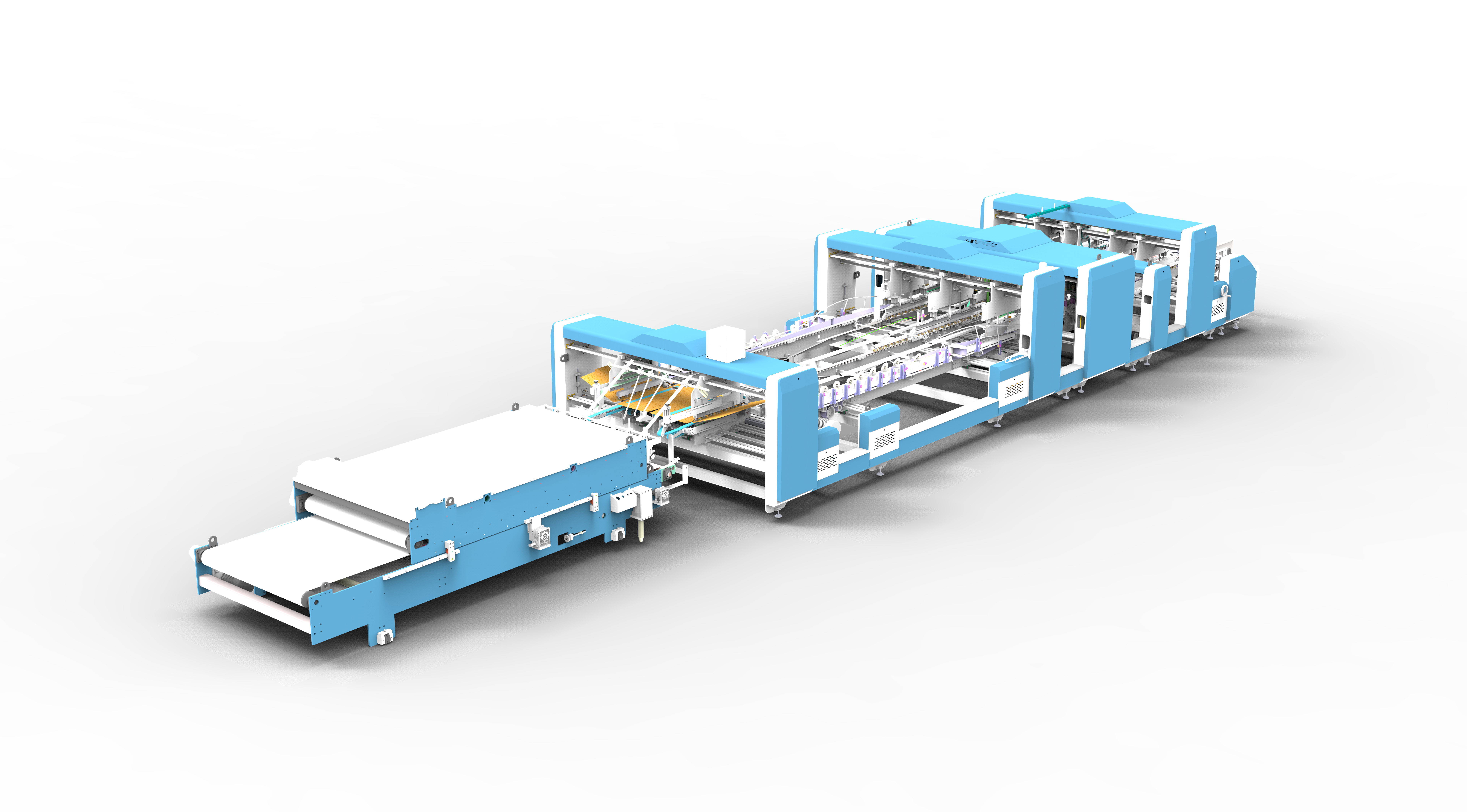
It's worth noting that this level of adjustability isn't a separate mode reserved only for gift box production — it's the same gluing and folding sections used across a plant's full order range, with settings that can be tuned up or down depending on what a given job requires. A plant running mostly structural cartons doesn't lose throughput by having this range of control available; it simply uses a broader portion of that range when a gift box or specialty finish order comes through. That's the practical advantage of building this precision into the machine from the start rather than treating it as a specialty add-on: the same production line that runs standard shipping cartons all week can take on a coated, foil-stamped gift box order without being reconfigured into a different piece of equipment. That flexibility matters in practice, since few plants run exclusively high-end work, and switching between structural and surface-critical orders on the same line is common — and it's exactly the kind of switching this equipment is built to support.
None of this eliminates the need for careful setup and monitoring on a given run. Adjustable pressure and gluing precision reduce the conditions that lead to visible defects, but achieving a consistently clean result on sensitive materials still depends on setting the machine appropriately for the specific board and finish in use, and checking early output before a full batch is committed. What the equipment provides is the range of control needed to make that kind of fine-tuning possible in the first place, rather than forcing every material through one fixed set of parameters.
The defects that get a gift box rejected rarely come from a structural weakness — they come from glue placement that wasn't tight enough for a visible seam, or folding pressure that wasn't suited to a coated surface. Addressing both directly, through controlled gluing with secondary positioning and adjustable folding force for sensitive materials, generally reduces the kind of surface-level defects that standard production settings tend to miss until a batch is already at inspection. This is the standard we hold our own gluing and folding sections to: not just meeting the structural requirements every corrugated box needs, but holding up under the closer visual scrutiny that gift box and presentation packaging demand.
As a manufacturer of corrugated box folder gluer machines, we build our gluing and folding sections to cover this range, from structural cartons to coated, laminated, and foil-finished gift box stock, based on feedback from plants producing across both categories. That range is what allows our equipment to move between everyday shipping cartons and higher-scrutiny presentation packaging without a separate production line for each. If your line is running into surface defects on gift box or specialty finish orders, our technical team can review your material types and finish requirements and help identify the setup adjustments most likely to reduce them.
'%3e%3cg%20id='Group%201315'%3e%3cg%20id='Group'%20opacity='0.5'%3e%3cpath%20id='Vector'%20d='M387.997%200L232.635%20265.605L58.6579%2086.8843L285.379%200H387.997Z'%20fill='url(%23paint0_linear_821_1490)'/%3e%3c/g%3e%3cg%20id='Group_2'%20opacity='0.5'%3e%3cg%20id='Group%201314'%3e%3cpath%20id='Vector_2'%20d='M376.103%2012.2625L298.38%20330L10.1988%20240.481L298.38%2012.2625H376.103Z'%20fill='url(%23paint1_linear_821_1490)'/%3e%3c/g%3e%3c/g%3e%3c/g%3e%3c/g%3e%3c/g%3e%3cdefs%3e%3clinearGradient%20id='paint0_linear_821_1490'%20x1='319.349'%20y1='11.6627'%20x2='157.133'%20y2='145.876'%20gradientUnits='userSpaceOnUse'%3e%3cstop%20stop-color='%23D2DFFF'/%3e%3cstop%20offset='1'%20stop-color='%23D2DFFF'%20stop-opacity='0.01'/%3e%3c/linearGradient%3e%3clinearGradient%20id='paint1_linear_821_1490'%20x1='253.685'%20y1='25.1395'%20x2='74.5789'%20y2='173.327'%20gradientUnits='userSpaceOnUse'%3e%3cstop%20stop-color='%23D2DFFF'/%3e%3cstop%20offset='1'%20stop-color='%23D2DFFF'%20stop-opacity='0.01'/%3e%3c/linearGradient%3e%3c/defs%3e%3c/svg%3e)
'/%3e%3cpath%20id='Rectangle%20455'%20d='M0%2012H6L24%2056H0V12Z'%20fill='%23CE221D'/%3e%3c/g%3e%3cdefs%3e%3clinearGradient%20id='paint0_linear_769_2773'%20x1='0'%20y1='28'%20x2='432.5'%20y2='28'%20gradientUnits='userSpaceOnUse'%3e%3cstop%20stop-color='%23153B8A'/%3e%3cstop%20offset='1'%20stop-color='%23153B8A'%20stop-opacity='0'/%3e%3c/linearGradient%3e%3c/defs%3e%3c/svg%3e) Adapt to packaging factories and ecommerce supporting carton processing factories.
Adapt to packaging factories and ecommerce supporting carton processing factories.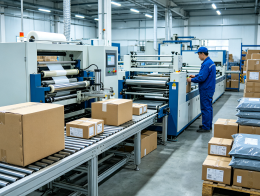 The printing and packaging factory produces molded paper boxes.
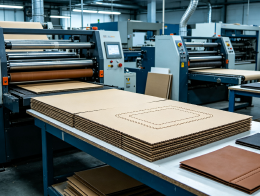 Production of two-piece packaging boxes for large household appliances with butt joint bonding.
 Pre-apply double-sided tape to the packaging of electronic products.
 Automatic Carton Forming Technology
 Double-sided tape applicator
Two-layer systems are designed for operational efficiency and ease of use. With automated synchronization and reduced ...
Each carton factory has different carton sizes, cardboard types, output capacity and workshop conditions. Please fill in the left form with your detailed production demands. Our technical team will tailor the most suitable machine configuration and professional production solution for you, providing free one-on-one technical guidance and customized support.