


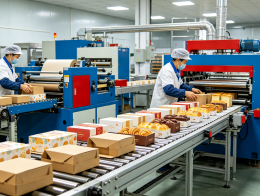
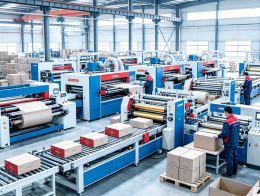
 Adapt to packaging factories and ecommerce supporting carton processing factories.
Plant managers weighing manual gluing against an automated corrugated box folder gluer machine usually start with the same question: why spend a large amount upfront when workers can fold and glue boxes by hand for far less? The comparison looks straightforward on paper, since a manual setup avoids the equipment purchase entirely. In practice, the real cost difference shows up somewhere else — not in the price tag, but in how each approach behaves once it's running at production volume.
Manual gluing spreads its cost across people rather than concentrating it in a machine, which is exactly why it's easy to underestimate. A typical manual setup needs separate workers handling feeding, alignment, and glue application, and each of those roles adds up per shift even though no single task looks expensive on its own. Industry cost studies on folder gluer adoption commonly report labor reductions in the range of 40 to 70 percent after switching to automated production, which suggests that a meaningful share of what plants spend on manual gluing is going toward coordination and repetition rather than the gluing task itself. Changeover time follows a similar pattern: manual and semi-automatic lines often need tens of minutes to reset for a new box style, while automated systems with stored job settings can bring that down to single digits. Multiplied across frequent order changes, that gap alone accounts for a large share of the labor hours a manual line consumes.
The second cost that rarely makes it into a manual-versus-automated comparison is consistency, or the lack of it. Glue pressure, alignment accuracy, and folding force in a manual process depend on how a given worker is doing that day, and that variability doesn't stay contained to one box. Documented cases in corrugated production have shown waste rates dropping from around 7.8 percent to under 3 percent after standardizing settings and reducing manual variability in the finishing stage. That difference represents board, adhesive, and labor time spent producing boxes that get scrapped rather than shipped — a cost that shows up on a waste report, not on a machine invoice, which is part of why it's so often left out of the initial comparison.
There's a third factor tied closely to labor cost that's easy to overlook until a plant is actually trying to staff a manual line: skilled folder-gluer operators who can maintain consistent alignment and glue application at speed are not always easy to find or retain. A manual process depends on that skill being present and consistent shift after shift, and turnover in that role tends to show up immediately as a dip in output quality. Automated systems don't remove the need for trained staff entirely, but they shift the skill requirement toward machine operation and monitoring, which is generally easier to train for and less sensitive to any one person's daily performance.
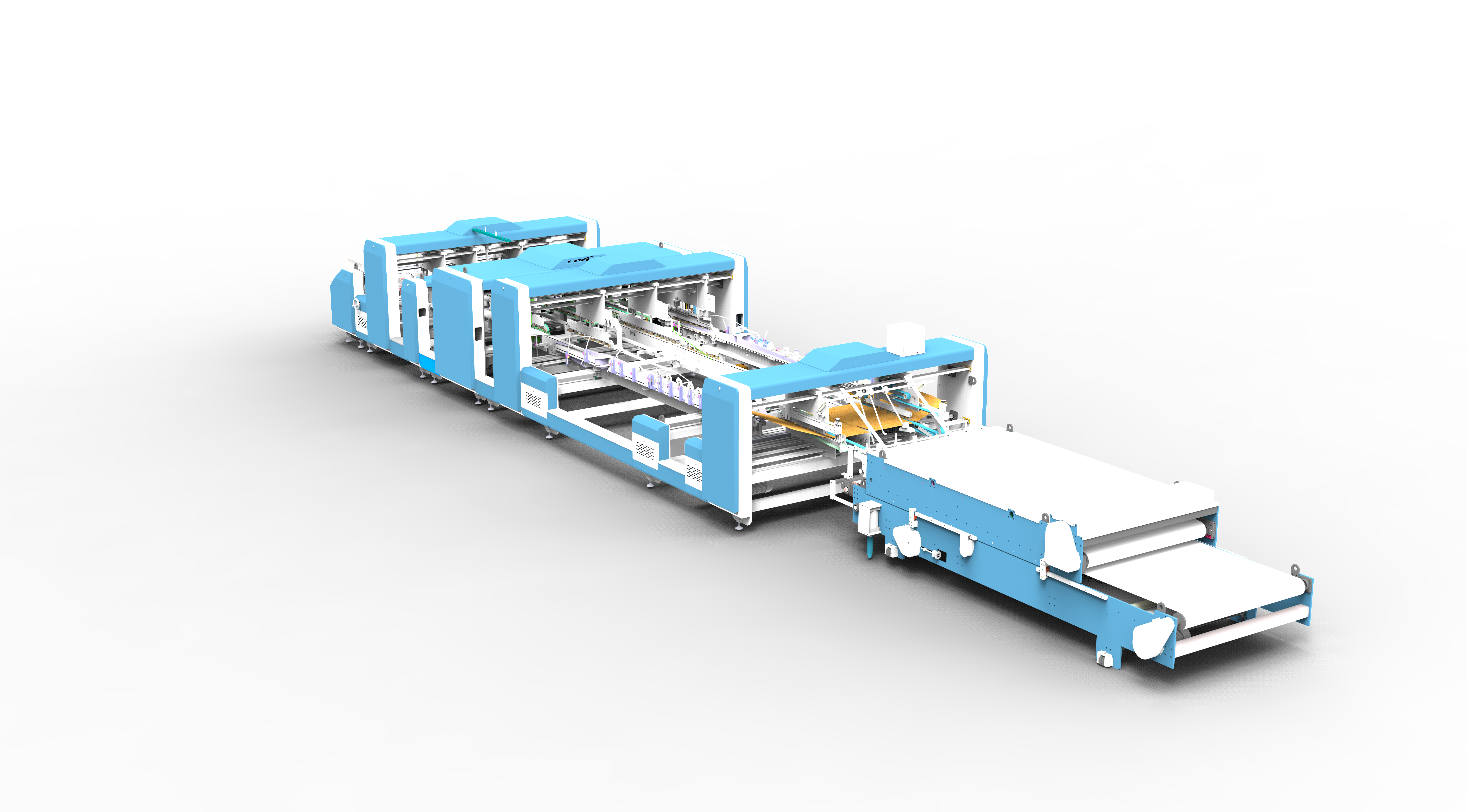
We design our corrugated box folder gluer machines around these two specific cost drivers, changeover time and process consistency, rather than treating automation as a general speed upgrade.
On changeover, the HMI interface paired with motorized memory adjustment lets an operator store feeder guide positions, folding belt settings, and glue head placement for a given box style and recall them for the next run instead of resetting each component by hand. For a plant running frequent order changes, this is where much of the labor-hour gap between manual and automated production actually comes from — not from running faster during production, but from spending far less time between production runs. A changeover that used to require multiple workers and tens of minutes can be brought down to a task one operator completes in a few minutes, which also reduces the plant's exposure to the operator-skill issue described above, since recalled settings don't depend on one person's memory of how a particular box style was set up last time.
On consistency, servo-driven motors control the gluing system's position and application, so glue placement and volume follow the programmed setting for every panel rather than the hand pressure and timing of whichever worker is on the line that shift. This is what keeps output steady across a full shift instead of drifting as workers rotate or fatigue sets in over long runs. The feeding, folding, and squaring sections carry similar independent drive and adjustment features, which support this same consistency through the rest of the process, though the gluing precision and changeover speed are where the cost impact is most direct and most measurable.
The upfront cost of an automated folder gluer is real and shouldn't be minimized, but comparing it directly against a manual setup's absence of equipment cost misses where the money actually goes over time. A more accurate comparison looks at cost per thousand boxes produced, factoring in labor hours, waste, and the production time lost to changeovers, rather than comparing a purchase price against zero.
Industry data across folder gluer installations commonly points to payback periods in the range of 12 to 24 months, driven by the combination of reduced labor hours, lower waste rates, and higher throughput per shift. That range varies by production volume, box complexity, and how many changeovers a plant runs in a given week, so it should be treated as a general industry pattern rather than a fixed guarantee for any specific operation. Plants running high volumes with frequent style changes tend to see faster payback, since that's exactly the combination where manual gluing's hidden costs, labor spread thin and changeover downtime, compound the fastest. Evaluating the investment over a three-to-five-year production cycle, rather than against the purchase price alone, generally gives a clearer picture of where the actual savings land.
The cost difference between manual gluing and an automated corrugated box folder gluer machine rarely comes down to the equipment price versus paying workers by the hour. It comes down to how much labor time gets absorbed by changeovers, and how much material and output gets lost to inconsistent gluing and folding across a shift. Both of those costs are easy to underestimate in a manual setup because they're distributed across people and time rather than appearing as a single line item.
As a manufacturer of corrugated box folder gluer machines, we work with plants to look at their actual order volume, box style variety, and changeover frequency before recommending a configuration, since those factors determine how quickly automation pays for itself in a given operation. If you're weighing manual gluing against automation for your own line, our technical team can review your production numbers and put together a cost comparison specific to your box range and output targets.
'%3e%3cg%20id='Group%201315'%3e%3cg%20id='Group'%20opacity='0.5'%3e%3cpath%20id='Vector'%20d='M387.997%200L232.635%20265.605L58.6579%2086.8843L285.379%200H387.997Z'%20fill='url(%23paint0_linear_821_1490)'/%3e%3c/g%3e%3cg%20id='Group_2'%20opacity='0.5'%3e%3cg%20id='Group%201314'%3e%3cpath%20id='Vector_2'%20d='M376.103%2012.2625L298.38%20330L10.1988%20240.481L298.38%2012.2625H376.103Z'%20fill='url(%23paint1_linear_821_1490)'/%3e%3c/g%3e%3c/g%3e%3c/g%3e%3c/g%3e%3c/g%3e%3cdefs%3e%3clinearGradient%20id='paint0_linear_821_1490'%20x1='319.349'%20y1='11.6627'%20x2='157.133'%20y2='145.876'%20gradientUnits='userSpaceOnUse'%3e%3cstop%20stop-color='%23D2DFFF'/%3e%3cstop%20offset='1'%20stop-color='%23D2DFFF'%20stop-opacity='0.01'/%3e%3c/linearGradient%3e%3clinearGradient%20id='paint1_linear_821_1490'%20x1='253.685'%20y1='25.1395'%20x2='74.5789'%20y2='173.327'%20gradientUnits='userSpaceOnUse'%3e%3cstop%20stop-color='%23D2DFFF'/%3e%3cstop%20offset='1'%20stop-color='%23D2DFFF'%20stop-opacity='0.01'/%3e%3c/linearGradient%3e%3c/defs%3e%3c/svg%3e)
'/%3e%3cpath%20id='Rectangle%20455'%20d='M0%2012H6L24%2056H0V12Z'%20fill='%23CE221D'/%3e%3c/g%3e%3cdefs%3e%3clinearGradient%20id='paint0_linear_769_2773'%20x1='0'%20y1='28'%20x2='432.5'%20y2='28'%20gradientUnits='userSpaceOnUse'%3e%3cstop%20stop-color='%23153B8A'/%3e%3cstop%20offset='1'%20stop-color='%23153B8A'%20stop-opacity='0'/%3e%3c/linearGradient%3e%3c/defs%3e%3c/svg%3e) Adapt to packaging factories and ecommerce supporting carton processing factories.
Adapt to packaging factories and ecommerce supporting carton processing factories.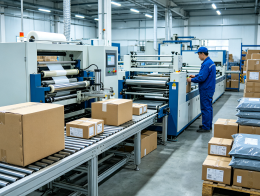 The printing and packaging factory produces molded paper boxes.
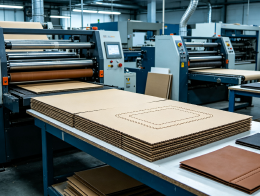 Production of two-piece packaging boxes for large household appliances with butt joint bonding.
 Pre-apply double-sided tape to the packaging of electronic products.
 Automatic Carton Forming Technology
 Double-sided tape applicator
Two-layer systems are designed for operational efficiency and ease of use. With automated synchronization and reduced ...
Each carton factory has different carton sizes, cardboard types, output capacity and workshop conditions. Please fill in the left form with your detailed production demands. Our technical team will tailor the most suitable machine configuration and professional production solution for you, providing free one-on-one technical guidance and customized support.