


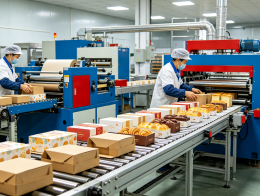
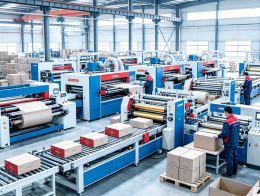
 Adapt to packaging factories and ecommerce supporting carton processing factories.
Understanding how a carton is produced requires more than looking at individual processing steps. The complete workflow determines how efficiently each sheet moves from initial feeding through gluing, folding, calibration, stitching, and final stacking. Our fully automatic high-speed folder gluer-stitcher machine integrates these operations into one continuous production line, reducing unnecessary material handling between individual processes.
On a conventional line, a sheet typically moves through several independent stations: feeding, gluing, folding, gluing or stitching, and then counting and stacking. Each of these can sit on its own piece of equipment, sometimes even on a separate line altogether. Getting the sheet from one station to the next usually depends on manual loading or unloading, or on a conveyor bridging two machines that were not built to run as one system.
Every one of those handoffs is a place where something can go wrong. A sheet can shift out of position during a manual transfer, arrive at the next station slightly misaligned, or simply move at a different pace than the equipment ahead of or behind it. When each station also sets its own parameters, such as glue volume, fold angle, or feed speed, small inconsistencies at each stage tend to accumulate rather than cancel out, and the finished carton can end up with dimensions or glue coverage that vary more than expected across a run.
This also makes troubleshooting harder than it needs to be. If a finished box comes out wrong, tracing the issue back to its source means checking several independent stations rather than a single continuous process. The more break points a workflow has, the longer that investigation tends to take, and the more production time gets absorbed by finding an answer rather than fixing it.
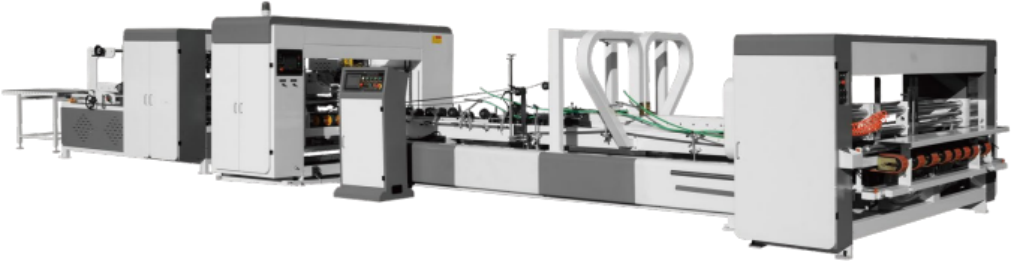
We built our folder gluer-stitcher machine around a different idea: keep the sheet on one line from the moment it is fed in to the moment it comes out as a finished carton, so there is no point where it has to be picked up, repositioned, or handed off to a separate piece of equipment.
The sequence starts with automatic belt suction feeding, which pulls sheets into the line one at a time at a controlled, steady pace. Because feeding sets the rhythm for everything downstream, keeping it automated and consistent is what allows the rest of the line to run without waiting on manual input between sheets.
From there, the sheet moves directly into automatic gluing. Because gluing follows feeding on the same line rather than on a separate machine, glue application is timed to the sheet's position as it arrives, rather than depending on how accurately an operator repositioned it after a transfer. Autofolding comes next, taking the glued sheet straight into the folding stage without requiring a new reference point or a manual realignment step.
Automatic calibration runs through this sequence rather than sitting at a single fixed point in it. As the sheet moves from feeding through folding, calibration keeps checking and adjusting its position, which is what allows the final gluing or stitching stage to work from an accurate starting point instead of compounding small errors carried over from earlier steps.
The line then moves into either gluing mode or stitching mode, depending on the carton being produced. Both modes share the same feeding, folding, and calibration stages that came before them, so switching between a glued carton and a stitched one does not mean reconfiguring a separate machine or restarting the sheet on a different line. In gluing mode, the sequence runs at mechanical speeds up to around 180 meters per minute. In stitching mode, the average stitching speed is around 80 meters per minute, with a stitch distance adjustable between 30 and 120 millimeters to match different carton specifications.
Once gluing or stitching is complete, the finished carton continues directly into packing, with an optional flap-folding attachment available for cartons that need it, before moving on to finished-product output and automatic counting and stacking. The sheet that entered as flat board at the start of the line leaves as a stacked, finished carton without ever being removed from the process in between.
The practical result of keeping a sheet on one continuous line is that the number of transfer points drops sharply compared with a setup built from separate stations. Fewer transfer points means fewer opportunities for a sheet to shift, fewer places where timing between stations can drift apart, and less manual handling overall between the first feed and the last stack.
Running calibration continuously through the sequence, rather than only at one station, also changes how consistency builds up across a production run. Instead of each stage working from its own independently set reference point, the line carries one calibrated position through gluing, folding, and stitching, which is what keeps carton dimensions closer together from the first piece of a run to the last.
There is a practical benefit for troubleshooting as well. When a finished carton shows a defect, checking a single continuous line is a more direct process than tracing the issue back through several separate machines that each had their own settings. That shorter path from noticing a problem to identifying its source tends to translate into less downtime when an adjustment is needed.
We design our fully automatic high-speed folder gluer-stitcher machine on the premise that how well each stage hands off to the next matters just as much as how fast any single stage runs on its own. A production line can have a fast gluing station and a fast stitching station and still lose time and consistency at every point where a sheet has to be manually moved between them.
Every stage of our line, from belt suction feeding through gluing, folding, calibration, and either gluing or stitching, is built to work as one connected sequence rather than a series of independent stations linked together after the fact. That continuity is what lets the line hold consistent carton dimensions across a full run, whatever mode it happens to be running in.
If you would like to see how this workflow applies to the specific cartons you produce, we are glad to walk through the sequence in more detail or arrange a demonstration of the line in operation.
'%3e%3cg%20id='Group%201315'%3e%3cg%20id='Group'%20opacity='0.5'%3e%3cpath%20id='Vector'%20d='M387.997%200L232.635%20265.605L58.6579%2086.8843L285.379%200H387.997Z'%20fill='url(%23paint0_linear_821_1490)'/%3e%3c/g%3e%3cg%20id='Group_2'%20opacity='0.5'%3e%3cg%20id='Group%201314'%3e%3cpath%20id='Vector_2'%20d='M376.103%2012.2625L298.38%20330L10.1988%20240.481L298.38%2012.2625H376.103Z'%20fill='url(%23paint1_linear_821_1490)'/%3e%3c/g%3e%3c/g%3e%3c/g%3e%3c/g%3e%3c/g%3e%3cdefs%3e%3clinearGradient%20id='paint0_linear_821_1490'%20x1='319.349'%20y1='11.6627'%20x2='157.133'%20y2='145.876'%20gradientUnits='userSpaceOnUse'%3e%3cstop%20stop-color='%23D2DFFF'/%3e%3cstop%20offset='1'%20stop-color='%23D2DFFF'%20stop-opacity='0.01'/%3e%3c/linearGradient%3e%3clinearGradient%20id='paint1_linear_821_1490'%20x1='253.685'%20y1='25.1395'%20x2='74.5789'%20y2='173.327'%20gradientUnits='userSpaceOnUse'%3e%3cstop%20stop-color='%23D2DFFF'/%3e%3cstop%20offset='1'%20stop-color='%23D2DFFF'%20stop-opacity='0.01'/%3e%3c/linearGradient%3e%3c/defs%3e%3c/svg%3e)
'/%3e%3cpath%20id='Rectangle%20455'%20d='M0%2012H6L24%2056H0V12Z'%20fill='%23CE221D'/%3e%3c/g%3e%3cdefs%3e%3clinearGradient%20id='paint0_linear_769_2773'%20x1='0'%20y1='28'%20x2='432.5'%20y2='28'%20gradientUnits='userSpaceOnUse'%3e%3cstop%20stop-color='%23153B8A'/%3e%3cstop%20offset='1'%20stop-color='%23153B8A'%20stop-opacity='0'/%3e%3c/linearGradient%3e%3c/defs%3e%3c/svg%3e) Adapt to packaging factories and ecommerce supporting carton processing factories.
Adapt to packaging factories and ecommerce supporting carton processing factories.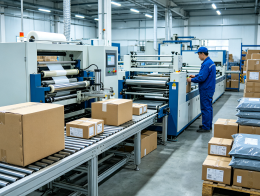 The printing and packaging factory produces molded paper boxes.
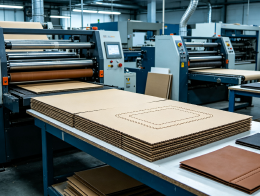 Production of two-piece packaging boxes for large household appliances with butt joint bonding.
 Pre-apply double-sided tape to the packaging of electronic products.
 Automatic Carton Forming Technology
 Double-sided tape applicator
Two-layer systems are designed for operational efficiency and ease of use. With automated synchronization and reduced ...
Each carton factory has different carton sizes, cardboard types, output capacity and workshop conditions. Please fill in the left form with your detailed production demands. Our technical team will tailor the most suitable machine configuration and professional production solution for you, providing free one-on-one technical guidance and customized support.