


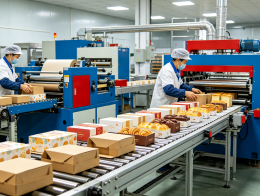
 Adapt to packaging factories and ecommerce supporting carton processing factories.
Incomplete folding rarely announces itself as one clear defect. It shows up as a slightly soft crease that won't hold its shape, a folded flap that lags behind the panel beneath it, or a finished box that looks fine on the top of the stack but starts showing crooked corners a few hundred pieces in. On a corrugated box folder gluer machine, these symptoms usually trace back to the same place: the folding section, and specifically how well its components stay synchronized as the line runs at speed.
A folding section on a folder gluer depends on close coordination between the conveyor belts moving the blank forward and the mechanical components pressing the panel down along the score line. When that coordination holds, the fold lands cleanly. When it doesn't, the result is a defect known in the industry as fish tailing, where the upper panel at the glued seam lags behind the lower panel being carried by the conveyor belt. The fold still happens, but it happens unevenly, and the seam ends up misaligned before the glue even has a chance to set.
This kind of drift is easy to miss during a quick visual check because a single-source folding drive can look like it's working correctly one moment and fall out of sync the next as speed increases or as the blank thickness changes slightly across a run. Fixed-angle folding compounds the problem. A folding mechanism set to one angle regardless of board thickness or box style works acceptably for the material it was tuned to, but corrugated plants rarely run one board weight all day. When a thicker or stiffer blank comes through, a fixed folding angle may not apply enough pressure to bring the fold fully to close, leaving the crease soft and the glue flap sitting slightly proud instead of flush.
It's also worth noting that folding errors are not always created in the folding section itself. If a blank enters that station already sitting slightly off-center from the feeding or pre-folding stage, the folding mechanism has to correct for a misalignment it didn't cause, and the resulting fold tends to come out asymmetrical. That upstream connection matters, but the folding section is still where most of the visible defect actually takes shape, which is why it deserves the closest look when troubleshooting incomplete folds.
We built the folding section on our corrugated box folder gluer machines around the two failure points described above: drive synchronization and fixed-angle folding.
Rather than relying on a single conveyor drive to carry the folding motion through both the second and fourth fold lines, we give the folding section its own independent motor drive to complete the second fold line. Running this stage on its own drive, separate from the general line conveyor, reduces the timing lag that produces fish tailing, since the folding motion is no longer waiting on a shared belt system to stay perfectly synchronized across the full width of the blank.
The fourth fold line is handled through a 180-degree folding combination, which allows the fold to be brought fully closed rather than left at a partial angle. This matters most with thicker or stiffer corrugated board, where a partial fold leaves the glue flap without enough contact pressure against the panel it's meant to bond to. Completing the fold to 180 degrees keeps that contact consistent, which in turn gives the gluing station a properly seated surface to bond rather than a flap that's still springing back toward its original position.
To address the second problem, fixed folding angles that can't adjust for different materials, the left and right deflection belts on the folding section use stepless speed adjustment, with a servo motor configuration available for plants that want finer control. Instead of setting the folding mechanism to one angle and running every board through it regardless of thickness or box style, operators can adjust the folding rhythm to match the material actually on the line. For a plant running mixed orders across a shift, this kind of adjustability reduces the setup changes needed between jobs and keeps fold quality consistent as board specifications shift.
A well-designed folding section does its job most reliably when the stations around it are holding their own tolerances too. Independently driven feeding keeps blanks entering the folding section aligned rather than already drifting off-center. On the output side, a squaring section with independently adjustable upper and lower pallets helps carry that alignment through to the finished stack rather than letting a good fold get thrown off by inconsistent handling downstream. None of these stations fold anything themselves, but a folding section working with well-aligned input, and handing off to a squaring station built to preserve that alignment, holds its accuracy far more consistently over a full production run than a folding station working in isolation.
The drive components behind this coordination matter as much as the mechanical layout. Independent motor drives paired with servo control on the folding belts give operators repeatable adjustment rather than a fixed setting that has to be manually reworked for every material change. That repeatability is what keeps fold quality from drifting gradually over the course of a shift, which is the pattern most plants actually experience rather than a single sudden failure.
This also changes how troubleshooting works in practice. On a folding section built around a single shared drive, tracing a fish-tailing defect back to its cause often means shutting the line down and inspecting several components in sequence, since the conveyor, the folding mechanism, and the belt tension are all tied to the same motion. When the folding section runs on its own independent drive, an operator can isolate whether the issue sits in the folding stage itself or somewhere upstream far more quickly, which shortens the time a line spends stopped for adjustment rather than producing saleable boxes.
Incomplete folding is rarely a single-part failure. It's typically the result of a folding section that can't keep its drive components synchronized at speed, combined with a fixed folding angle that doesn't adjust for the board actually running through the machine. Addressing both of those points, independent drive for the fold lines and adjustable folding speed across the deflection belts, resolves most fish tailing and soft-crease issues at the source rather than requiring operators to compensate for them downstream.
As a manufacturer of corrugated box folder gluer machines, we design our folding section around exactly this combination of independent drive and adjustable folding speed, based on feedback from production lines running a range of board weights and box styles. If your line is showing signs of inconsistent folding or seam misalignment, our technical team can review your current board range and production speed and recommend a folding section configuration suited to your output requirements.
'%3e%3cg%20id='Group%201315'%3e%3cg%20id='Group'%20opacity='0.5'%3e%3cpath%20id='Vector'%20d='M387.997%200L232.635%20265.605L58.6579%2086.8843L285.379%200H387.997Z'%20fill='url(%23paint0_linear_821_1490)'/%3e%3c/g%3e%3cg%20id='Group_2'%20opacity='0.5'%3e%3cg%20id='Group%201314'%3e%3cpath%20id='Vector_2'%20d='M376.103%2012.2625L298.38%20330L10.1988%20240.481L298.38%2012.2625H376.103Z'%20fill='url(%23paint1_linear_821_1490)'/%3e%3c/g%3e%3c/g%3e%3c/g%3e%3c/g%3e%3c/g%3e%3cdefs%3e%3clinearGradient%20id='paint0_linear_821_1490'%20x1='319.349'%20y1='11.6627'%20x2='157.133'%20y2='145.876'%20gradientUnits='userSpaceOnUse'%3e%3cstop%20stop-color='%23D2DFFF'/%3e%3cstop%20offset='1'%20stop-color='%23D2DFFF'%20stop-opacity='0.01'/%3e%3c/linearGradient%3e%3clinearGradient%20id='paint1_linear_821_1490'%20x1='253.685'%20y1='25.1395'%20x2='74.5789'%20y2='173.327'%20gradientUnits='userSpaceOnUse'%3e%3cstop%20stop-color='%23D2DFFF'/%3e%3cstop%20offset='1'%20stop-color='%23D2DFFF'%20stop-opacity='0.01'/%3e%3c/linearGradient%3e%3c/defs%3e%3c/svg%3e)
'/%3e%3cpath%20id='Rectangle%20455'%20d='M0%2012H6L24%2056H0V12Z'%20fill='%23CE221D'/%3e%3c/g%3e%3cdefs%3e%3clinearGradient%20id='paint0_linear_769_2773'%20x1='0'%20y1='28'%20x2='432.5'%20y2='28'%20gradientUnits='userSpaceOnUse'%3e%3cstop%20stop-color='%23153B8A'/%3e%3cstop%20offset='1'%20stop-color='%23153B8A'%20stop-opacity='0'/%3e%3c/linearGradient%3e%3c/defs%3e%3c/svg%3e) Adapt to packaging factories and ecommerce supporting carton processing factories.
Adapt to packaging factories and ecommerce supporting carton processing factories.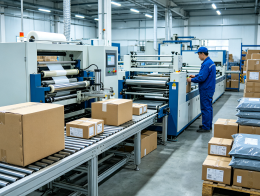 The printing and packaging factory produces molded paper boxes.
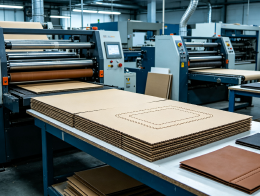 Production of two-piece packaging boxes for large household appliances with butt joint bonding.
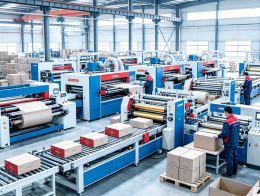 Pre-apply double-sided tape to the packaging of electronic products.
 Automatic Carton Forming Technology
 Double-sided tape applicator
Two-layer systems are designed for operational efficiency and ease of use. With automated synchronization and reduced ...
Each carton factory has different carton sizes, cardboard types, output capacity and workshop conditions. Please fill in the left form with your detailed production demands. Our technical team will tailor the most suitable machine configuration and professional production solution for you, providing free one-on-one technical guidance and customized support.