


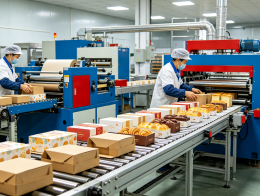
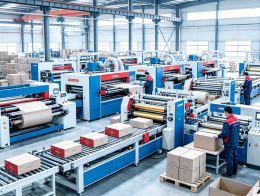
 Adapt to packaging factories and ecommerce supporting carton processing factories.
E-commerce packaging demand doesn't move at a steady pace. Order volumes spike sharply around promotional seasons, box specifications change from one production run to the next, and margins on packaging are thin enough that even small inefficiencies add up quickly. For manufacturers supplying corrugated boxes to online retailers and fulfillment centers, the real challenge isn't just producing boxes — it's producing them fast, consistently, and across a growing number of SKUs without letting costs climb along with volume. This is where the design of a corrugated box folder gluer machine starts to matter more than most buyers initially expect.
Two problems tend to surface first when a packaging line tries to keep up with e-commerce order patterns.
The first is a production ceiling tied to manual dependency. Many older or lower-cost folder gluer lines still rely heavily on manual paper feeding, manual alignment, and operator adjustments during a run. That approach can work for stable, low-volume production, but it doesn't hold up well when order volume surges. Labor requirements tend to rise almost in step with output, so instead of unit costs dropping as volume increases, they stay flat or even climb. For a packaging supplier trying to win e-commerce contracts on price and lead time, that's a difficult position to compete from.
The second problem is changeover time. E-commerce packaging is rarely a single box size run at high volume. It's usually a mix of smaller batches across multiple dimensions — different SKUs, different carton depths, different customer specifications — often with quick turnaround expectations. On equipment where feeding width, stacking parameters, or alignment settings have to be adjusted manually and re-tested before each run, changeover can eat up a meaningful share of the working day. Every minute spent recalibrating is a minute the machine isn't producing, and that idle time becomes a real cost even though it doesn't show up as a line item on the machine's spec sheet.
There's also a quieter cost that comes from inconsistent gluing. Uneven glue application or unstable folding pressure doesn't always stop the line, but it does show up later as rejected cartons or customer complaints about seam strength — costs that are harder to trace back to their source but still affect the bottom line.
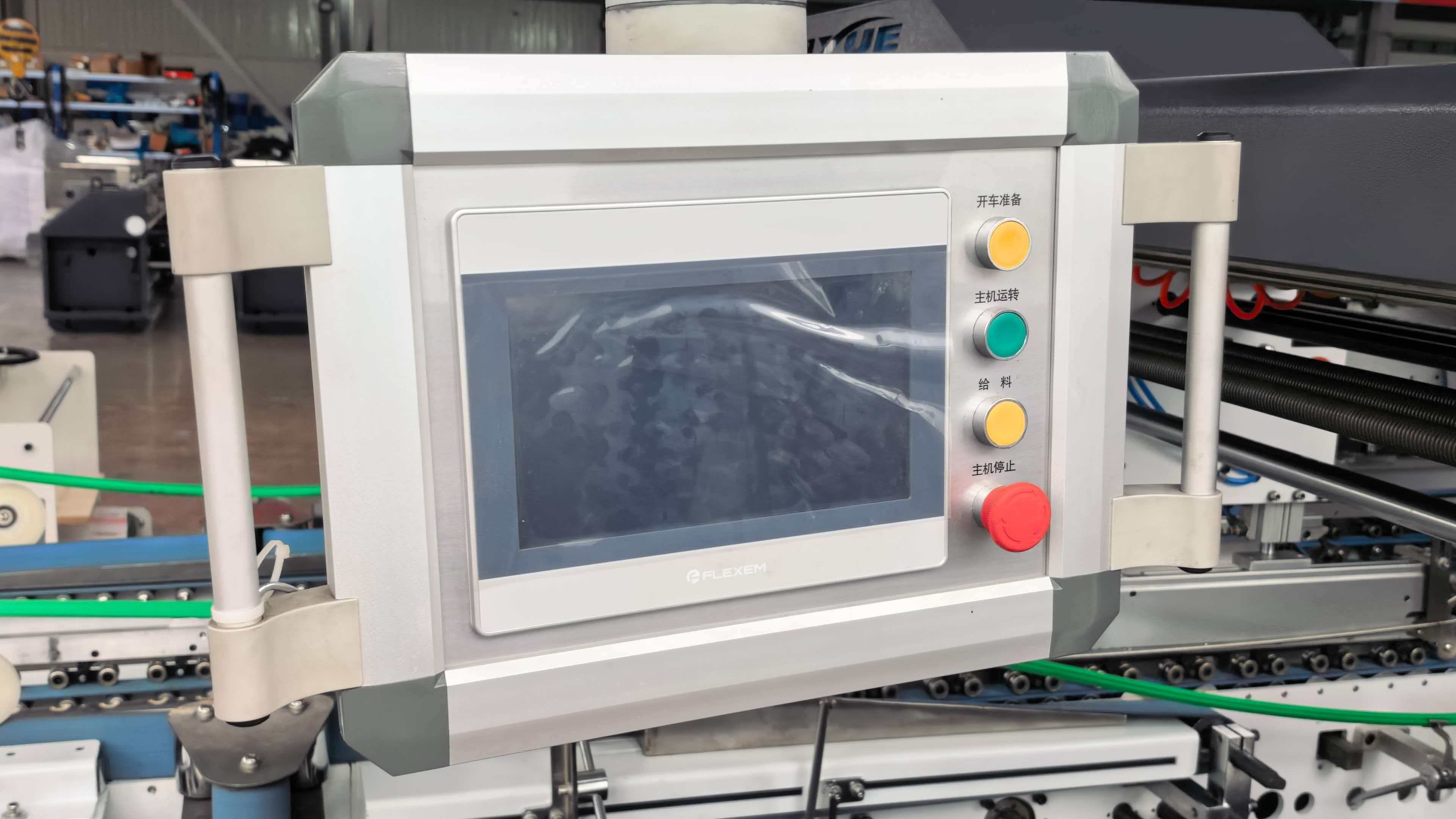
When we design our corrugated box folder gluer machines, we build around these two pressure points specifically, rather than treating every mechanical component as equally important to the story.
The first area we focus on is the gluing and folding drive system. Instead of a single mechanical linkage running the whole sequence, our machines use independently driven servo motors for the gluing and folding sections, with both hot-melt and cold-glue application available depending on the box construction. Independent servo drive means the roller speed and glue application stay consistent across a full production run, rather than drifting as the line speeds up or slows down. In practical terms, this is what allows the machine to sustain output in the range of 3,000 to 5,000 pieces per hour without the gluing quality trailing off toward the end of a shift. More even glue coverage also means fewer cartons rejected for weak seams, which reduces material waste in a way that compounds over a full production month.
The second area is changeover speed. Our feeding section uses a friction-type suction paper feeder with independently adjustable side guides and an extendable rear support for the paper stack, so the machine can be reset for a different box dimension without extensive manual measurement. The patting and conveying sections are similarly built with independently motor-driven length and width adjustment, which lets an operator move from one box specification to the next in a fraction of the time a fully manual setup would require. For a packaging producer running multiple e-commerce customers with different box specifications through the same line, that difference in changeover time translates directly into more usable production hours per day.
The rest of the machine is built to support these two priorities. Structural components — linear guide rails, bearings, PLC and HMI control, servo motors, frequency converters — are sourced from established industrial suppliers, which is a large part of why the machine can run at higher speeds and through frequent changeovers without a corresponding rise in maintenance issues. We don't consider this a secondary detail; a folder gluer that runs fast but requires constant part replacement doesn't actually reduce cost, it just moves the expense from labor to downtime.
What e-commerce packaging producers generally need isn't just a faster machine or a more flexible one — it's both, on the same line. A high-output machine that can't switch between box sizes efficiently ends up idle during changeovers regardless of its top speed rating. A flexible machine that can't sustain consistent throughput doesn't help much during a seasonal order surge. The value in our folder gluer design comes from combining servo-driven consistency at production speed with a feeding and adjustment system built for frequent changeovers, so the same line can handle a high-volume run one day and a smaller, different-specification batch the next without a significant efficiency penalty either way.
This combination is also what tends to matter most when we talk with packaging manufacturers who supply e-commerce fulfillment operations directly. Their production planning isn't built around a single ideal box size — it's built around variability, and the equipment needs to be able to absorb that variability without turning it into lost production time or rising labor costs.
Reducing per-unit cost in corrugated packaging production rarely comes down to one single upgrade. It's usually the result of removing the specific points where a line loses time or consistency — and for e-commerce packaging in particular, that tends to be manual-dependent feeding, uneven gluing, and slow changeovers between box specifications. A corrugated box folder gluer machine designed around servo-driven precision and fast, adjustable feeding directly addresses both the production-speed side and the flexibility side of that equation.
We've built our folder gluer machines around this understanding, using industrial-grade components across the drive, control, and structural systems to support both sustained high-speed output and quick adjustment between production runs. If your production line is managing growing e-commerce order volume alongside frequent box-size changes, we're glad to walk through which configuration would fit your paper size range, target output, and existing production setup.
'%3e%3cg%20id='Group%201315'%3e%3cg%20id='Group'%20opacity='0.5'%3e%3cpath%20id='Vector'%20d='M387.997%200L232.635%20265.605L58.6579%2086.8843L285.379%200H387.997Z'%20fill='url(%23paint0_linear_821_1490)'/%3e%3c/g%3e%3cg%20id='Group_2'%20opacity='0.5'%3e%3cg%20id='Group%201314'%3e%3cpath%20id='Vector_2'%20d='M376.103%2012.2625L298.38%20330L10.1988%20240.481L298.38%2012.2625H376.103Z'%20fill='url(%23paint1_linear_821_1490)'/%3e%3c/g%3e%3c/g%3e%3c/g%3e%3c/g%3e%3c/g%3e%3cdefs%3e%3clinearGradient%20id='paint0_linear_821_1490'%20x1='319.349'%20y1='11.6627'%20x2='157.133'%20y2='145.876'%20gradientUnits='userSpaceOnUse'%3e%3cstop%20stop-color='%23D2DFFF'/%3e%3cstop%20offset='1'%20stop-color='%23D2DFFF'%20stop-opacity='0.01'/%3e%3c/linearGradient%3e%3clinearGradient%20id='paint1_linear_821_1490'%20x1='253.685'%20y1='25.1395'%20x2='74.5789'%20y2='173.327'%20gradientUnits='userSpaceOnUse'%3e%3cstop%20stop-color='%23D2DFFF'/%3e%3cstop%20offset='1'%20stop-color='%23D2DFFF'%20stop-opacity='0.01'/%3e%3c/linearGradient%3e%3c/defs%3e%3c/svg%3e)
'/%3e%3cpath%20id='Rectangle%20455'%20d='M0%2012H6L24%2056H0V12Z'%20fill='%23CE221D'/%3e%3c/g%3e%3cdefs%3e%3clinearGradient%20id='paint0_linear_769_2773'%20x1='0'%20y1='28'%20x2='432.5'%20y2='28'%20gradientUnits='userSpaceOnUse'%3e%3cstop%20stop-color='%23153B8A'/%3e%3cstop%20offset='1'%20stop-color='%23153B8A'%20stop-opacity='0'/%3e%3c/linearGradient%3e%3c/defs%3e%3c/svg%3e) Adapt to packaging factories and ecommerce supporting carton processing factories.
Adapt to packaging factories and ecommerce supporting carton processing factories.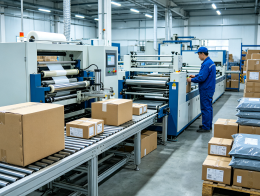 The printing and packaging factory produces molded paper boxes.
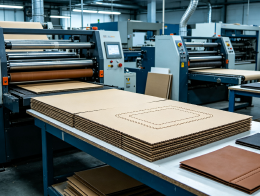 Production of two-piece packaging boxes for large household appliances with butt joint bonding.
 Pre-apply double-sided tape to the packaging of electronic products.
 Automatic Carton Forming Technology
 Double-sided tape applicator
Two-layer systems are designed for operational efficiency and ease of use. With automated synchronization and reduced ...
Each carton factory has different carton sizes, cardboard types, output capacity and workshop conditions. Please fill in the left form with your detailed production demands. Our technical team will tailor the most suitable machine configuration and professional production solution for you, providing free one-on-one technical guidance and customized support.