


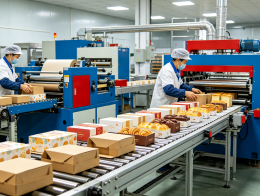
 Adapt to packaging factories and ecommerce supporting carton processing factories.
Carton compression strength is usually discussed in terms of board grade, flute profile, and paper weight, but folding precision plays an equally important role that gets far less attention. Even small deviations in fold angle or crease consistency can be magnified once a carton is stacked several layers high or subjected to the pressure of transport, and the result shows up not as a material failure but as a structural one — the box gives way exactly where the fold line was slightly off. As a corrugated box folder gluer machine manufacturer, we see this connection play out constantly in how our machines are engineered and evaluated.
A carton's ability to resist compression depends heavily on the flute structure carrying load evenly and vertically along each fold line. When a folder gluer machine's folding section lacks precision or responds with any lag, fold angles drift and crease lines become uneven, and this creates a concentrated stress point right at the corner where the deviation occurred. Under compression testing, or simply during real-world stacking, that corner is typically the first place a carton begins to deform or collapse — not because the board itself was weak, but because the fold redirected load in a way the structure wasn't designed to handle.
A second, closely related issue appears on machines that rely on a single motor driving multiple fold lines through mechanical linkage. Synchronizing several folding actions from one shared power source is difficult, and this becomes more apparent on carton styles that require multiple fold lines, such as designs using a 180-degree combination fold. Small timing or positional differences between each fold line tend to accumulate rather than cancel out, so by the time all folds are complete, the four walls of the finished box carry load unevenly. The carton may look correctly folded, but its actual compression performance falls short of what the board specification would otherwise support.
A less obvious contributor is frame vibration during high-speed folding. If a corrugated box folder gluer machine's structural frame isn't rigid enough to absorb the forces generated by continuous fast folding cycles, that vibration can interfere with crease consistency even when the folding drive itself is functioning correctly — the fold line ends up slightly different from one cycle to the next, simply because the machine underneath it isn't holding still.
We treat fold-line accuracy as a structural engineering question rather than a simple mechanical action, because the connection between folding precision and finished-carton strength is well established in how corrugated board actually carries load. This is one of the core design principles behind every corrugated box folder gluer machine we build.
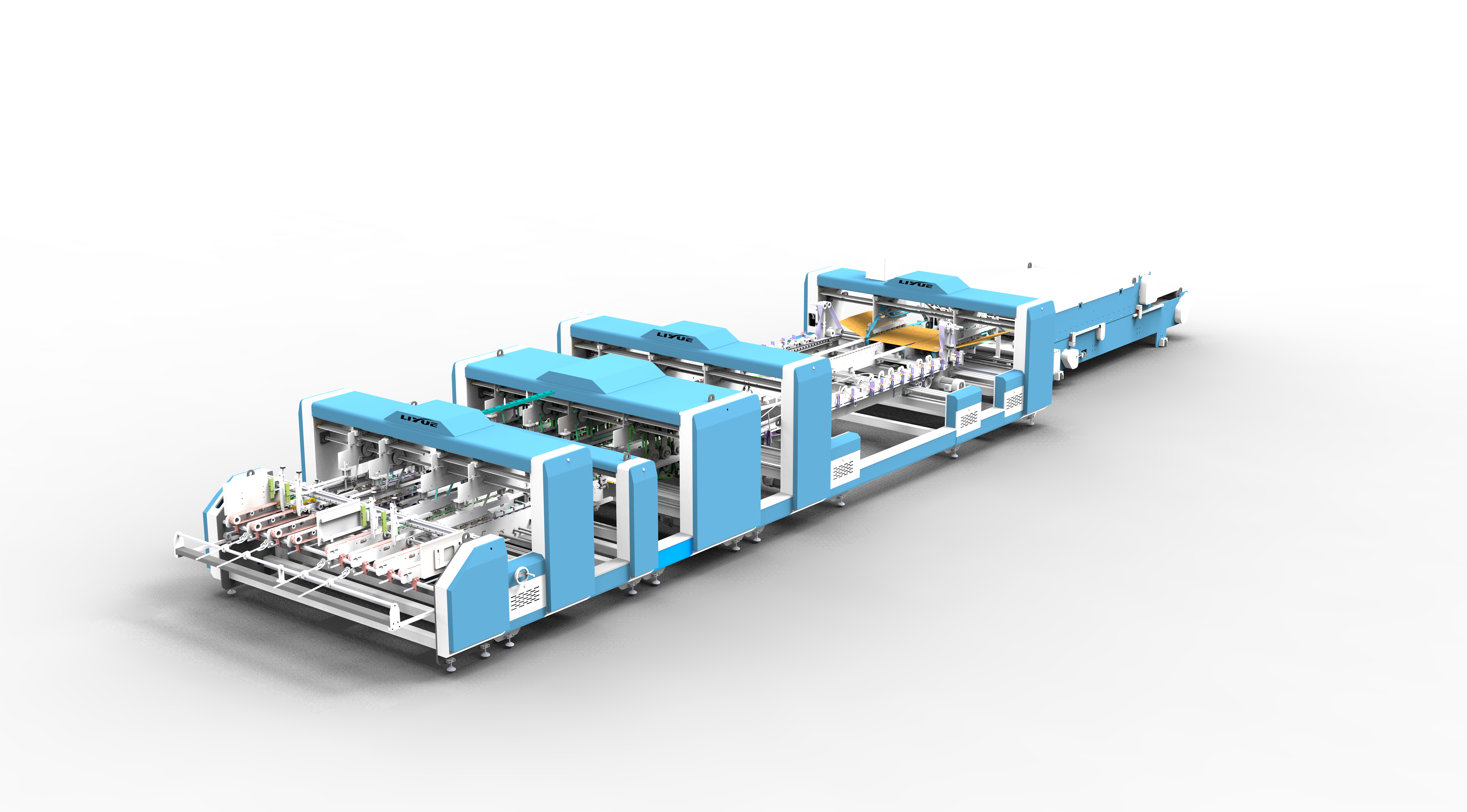
Our folding section is driven by independent motors capable of completing the second fold line with precision, with the fourth fold line executed using a 180-degree combination method — a configuration chosen specifically so that multiple fold actions on complex carton styles work in coordination rather than simply happening one after another through shared mechanical linkage. The left and right turning points are equipped with stepless variable speed adjustment, with servo motor configuration available, which allows fold angle and position to stay consistent across different production speeds. This matters because a fold that holds its accuracy only at one specific speed setting isn't solving the underlying precision problem — it's just avoiding it under narrow conditions.
Precision at the folding station only translates into real carton strength if the rest of the machine holds still while that folding happens, which is why frame construction is the second half of this equation for any well-built corrugated box folder gluer machine. Our machine wall panels are built from 16mm steel that goes through a cold and heat treatment process meeting international standards, paired with NSK and HRB bearings and HIWIN or Shangyin linear guide rails. This combination gives the frame the rigidity to resist vibration during continuous high-speed folding, so the precision built into the independent servo drive isn't quietly undone by a frame that flexes under load. In effect, the rigid frame is what allows the folding drive's accuracy to actually reach the finished carton rather than being absorbed by structural movement along the way.
These systems work alongside the machine's frequency converter and PLC control, which help keep folding rhythm coordinated with the rest of the production sequence — a supporting role, but one that matters when fold timing needs to stay consistent across a long production run rather than just the first few cycles after startup.
None of this suggests that folding precision alone determines a carton's compression strength — board grade, flute type, moisture content, and storage conditions all play their part, and no corrugated box folder gluer machine can compensate for underlying material weakness. What precise, well-synchronized folding does accomplish is making sure the carton achieves the compression performance its material specification is actually capable of, rather than losing strength to stress concentrations introduced during the folding process itself.
This distinction matters most in applications where compression strength is closely tied to real operational requirements — multi-layer warehouse stacking, long-distance transport, or export packaging subject to strict compression testing. In these cases, a carton that loses even a modest percentage of its rated compression strength to uneven folding can mean the difference between passing and failing a stacking test, or between a shipment arriving intact and one arriving with crushed corners. Folding precision isn't a cosmetic detail in these scenarios — it's part of what determines whether the box does its job, and it's a large part of why the folding drive and frame rigidity of a corrugated box folder gluer machine deserve real scrutiny during equipment selection.
For a production facility, this also reframes how folding-related defects should be evaluated during quality checks. A box that looks properly folded to the eye may still carry a fold-line deviation too small to notice visually but large enough to create a stress concentration under load. Understanding this connection is part of why fold-line accuracy deserves attention not just as a cosmetic quality metric, but as a direct input into the carton's actual physical performance — and why the machine responsible for that fold deserves the same level of scrutiny as the board itself.
Carton compression strength is often treated as something decided entirely at the paper mill, but the folding stage plays a real and measurable role in whether that potential strength is preserved or compromised. A precisely driven fold, executed on a frame rigid enough to hold its accuracy under continuous high-speed operation, is what keeps load distributed the way the board was designed to carry it — and that combination of precision and rigidity is exactly what separates a well-engineered corrugated box folder gluer machine from a machine that simply folds cardboard.
This is the standard we build our folding sections around — independent servo drive for accurate, coordinated fold-line execution, paired with a heat-treated steel frame built to stay rigid through extended high-speed runs. As a manufacturer that designs and builds corrugated box folder gluer machines specifically for packaging producers who depend on consistent compression performance, we approach every folding section as a contributor to finished-carton strength, not just a production speed metric. For packaging producers where compression performance is a real specification rather than a nice-to-have, we'd encourage a closer look at folding drive design and frame construction when comparing corrugated box folder gluer machines, not just headline production speed. We're glad to talk through how our folding and frame design apply to your specific carton styles and compression requirements — reach out to our team, and we can help you evaluate what precision actually means for the boxes you're producing.
'%3e%3cg%20id='Group%201315'%3e%3cg%20id='Group'%20opacity='0.5'%3e%3cpath%20id='Vector'%20d='M387.997%200L232.635%20265.605L58.6579%2086.8843L285.379%200H387.997Z'%20fill='url(%23paint0_linear_821_1490)'/%3e%3c/g%3e%3cg%20id='Group_2'%20opacity='0.5'%3e%3cg%20id='Group%201314'%3e%3cpath%20id='Vector_2'%20d='M376.103%2012.2625L298.38%20330L10.1988%20240.481L298.38%2012.2625H376.103Z'%20fill='url(%23paint1_linear_821_1490)'/%3e%3c/g%3e%3c/g%3e%3c/g%3e%3c/g%3e%3c/g%3e%3cdefs%3e%3clinearGradient%20id='paint0_linear_821_1490'%20x1='319.349'%20y1='11.6627'%20x2='157.133'%20y2='145.876'%20gradientUnits='userSpaceOnUse'%3e%3cstop%20stop-color='%23D2DFFF'/%3e%3cstop%20offset='1'%20stop-color='%23D2DFFF'%20stop-opacity='0.01'/%3e%3c/linearGradient%3e%3clinearGradient%20id='paint1_linear_821_1490'%20x1='253.685'%20y1='25.1395'%20x2='74.5789'%20y2='173.327'%20gradientUnits='userSpaceOnUse'%3e%3cstop%20stop-color='%23D2DFFF'/%3e%3cstop%20offset='1'%20stop-color='%23D2DFFF'%20stop-opacity='0.01'/%3e%3c/linearGradient%3e%3c/defs%3e%3c/svg%3e)
'/%3e%3cpath%20id='Rectangle%20455'%20d='M0%2012H6L24%2056H0V12Z'%20fill='%23CE221D'/%3e%3c/g%3e%3cdefs%3e%3clinearGradient%20id='paint0_linear_769_2773'%20x1='0'%20y1='28'%20x2='432.5'%20y2='28'%20gradientUnits='userSpaceOnUse'%3e%3cstop%20stop-color='%23153B8A'/%3e%3cstop%20offset='1'%20stop-color='%23153B8A'%20stop-opacity='0'/%3e%3c/linearGradient%3e%3c/defs%3e%3c/svg%3e) Adapt to packaging factories and ecommerce supporting carton processing factories.
Adapt to packaging factories and ecommerce supporting carton processing factories.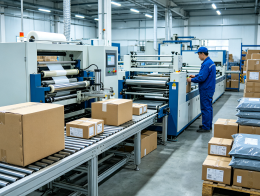 The printing and packaging factory produces molded paper boxes.
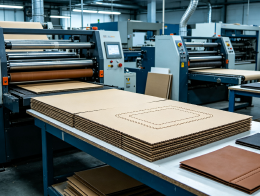 Production of two-piece packaging boxes for large household appliances with butt joint bonding.
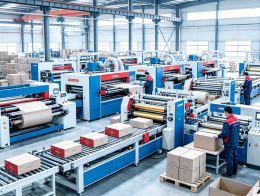 Pre-apply double-sided tape to the packaging of electronic products.
 Automatic Carton Forming Technology
 Double-sided tape applicator
Two-layer systems are designed for operational efficiency and ease of use. With automated synchronization and reduced ...
Each carton factory has different carton sizes, cardboard types, output capacity and workshop conditions. Please fill in the left form with your detailed production demands. Our technical team will tailor the most suitable machine configuration and professional production solution for you, providing free one-on-one technical guidance and customized support.