


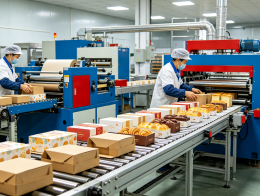
 Adapt to packaging factories and ecommerce supporting carton processing factories.
Carton folding accuracy is one of the most common pain points in packaging production. Misaligned fold lines, uneven edges, and inconsistent box shape slow down output and affect how a finished carton looks and performs once it reaches the shelf. Much of this comes down to how the folding section handles multi-stage folds, particularly where traditional mechanical drive struggles to keep pace with modern production speeds. 180° folding technology, built around independent motor drive rather than a single linked mechanism, addresses these limitations at the source.
Folding accuracy in carton production depends on how consistently a fold line can be positioned and closed, fold after fold, at production speed. In manual or semi-automatic setups, fold positioning relies heavily on operator experience. Even skilled operators introduce small variations from batch to batch, and those variations become harder to control as line speed increases. Once a production run moves beyond a certain speed, manual adjustment simply cannot keep pace with the folding rhythm, and precision tends to drift.
Conventional mechanical folding systems bring a different set of limitations. Many rely on a fixed folding angle and a single linked drive mechanism, which works reasonably well for simple box styles but becomes restrictive for cartons with more complex fold structures. When a fold is not completed cleanly, or when folding pressure is applied unevenly, the result can be a bulged panel, a cracked white line, or a carton that does not sit flush after erection. This is particularly noticeable at the second and fourth fold lines, where multiple folding stages need to work in sequence. If each stage introduces even a small amount of error, those errors accumulate across the process rather than cancelling out.
The downstream impact of these issues is measurable rather than cosmetic. Folding defects contribute directly to reject rates and rework, both of which add cost and reduce effective output. At higher production speeds, folding errors tend to be magnified rather than smoothed out, which makes it harder to meet the appearance standards that many customers specify for finished cartons. Folding precision also affects what happens later in the process: a fold line that is slightly off position can reduce the contact area available for gluing, which in turn affects bond strength. In this way, folding quality and gluing quality are closely connected rather than separate concerns.
180° folding refers to a fold that closes a full 180 degrees, bringing the panel completely flat against the adjoining surface. For certain box styles, particularly those with double-wall construction or reinforced panels, this full closure is necessary to achieve proper strength and a flush finish. A partial or inconsistent fold angle at this stage tends to leave a visible gap or a soft edge, which becomes a quality issue at final inspection.
Achieving a reliable 180° fold at production speed depends heavily on how the folding motion is driven. In a folder gluer folding section built around independent motor drive, each folding stage is controlled separately rather than through a single shared mechanical linkage. This allows the second and fourth fold lines to be completed and closed accurately, with less dependency on how earlier stages performed. Compared with traditional linked drive systems, independent drive generally offers finer control over folding timing and pressure, faster response when adjustments are needed, and fewer mechanical failure points, since there are fewer shared moving parts that can wear unevenly over time.
Alongside drive independence, stepless speed adjustment on the left and right folding belts plays an important role in accommodating different production requirements. Paper and board thickness varies between jobs, and different box styles call for different folding timing. Stepless adjustment allows the folding belts to be tuned to match these variables rather than forcing every job through a single fixed setting. Where higher consistency is required, an optional servo motor configuration can be added, offering faster response and finer adjustment resolution, along with more efficient energy use during operation.
Ease of disassembly is a practical consideration that is sometimes overlooked in discussions of folding accuracy, but it has a direct effect on production efficiency. A folding section that can be adjusted and cleaned without extended downtime reduces the time lost during changeovers and routine maintenance. For small and mid-sized packaging operations running frequent job changes, this can have a meaningful effect on overall equipment utilization, even when the folding mechanism itself is performing well.
These principles inform how a folder gluer's folding section is engineered. Independent motor drive addresses the accumulated error problem that occurs across multiple folding stages, since each fold is controlled and monitored on its own rather than inheriting variation from the stage before it. Stepless speed adjustment, together with the option of servo motor drive, allows the folding section to adapt to different paper weights and box styles without requiring mechanical reconfiguration between jobs. An easy-to-disassemble structure supports faster maintenance and changeover, which helps keep actual production time closer to planned production time.
The folding section does not operate in isolation. Its output feeds directly into the gluing and pressing stages that follow, so consistent fold geometry supports more reliable adhesive contact and a more stable finished carton. Approaching folder gluer design this way, as a set of connected stages rather than isolated components, tends to produce more predictable results across a full production run.
In practical terms, this kind of folding section design is associated with a reduction in fold-related rework and shorter changeover times between box styles, though actual results vary by paper stock, box design, and how the equipment is operated and maintained. These are the kinds of incremental, verifiable gains that matter most on a real production floor, rather than broad claims about performance.
Fold line accuracy is one of the clearest indicators of carton quality, because it affects both the visual appearance of the finished box and its structural performance once erected. A folding section built around independent motor drive, adjustable folding speed, and a maintenance-friendly structure is designed to address the specific failure points that show up in conventional folding systems, particularly at multi-stage folds like the second and fourth fold lines.
As a manufacturer of folder gluer machines, we design the folding section as an integrated part of the overall machine rather than as a standalone add-on, with attention to how it interacts with the gluing and pressing stages that follow it. For packaging producers evaluating equipment for complex box styles or high-speed production, understanding how a folding section is engineered, and not just what specifications it lists, is a useful starting point for assessing fit.
'%3e%3cg%20id='Group%201315'%3e%3cg%20id='Group'%20opacity='0.5'%3e%3cpath%20id='Vector'%20d='M387.997%200L232.635%20265.605L58.6579%2086.8843L285.379%200H387.997Z'%20fill='url(%23paint0_linear_821_1490)'/%3e%3c/g%3e%3cg%20id='Group_2'%20opacity='0.5'%3e%3cg%20id='Group%201314'%3e%3cpath%20id='Vector_2'%20d='M376.103%2012.2625L298.38%20330L10.1988%20240.481L298.38%2012.2625H376.103Z'%20fill='url(%23paint1_linear_821_1490)'/%3e%3c/g%3e%3c/g%3e%3c/g%3e%3c/g%3e%3c/g%3e%3cdefs%3e%3clinearGradient%20id='paint0_linear_821_1490'%20x1='319.349'%20y1='11.6627'%20x2='157.133'%20y2='145.876'%20gradientUnits='userSpaceOnUse'%3e%3cstop%20stop-color='%23D2DFFF'/%3e%3cstop%20offset='1'%20stop-color='%23D2DFFF'%20stop-opacity='0.01'/%3e%3c/linearGradient%3e%3clinearGradient%20id='paint1_linear_821_1490'%20x1='253.685'%20y1='25.1395'%20x2='74.5789'%20y2='173.327'%20gradientUnits='userSpaceOnUse'%3e%3cstop%20stop-color='%23D2DFFF'/%3e%3cstop%20offset='1'%20stop-color='%23D2DFFF'%20stop-opacity='0.01'/%3e%3c/linearGradient%3e%3c/defs%3e%3c/svg%3e)
'/%3e%3cpath%20id='Rectangle%20455'%20d='M0%2012H6L24%2056H0V12Z'%20fill='%23CE221D'/%3e%3c/g%3e%3cdefs%3e%3clinearGradient%20id='paint0_linear_769_2773'%20x1='0'%20y1='28'%20x2='432.5'%20y2='28'%20gradientUnits='userSpaceOnUse'%3e%3cstop%20stop-color='%23153B8A'/%3e%3cstop%20offset='1'%20stop-color='%23153B8A'%20stop-opacity='0'/%3e%3c/linearGradient%3e%3c/defs%3e%3c/svg%3e) Adapt to packaging factories and ecommerce supporting carton processing factories.
Adapt to packaging factories and ecommerce supporting carton processing factories.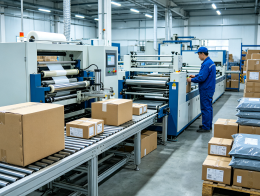 The printing and packaging factory produces molded paper boxes.
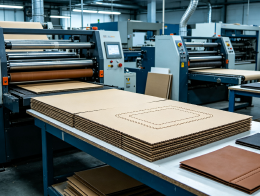 Production of two-piece packaging boxes for large household appliances with butt joint bonding.
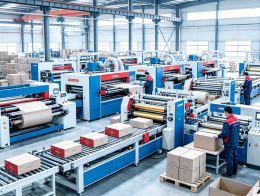 Pre-apply double-sided tape to the packaging of electronic products.
 Automatic Carton Forming Technology
 Double-sided tape applicator
Two-layer systems are designed for operational efficiency and ease of use. With automated synchronization and reduced ...
Each carton factory has different carton sizes, cardboard types, output capacity and workshop conditions. Please fill in the left form with your detailed production demands. Our technical team will tailor the most suitable machine configuration and professional production solution for you, providing free one-on-one technical guidance and customized support.