


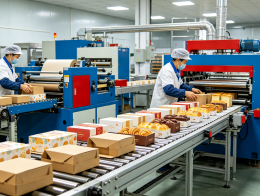
 Adapt to packaging factories and ecommerce supporting carton processing factories.
Bond strength is one of the most decisive factors in corrugated box production. A folder gluer machine can run at high speed and still produce boxes that fail at the seam if the gluing system underneath isn't built to keep up. As board weights, coatings, and order variety continue to expand across the packaging industry, manufacturers are paying closer attention to how their equipment applies glue, not just how fast it folds and glues.
Most folder gluers built around a single cold glue system share a familiar set of limitations. Cold glue needs time to set, and that dwell time puts a practical ceiling on how fast the line can run without risking weak or incomplete bonds. Workshop conditions add another variable: in humid environments or during colder months, cold glue can cure unevenly, and bond strength becomes harder to predict from one run to the next. Heavier board stock and laminated or coated surfaces compound the problem further, since cold glue alone often struggles to achieve full, even contact across these less porous materials.
The application mechanism itself introduces additional risk. Basic brush or wheel-based glue application tends to distribute adhesive unevenly, particularly as components wear with continuous use. A glue wheel that has lost its original precision after months of operation will leave gaps in some areas and excess buildup in others, and neither outcome is good for bond quality or downstream cleanliness. Many of these simpler structures are also built around a single glue type, which leaves little room to adjust when an order calls for a different substrate or a faster turnaround.
Gluing accuracy and panel positioning are more closely connected than they might first appear. When the glue wheel groups on a machine aren't properly matched or synchronized, boxes can come out of the line skewed or misaligned, especially as production speed increases. This kind of secondary positioning error tends to show up gradually, appearing as a slow creep in scrap rate rather than a single obvious failure, which makes it harder to catch and more costly to fix once it becomes a recurring issue on the line.
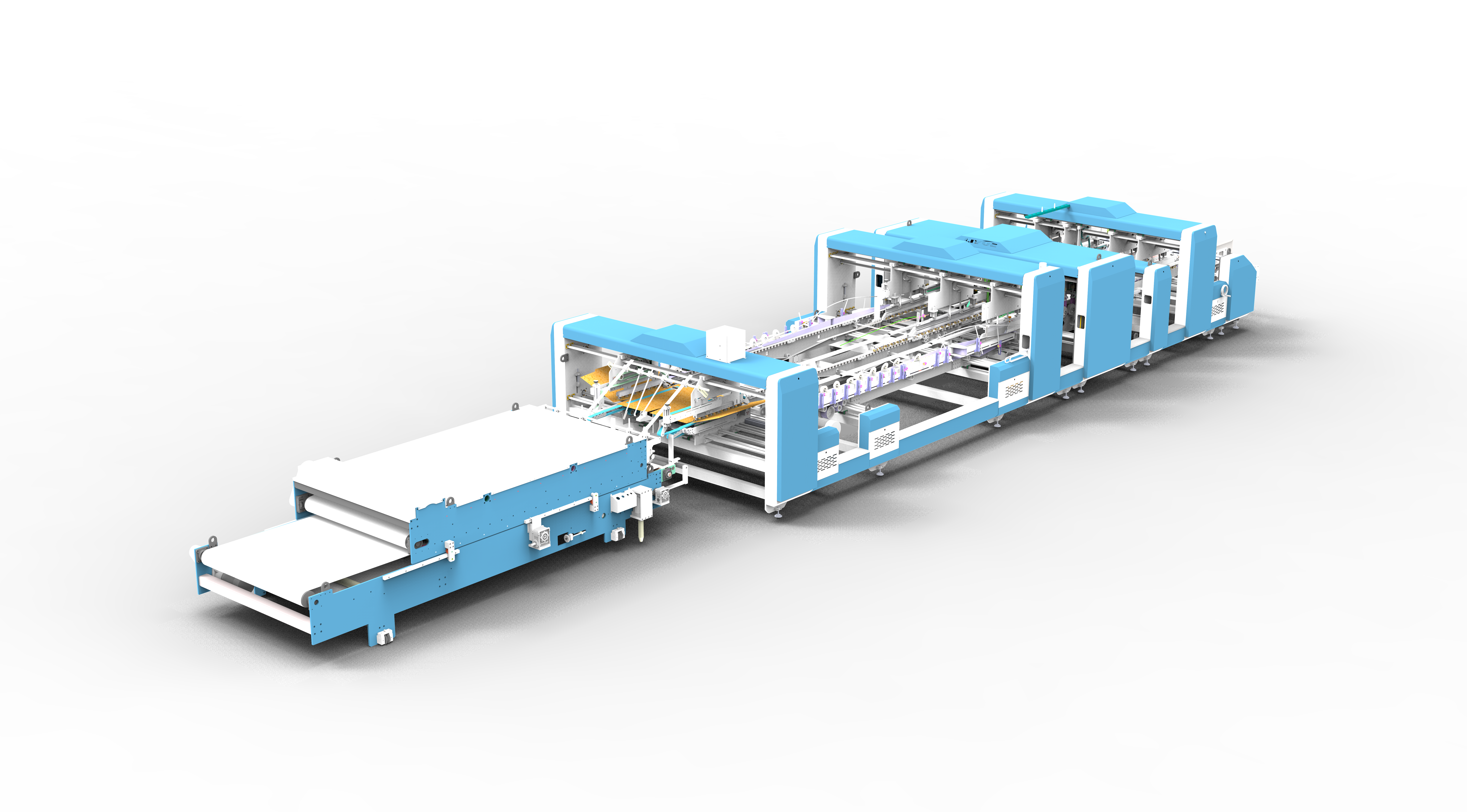
A mechanical roller gluing structure addresses much of this at the source. Instead of relying on a single contact point or a brush pass, the roller applies adhesive through continuous rolling contact with the board surface, producing a more even glue film and reducing the gaps and buildup that come with less consistent application methods. This structure also tends to hold its precision longer under continuous operation, since the rolling action distributes wear more evenly than a fixed brush or narrow wheel edge.
Pairing this roller mechanism with both hot and cold glue dipping capability gives manufacturers more flexibility to match the adhesive to the job rather than the job to the adhesive. Hot melt glue cures quickly, which supports faster, continuous runs where dwell time is limited and turnaround matters. Cold glue remains a sound choice for particular substrates or specific production requirements where its properties are the better fit. Having both options built into the same gluing section means production teams can adjust their approach order by order, without needing to reconfigure the machine or bring in separate equipment for different glue types.
Some orders call for more than a full-surface roller pass can offer, particularly boxes with complex geometries or specialty board where precise, localized adhesive placement matters more than broad coverage. An optional spray glue system fills that gap, applying glue where it's actually needed and reducing waste on jobs where a full roller pass would use more material than the design calls for.
The secondary positioning problem is addressed directly through the configuration of the glue wheel groups themselves. Structuring the gluing section around two glue wheel groups, both configured for cold application, gives the machine a more stable foundation for keeping panels aligned as they move through at production speed. Rather than depending on a single application point to manage both the gluing and the positioning accuracy, the dual-group configuration distributes that responsibility, which is a meaningful part of why boxes stay aligned through faster production cycles.
None of these components solve the whole problem on their own — the gains come from how they're integrated. A folder gluer machine's gluing section built around mechanical roller application, hot-and-cold dipping capability, an optional spray glue system, and dual cold glue wheel groups is designed to address the gluing challenge from several angles at once: even adhesive coverage from the roller structure, flexibility to switch glue types based on the order, targeted application where a full roller pass isn't the right fit, and more reliable panel alignment from the dual wheel group configuration.
For manufacturers evaluating equipment, the practical value of this kind of integrated gluing section shows up in a few concrete ways on the production floor. Bond consistency becomes less dependent on workshop temperature and humidity, since the machine isn't limited to a single glue type that performs unevenly outside a narrow range of conditions. Substrate flexibility improves, since heavier or coated boards that challenge cold glue on its own can be handled with hot melt application instead. And the alignment issues that often trace back to mismatched glue wheel groups become less likely to develop into a recurring scrap problem, because the dual-group structure is built to manage positioning accuracy as part of the gluing process rather than as an afterthought.
This is the thinking behind the gluing section on our folder gluer machines: mechanical roller application for even coverage, dual hot-and-cold dipping capability so production teams aren't locked into one glue type, an optional spray glue system for orders that call for more precise application, and dual cold glue wheel groups configured to support accurate secondary positioning at production speed. As a manufacturer working directly with corrugated box producers across a range of substrates and order volumes, we've built this configuration around the gluing challenges that actually show up on the production floor, not just the ones that are easy to solve on paper.
If you're weighing how to reduce bonding-related downtime, improve consistency across different board types, or better understand how a folder gluer's gluing section is engineered, our technical team is available to walk through the specifications in detail or arrange a demonstration of the equipment in operation. Contact us to discuss which configuration fits your production line and the substrates you work with most.
'%3e%3cg%20id='Group%201315'%3e%3cg%20id='Group'%20opacity='0.5'%3e%3cpath%20id='Vector'%20d='M387.997%200L232.635%20265.605L58.6579%2086.8843L285.379%200H387.997Z'%20fill='url(%23paint0_linear_821_1490)'/%3e%3c/g%3e%3cg%20id='Group_2'%20opacity='0.5'%3e%3cg%20id='Group%201314'%3e%3cpath%20id='Vector_2'%20d='M376.103%2012.2625L298.38%20330L10.1988%20240.481L298.38%2012.2625H376.103Z'%20fill='url(%23paint1_linear_821_1490)'/%3e%3c/g%3e%3c/g%3e%3c/g%3e%3c/g%3e%3c/g%3e%3cdefs%3e%3clinearGradient%20id='paint0_linear_821_1490'%20x1='319.349'%20y1='11.6627'%20x2='157.133'%20y2='145.876'%20gradientUnits='userSpaceOnUse'%3e%3cstop%20stop-color='%23D2DFFF'/%3e%3cstop%20offset='1'%20stop-color='%23D2DFFF'%20stop-opacity='0.01'/%3e%3c/linearGradient%3e%3clinearGradient%20id='paint1_linear_821_1490'%20x1='253.685'%20y1='25.1395'%20x2='74.5789'%20y2='173.327'%20gradientUnits='userSpaceOnUse'%3e%3cstop%20stop-color='%23D2DFFF'/%3e%3cstop%20offset='1'%20stop-color='%23D2DFFF'%20stop-opacity='0.01'/%3e%3c/linearGradient%3e%3c/defs%3e%3c/svg%3e)
'/%3e%3cpath%20id='Rectangle%20455'%20d='M0%2012H6L24%2056H0V12Z'%20fill='%23CE221D'/%3e%3c/g%3e%3cdefs%3e%3clinearGradient%20id='paint0_linear_769_2773'%20x1='0'%20y1='28'%20x2='432.5'%20y2='28'%20gradientUnits='userSpaceOnUse'%3e%3cstop%20stop-color='%23153B8A'/%3e%3cstop%20offset='1'%20stop-color='%23153B8A'%20stop-opacity='0'/%3e%3c/linearGradient%3e%3c/defs%3e%3c/svg%3e) Adapt to packaging factories and ecommerce supporting carton processing factories.
Adapt to packaging factories and ecommerce supporting carton processing factories.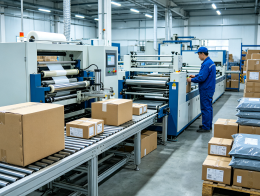 The printing and packaging factory produces molded paper boxes.
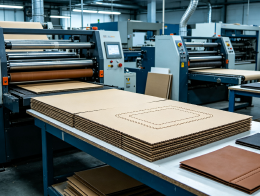 Production of two-piece packaging boxes for large household appliances with butt joint bonding.
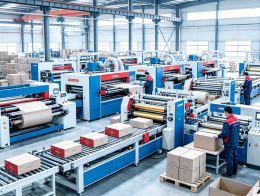 Pre-apply double-sided tape to the packaging of electronic products.
 Automatic Carton Forming Technology
 Double-sided tape applicator
Two-layer systems are designed for operational efficiency and ease of use. With automated synchronization and reduced ...
Each carton factory has different carton sizes, cardboard types, output capacity and workshop conditions. Please fill in the left form with your detailed production demands. Our technical team will tailor the most suitable machine configuration and professional production solution for you, providing free one-on-one technical guidance and customized support.