


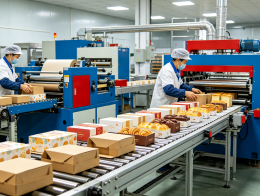
 Adapt to packaging factories and ecommerce supporting carton processing factories.
A batch of boxes performs perfectly in domestic use, then fails edge crush or compression testing once it reaches an overseas buyer or a port inspection. The instinct is usually to blame the board itself — wrong flute profile, wrong paper grade. In many cases, though, the material specification was never the issue. What changed was consistency: the same production line that turned out compliant samples early in a run started drifting as the batch grew larger, and that drift is exactly what international testing is designed to catch.
International buyers and freight carriers rely on standardized methods to judge whether a corrugated box will hold up in transit. The edge crush test, defined under ISO 3037 and TAPPI T811, measures how much compressive force the edge of the board can withstand before it collapses, and it's typically run on samples pulled throughout a production batch rather than on a single hand-picked piece. Box compression testing under ISO 12048 works the same way, evaluating a finished, filled carton's ability to hold up under stacking loads. Ply adhesion strength, covered under standards such as GB/T 6548, looks specifically at how well the layers of the board — and by extension the glued and spliced joints — stay bonded together under stress.
These are all sampling-based tests, which means a batch doesn't need every single box to fail for a shipment to get flagged. It needs enough variation that some samples fall below the threshold while others pass. That's where a folder gluer machine's gluing and splicing precision becomes directly relevant. If splice strength depends on a mechanical guide track that gradually loses precision as it wears, or if bonding at the splice point isn't actively corrected as production continues, splice quality tends to drift gradually rather than fail all at once. Early in a run, the joint may hold up fine. Several thousand pieces later, without any single dramatic breakdown, the same joint may be noticeably weaker, and that's often enough to pull the batch below a passing threshold on a spot-checked sample.
The second contributor is less obvious and easy to overlook: what happens to the machine's frame itself over long, continuous runs. Export orders tend to involve larger batch sizes and longer uninterrupted production windows than domestic short runs. If the frame supporting the folding and splicing sections isn't built to hold its dimensional accuracy under sustained high-speed operation, small amounts of flex can accumulate over time, and folding angles or splice alignment that were accurate at the start of a run can shift gradually by the end of it. This kind of issue rarely shows up in smaller domestic batches, simply because the run doesn't go on long enough to expose it, which is part of why it's frequently missed until an export shipment comes back with inconsistent test results.
For a plant trying to diagnose which of these two issues is at play, the pattern in the test data itself is usually the clearest signal. Splice-related variability tends to show up as inconsistency scattered throughout a batch, with no clear relationship to when in the run a given sample was produced. Frame-related drift, by contrast, tends to show a directional pattern — samples pulled from later in a production run testing measurably weaker than samples from the start of the same run. Reviewing whether failed samples cluster by production sequence or appear randomly across a batch is often enough to narrow down which part of the line needs attention before further testing is needed.
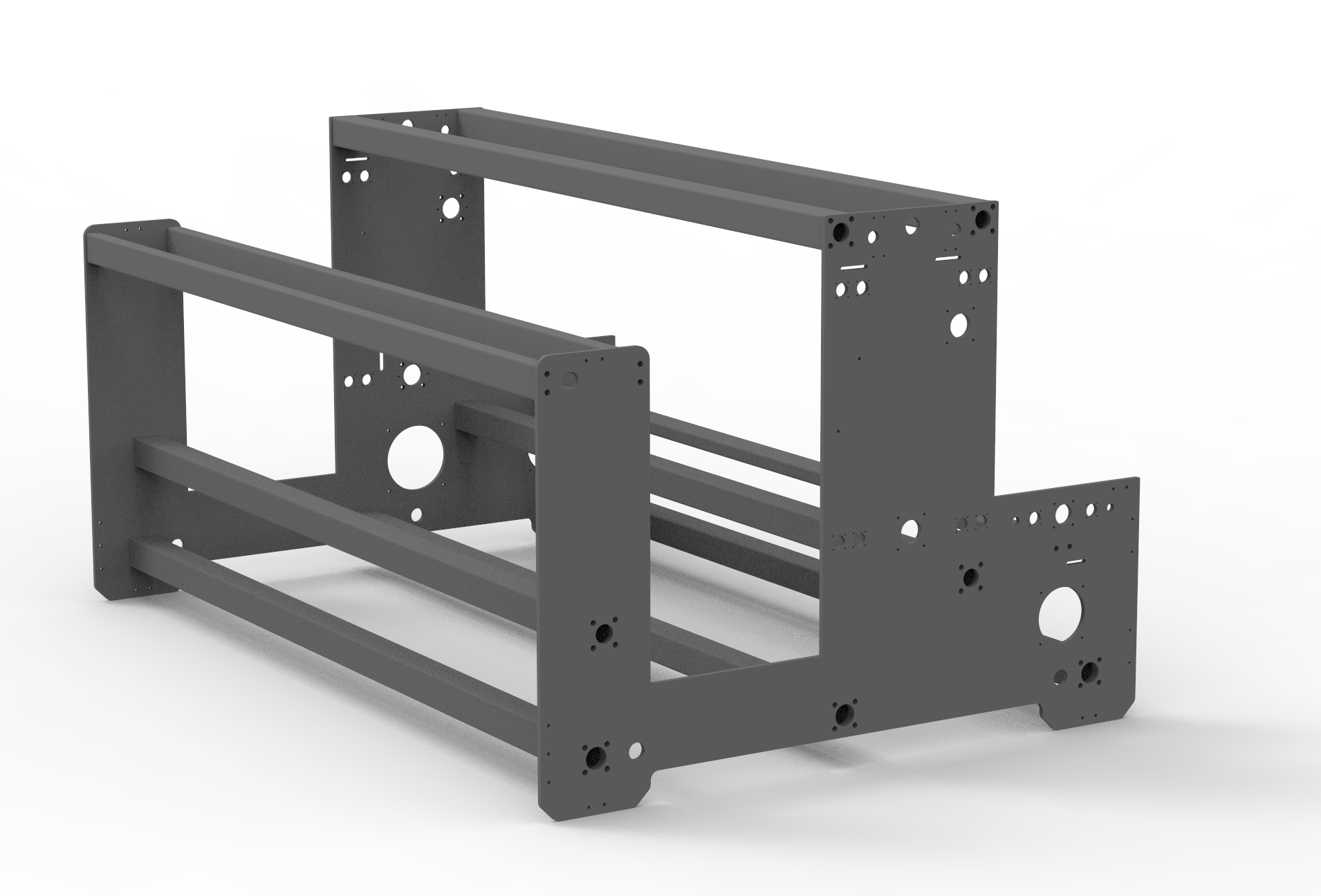
We built our splicing section and machine frame specifically around maintaining consistency across long production runs, rather than only around producing a strong result on a single test sample.
The splicing section uses a four-large, one-small guide belt layout, with each large belt driven through a dual-screw, motor-adjusted configuration rather than a fixed mechanical guide that wears down uniformly over time. The splice joint itself is bonded using a dual hot-and-cold method to keep bond strength consistent regardless of ambient conditions on the line, and a photoelectric sensing device paired with servo motor control monitors and adjusts splice alignment in real time as production continues. This is the part of the design most directly tied to the ply adhesion and edge crush concerns described above, since it's built to hold splice accuracy through the length of a run rather than relying on a guide track that degrades gradually as pieces accumulate.
The second point, frame stability, is addressed through the machine's wall panel construction, which uses 16mm cold-and-heat treated steel built to an international manufacturing standard. This construction is intended to reduce the dimensional flex that longer, continuous high-speed runs can otherwise introduce, which helps keep folding angles and splice positioning closer to their initial settings as a batch progresses rather than drifting as production continues over many hours.
The value of this kind of design isn't that any individual box gets stronger — it's that the gap between the first box off the line and the last one stays smaller. For export production specifically, where a single failed sample in a spot check can hold up or reject an entire shipment, that reduced variability across a batch is often more consequential than the peak strength of any one piece. A production line that holds its settings through a full run reduces the odds that testing catches inconsistency rather than catching a genuine material defect.
It's worth being clear about what this can and can't guarantee. A folder gluer's precision affects how consistently a design is executed, but the underlying board grade, flute profile, and adhesive selection still set the ceiling on what strength values are achievable in the first place. A well-built machine helps a plant reliably hit the compression and edge crush values its material specification is capable of, batch after batch — it doesn't substitute for choosing board and adhesive suited to the destination market's requirements in the first place.
Export testing failures usually trace back to consistency rather than a single wrong material choice. Splice strength that degrades gradually across a run, and a machine frame that flexes under sustained high-speed operation, are two of the most common reasons a batch that started out compliant ends up with samples that fall short by the time testing is done. Addressing both — through actively corrected splice alignment and a frame built to hold its dimensional accuracy over long runs — is generally what separates a production line that passes spot checks reliably from one that passes only when conditions happen to be right.
As a manufacturer of corrugated box folder gluer machines, we design our splicing section and frame construction around exactly this kind of long-run consistency, drawing on feedback from plants producing for a range of export markets and testing requirements. If your export shipments have run into inconsistent compression or edge crush results, our technical team can review your production volume and current setup and help identify where variability is most likely entering the process.
'%3e%3cg%20id='Group%201315'%3e%3cg%20id='Group'%20opacity='0.5'%3e%3cpath%20id='Vector'%20d='M387.997%200L232.635%20265.605L58.6579%2086.8843L285.379%200H387.997Z'%20fill='url(%23paint0_linear_821_1490)'/%3e%3c/g%3e%3cg%20id='Group_2'%20opacity='0.5'%3e%3cg%20id='Group%201314'%3e%3cpath%20id='Vector_2'%20d='M376.103%2012.2625L298.38%20330L10.1988%20240.481L298.38%2012.2625H376.103Z'%20fill='url(%23paint1_linear_821_1490)'/%3e%3c/g%3e%3c/g%3e%3c/g%3e%3c/g%3e%3c/g%3e%3cdefs%3e%3clinearGradient%20id='paint0_linear_821_1490'%20x1='319.349'%20y1='11.6627'%20x2='157.133'%20y2='145.876'%20gradientUnits='userSpaceOnUse'%3e%3cstop%20stop-color='%23D2DFFF'/%3e%3cstop%20offset='1'%20stop-color='%23D2DFFF'%20stop-opacity='0.01'/%3e%3c/linearGradient%3e%3clinearGradient%20id='paint1_linear_821_1490'%20x1='253.685'%20y1='25.1395'%20x2='74.5789'%20y2='173.327'%20gradientUnits='userSpaceOnUse'%3e%3cstop%20stop-color='%23D2DFFF'/%3e%3cstop%20offset='1'%20stop-color='%23D2DFFF'%20stop-opacity='0.01'/%3e%3c/linearGradient%3e%3c/defs%3e%3c/svg%3e)
'/%3e%3cpath%20id='Rectangle%20455'%20d='M0%2012H6L24%2056H0V12Z'%20fill='%23CE221D'/%3e%3c/g%3e%3cdefs%3e%3clinearGradient%20id='paint0_linear_769_2773'%20x1='0'%20y1='28'%20x2='432.5'%20y2='28'%20gradientUnits='userSpaceOnUse'%3e%3cstop%20stop-color='%23153B8A'/%3e%3cstop%20offset='1'%20stop-color='%23153B8A'%20stop-opacity='0'/%3e%3c/linearGradient%3e%3c/defs%3e%3c/svg%3e) Adapt to packaging factories and ecommerce supporting carton processing factories.
Adapt to packaging factories and ecommerce supporting carton processing factories.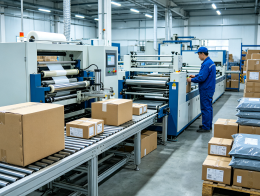 The printing and packaging factory produces molded paper boxes.
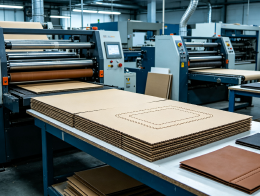 Production of two-piece packaging boxes for large household appliances with butt joint bonding.
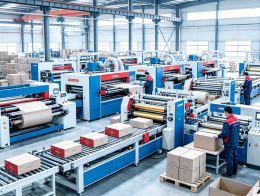 Pre-apply double-sided tape to the packaging of electronic products.
 Automatic Carton Forming Technology
 Double-sided tape applicator
Two-layer systems are designed for operational efficiency and ease of use. With automated synchronization and reduced ...
Each carton factory has different carton sizes, cardboard types, output capacity and workshop conditions. Please fill in the left form with your detailed production demands. Our technical team will tailor the most suitable machine configuration and professional production solution for you, providing free one-on-one technical guidance and customized support.