


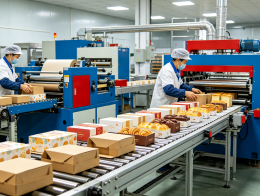
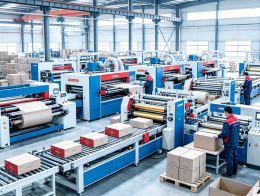
 Adapt to packaging factories and ecommerce supporting carton processing factories.
Corrugated box manufacturers often run gluing and stitching as two separate stages, each handled by its own machine. A sheet is folded and glued on one line, then physically carried to a second machine for stitching before it can be counted, stacked, and shipped. This split process has shaped corrugated box production for years, but it also introduces a number of avoidable inefficiencies that show up on the shop floor every day.
When gluing and stitching happen on separate machines, the sheet has to leave one process and enter another. That transfer point is where most of the friction accumulates. Operators need to physically move partially finished boxes, which adds handling time and creates opportunities for boxes to be damaged, misaligned, or set down in the wrong order before the next stage begins.
There is also a calibration problem. A gluing machine and a stitching machine are set up independently, each with its own operator, its own settings, and its own tolerances. Even small differences in how each machine is calibrated can lead to boxes that vary slightly from batch to batch, which becomes a real issue for buyers who need consistent box dimensions across large orders.
Speed mismatches compound the problem. Gluing lines and stitching lines rarely run at identical speeds, so one machine ends up waiting on the other, or work-in-progress piles up between them. Over a full shift, this bottleneck adds up to lost output that is difficult to recover.
Finally, running two machines means running two footprints. Corrugated plants are often tight on floor space, and a separate stitching line adds length to a layout that many factories cannot easily accommodate. For manufacturers whose customers order boxes that require both glued seams and stitched reinforcement, this two-machine setup becomes a daily source of added cost and coordination.
There is a staffing cost to this arrangement as well. Two machines generally call for two trained operators, each familiar with a different control panel, a different set of adjustment points, and a different maintenance routine. When one operator is absent or a machine needs servicing, the other stage of production is left waiting, since the two lines are not built to cover for each other. Training time doubles, spare parts inventories double, and troubleshooting a quality issue often means checking two separate machines to find out which one introduced the problem.
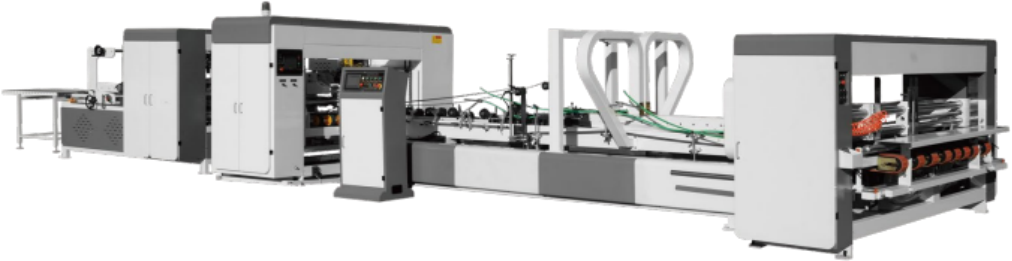
We approached this differently. Instead of treating gluing and stitching as two separate manufacturing steps, we built a single machine that carries the sheet through automatic belt suction feeding, automatic gluing, autofolding, automatic calibration, and automatic gluing or stitching, all on one continuous line. The sheet is fed once, and it does not leave the line until the box is complete and ready for counting and stacking.
The core of this design is a machine that can switch between two working modes without changing equipment. In gluing mode, the line runs at speeds up to around 170 meters per minute and handles carton sizes from roughly 1# to 12#, giving it enough range to serve a wide mix of box orders. In stitching mode, the same line runs at an average stitching speed of about 80 meters per minute, with a stitch distance that is adjustable between 30 and 120 millimeters so it can be matched to different box specifications rather than fixed to a single setup. Nail feeding runs at up to 800 nails per minute, keeping the stitching side of the process aligned with the pace of the rest of the line.
Because both processes share the same feeding, folding, and calibration stages, the machine does not need to be recalibrated twice for a single box. Automatic calibration runs as part of the sequence, which helps keep dimensions consistent from the first box in a run to the last, rather than relying on two independently adjusted machines to agree with each other.
The gluing side of the machine is built to handle carton sizes up to roughly 1200 by 2600 millimeters and down to about 170 by 420 millimeters, while board thickness on the C plus D plus C construction can reach up to 850 millimeters and the combined A plus B plus D plus E construction up to about 2600 millimeters, with a mechanical speed of up to 180 meters per minute. On the stitching side, the machine works with box sizes from around 300 by 800 millimeters up to 2600 millimeters, swing cover widths from roughly 100 to 300 millimeters, and a maximum stapling tongue width suited to the reinforcement style a customer specifies. Having this range built into one line means the same equipment can move between smaller retail cartons and larger shipping boxes without needing a second machine tuned for a different size class.
The most direct benefit is that boxes requiring both a glued seam and a stitched reinforcement no longer need to travel between two pieces of equipment. That single change removes a handling step, reduces the chance of misalignment during transfer, and shortens the overall time between feeding raw sheets and having finished boxes ready to stack.
Floor space is another practical gain. With a footprint of roughly 14000 by 4000 by 2000 millimeters, the machine occupies one line rather than the combined length of two separate machines plus the space needed to move material between them. For plants where layout space is limited, consolidating gluing and stitching into one line can free up room that would otherwise be dedicated to a second machine and its surrounding buffer area.
Because the same line handles both modes, an operator does not need to manage two sets of settings, two maintenance schedules, or two points of failure. Optional features such as a flap-folding attachment or automatic finished-product counting and stacking integrate into the same workflow, so the box moves from raw sheet to packed output along one coordinated sequence rather than passing through separate, loosely connected stages.
For box makers who receive orders that mix glued cartons with stitched ones, or single orders that need both features on the same box, this kind of setup also simplifies scheduling. Rather than planning capacity across two machines with different speeds and different bottlenecks, production runs against one line with a known throughput for each mode.
Quality control also becomes more straightforward when there is only one line to monitor. If a finished box shows an issue with either the glued seam or the stitching, an operator is checking a single sequence rather than tracing the box back through two separate machines to identify where the deviation happened. That shorter feedback loop tends to make adjustments faster and keeps a production run closer to spec from start to finish.
We design and build corrugated box forming equipment with the day-to-day realities of production plants in mind, not just the numbers on a spec sheet. Combining gluing and stitching into a single automatic line came out of watching how much time and floor space gets consumed by the handoff between separate machines, and building a line that removes that handoff rather than working around it.
Every part of the sequence, from belt suction feeding through folding, gluing, calibration, and stitching, is engineered to work as one coordinated process rather than a chain of independent stages. That is what allows the machine to hold consistent box dimensions across a full production run, whether it is operating in gluing mode or stitching mode.
If your production line is currently splitting gluing and stitching across separate machines, it is worth looking at what a single, calibrated line can do for your floor space, your changeover time, and the consistency of your finished boxes. We build this equipment to handle that combination directly, and we are glad to walk through how it would fit into your existing production setup.
'%3e%3cg%20id='Group%201315'%3e%3cg%20id='Group'%20opacity='0.5'%3e%3cpath%20id='Vector'%20d='M387.997%200L232.635%20265.605L58.6579%2086.8843L285.379%200H387.997Z'%20fill='url(%23paint0_linear_821_1490)'/%3e%3c/g%3e%3cg%20id='Group_2'%20opacity='0.5'%3e%3cg%20id='Group%201314'%3e%3cpath%20id='Vector_2'%20d='M376.103%2012.2625L298.38%20330L10.1988%20240.481L298.38%2012.2625H376.103Z'%20fill='url(%23paint1_linear_821_1490)'/%3e%3c/g%3e%3c/g%3e%3c/g%3e%3c/g%3e%3c/g%3e%3cdefs%3e%3clinearGradient%20id='paint0_linear_821_1490'%20x1='319.349'%20y1='11.6627'%20x2='157.133'%20y2='145.876'%20gradientUnits='userSpaceOnUse'%3e%3cstop%20stop-color='%23D2DFFF'/%3e%3cstop%20offset='1'%20stop-color='%23D2DFFF'%20stop-opacity='0.01'/%3e%3c/linearGradient%3e%3clinearGradient%20id='paint1_linear_821_1490'%20x1='253.685'%20y1='25.1395'%20x2='74.5789'%20y2='173.327'%20gradientUnits='userSpaceOnUse'%3e%3cstop%20stop-color='%23D2DFFF'/%3e%3cstop%20offset='1'%20stop-color='%23D2DFFF'%20stop-opacity='0.01'/%3e%3c/linearGradient%3e%3c/defs%3e%3c/svg%3e)
'/%3e%3cpath%20id='Rectangle%20455'%20d='M0%2012H6L24%2056H0V12Z'%20fill='%23CE221D'/%3e%3c/g%3e%3cdefs%3e%3clinearGradient%20id='paint0_linear_769_2773'%20x1='0'%20y1='28'%20x2='432.5'%20y2='28'%20gradientUnits='userSpaceOnUse'%3e%3cstop%20stop-color='%23153B8A'/%3e%3cstop%20offset='1'%20stop-color='%23153B8A'%20stop-opacity='0'/%3e%3c/linearGradient%3e%3c/defs%3e%3c/svg%3e) Adapt to packaging factories and ecommerce supporting carton processing factories.
Adapt to packaging factories and ecommerce supporting carton processing factories.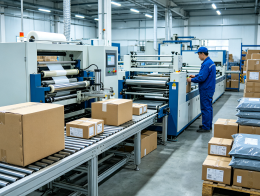 The printing and packaging factory produces molded paper boxes.
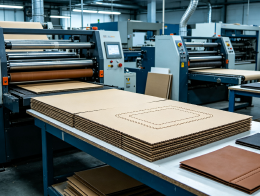 Production of two-piece packaging boxes for large household appliances with butt joint bonding.
 Pre-apply double-sided tape to the packaging of electronic products.
 Automatic Carton Forming Technology
 Double-sided tape applicator
Two-layer systems are designed for operational efficiency and ease of use. With automated synchronization and reduced ...
Each carton factory has different carton sizes, cardboard types, output capacity and workshop conditions. Please fill in the left form with your detailed production demands. Our technical team will tailor the most suitable machine configuration and professional production solution for you, providing free one-on-one technical guidance and customized support.