


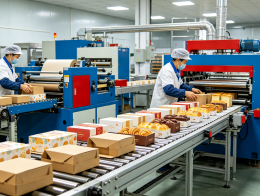
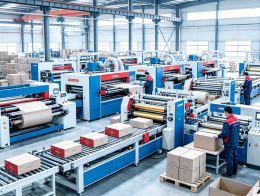
 Adapt to packaging factories and ecommerce supporting carton processing factories.
Turning a flat corrugated sheet into a finished, ready-to-ship carton looks simple from the outside — a sheet goes in, a box comes out. In our experience building folder gluer machines, that transformation depends on six connected stages: paper feeding, gluing, folding, squaring, conveying, and, for larger cartons, splicing. Each stage performs a distinct mechanical function, but none of them work in isolation on the machines we design. A sheet that enters our gluing section slightly off-center will carry that misalignment into folding; a folding inconsistency will surface again at the squaring stage as a carton that will not sit flat on a pallet. Because errors compound as the sheet moves through the line, we treat the six stages below as one system to engineer, not six separate components to assemble.
Corrugated box producers often compare folder gluer equipment primarily by maximum output speed, expressed in sheets or meters per minute. Speed is a legitimate factor, but it only tells part of the story, which is why we don't design around a single headline number. A machine can run at a high rated speed and still produce an unacceptable defect rate if feeding accuracy, glue application, or squaring cannot keep pace with that speed under real production conditions — variable board thickness, humidity affecting adhesive behavior, or long runs that expose wear in feeding components.
Plant managers who have run several generations of folder gluer equipment tend to judge machines less by a headline speed figure and more by how few sheets need to be pulled and reworked over a full shift. That outcome is a function of how well the six stations described below are synchronized, which is the standard we hold our own equipment to.
The process begins with separating flat blanks from a stack and moving them into the machine one sheet at a time. This sounds straightforward, but it is also the stage where a large share of downstream defects originate. Friction-roller feeding systems, which rely on rubber rollers gripping the top or bottom sheet in a stack, are prone to two recurring problems: double-sheet feeding, where two blanks are pulled through together, and gradual sheet drift, where the blank shifts sideways as it travels, especially with longer or thinner board that flexes more easily.
We build our feeding section around suction-based feeding to address both issues, using controlled air pressure to lift and hold each sheet individually before releasing it into the line, rather than depending on friction contact alone. Our side guides are adjustable to keep the sheet centered across a range of widths, and we add an extended support rack at the rear of the feeder to prevent longer blanks from sagging or curling before they enter the machine — a detail that matters more than it might seem, since a sheet that droops even slightly before feeding can enter our gluing section at a different angle than intended. Because every later stage assumes the sheet arrived correctly positioned, we treat feeding accuracy as the single most consequential variable in the entire process.
Once a sheet is correctly positioned, our gluing section applies adhesive along the panel edges that will become the box joint. The gluing method matters as much as the gluing location. Cold glue and hot-melt glue behave differently: cold glue generally allows more working time before it sets, which suits certain board weights and ambient conditions, while hot-melt glue sets quickly, which can support faster cycle times but leaves less room for correcting a misapplied bead before it bonds.
We don't build our gluing section around a single, fixed application method, since that would force customers to work around the machine regardless of what a given order calls for. Instead, our mechanical roller gluing system offers the option to switch between cold and hot-melt application, so the adhesive method can be matched to the board grade and production speed of the order at hand. Consistent glue coverage at this stage is also what allows our folding station downstream to form a clean, even joint rather than compensating for gaps or excess adhesive.
Our folding station brings the glued panels together along pre-scored lines to form the carton's basic structure. A folding path fixed to a single configuration works adequately when a line runs one box style continuously, but many of the corrugated plants we work with do not have that luxury — order books mix box styles, and every changeover that requires manual reconfiguration adds non-productive time to the shift.
We drive each folding element independently rather than linking it mechanically to a single drive, which lets folding angles and sequencing be adjusted without a full mechanical rebuild. We also include a second folding line supporting a combined 180-degree fold, which extends the range of box styles a single machine can handle, since some carton designs require an additional fold beyond the basic four-panel sequence. We design this section to be straightforward to disassemble for a more mundane but persistent reason: folding components accumulate glue residue and board dust over time, and a section that is easy to open for cleaning and adjustment stays accurate for longer between service intervals.
After folding, cartons on our machines pass through a patting, or squaring, station before moving further down the line. This step exists because folding a carton does not automatically leave it square — slight variances in board tension, glue placement, or feeding can leave a carton with edges that are close to aligned but not quite even. Left uncorrected, that small misalignment becomes visible once the carton is filled and stacked.
Manual squaring, still used on older or lower-volume lines, depends on an operator physically tapping or pressing cartons into alignment, which is slow and inconsistent by nature, and becomes noticeably less reliable on longer cartons where the front and back edges can drift independently. Our patting station uses independently driven upper and lower plates to square the carton mechanically and consistently, with quick changeover settings for different case lengths, automatic adjustment as cartons stack, and a belt tensioning system that keeps the squaring motion steady rather than degrading as the belts wear during a long production run.
Our conveyor section carries cartons through the remaining stages of the process, and it addresses a problem that is easy to overlook: corrugated board thickness is not always perfectly uniform, even within a single production run, due to variation in the raw linerboard and fluting material. A conveyor system built around fixed pressure settings can struggle with that variability — pressing too hard on thinner board risks crushing it, while pressure calibrated for thin board may not grip thicker board firmly enough to move it reliably.
We use a motor-driven conveyor with both manual and automatic follow-up adjustment, paired with a cylinder-based pressure regulation system, so conveying pressure can be adapted to the actual case length and board thickness running through the machine at a given moment, rather than staying fixed regardless of what is on the line. This is particularly relevant for customers running mixed order books, switching between lighter retail packaging and heavier board within the same shift.
Not every carton is formed from a single sheet. Larger cartons — appliance packaging, furniture packaging, and heavy-duty shipping cases — often exceed the maximum sheet size that upstream printing or die-cutting equipment can produce, which means two sheets need to be joined into one blank before folding can proceed. This is the role of our splicing section, and it is the stage where overall process precision is tested most directly.
Manual or semi-automatic splicing methods tend to produce inconsistent seam strength from one carton to the next, since alignment depends heavily on operator technique repeated hundreds or thousands of times per shift. That inconsistency becomes a structural concern on larger cartons, which need a reliable seam to hold their shape once loaded. We build our splicing section around independent servo motor positioning — commonly four units working in coordination — to keep both sheets aligned throughout the bonding process, while electric width adjustment lets the station be reconfigured for different carton dimensions without manual retooling. Vacuum suction control holds each sheet in place during splicing, and we offer double-sided gluing as an option at this stage to support the memory-style fold used in some carton designs, where the seam needs to hold its shape even before the box is fully erected.
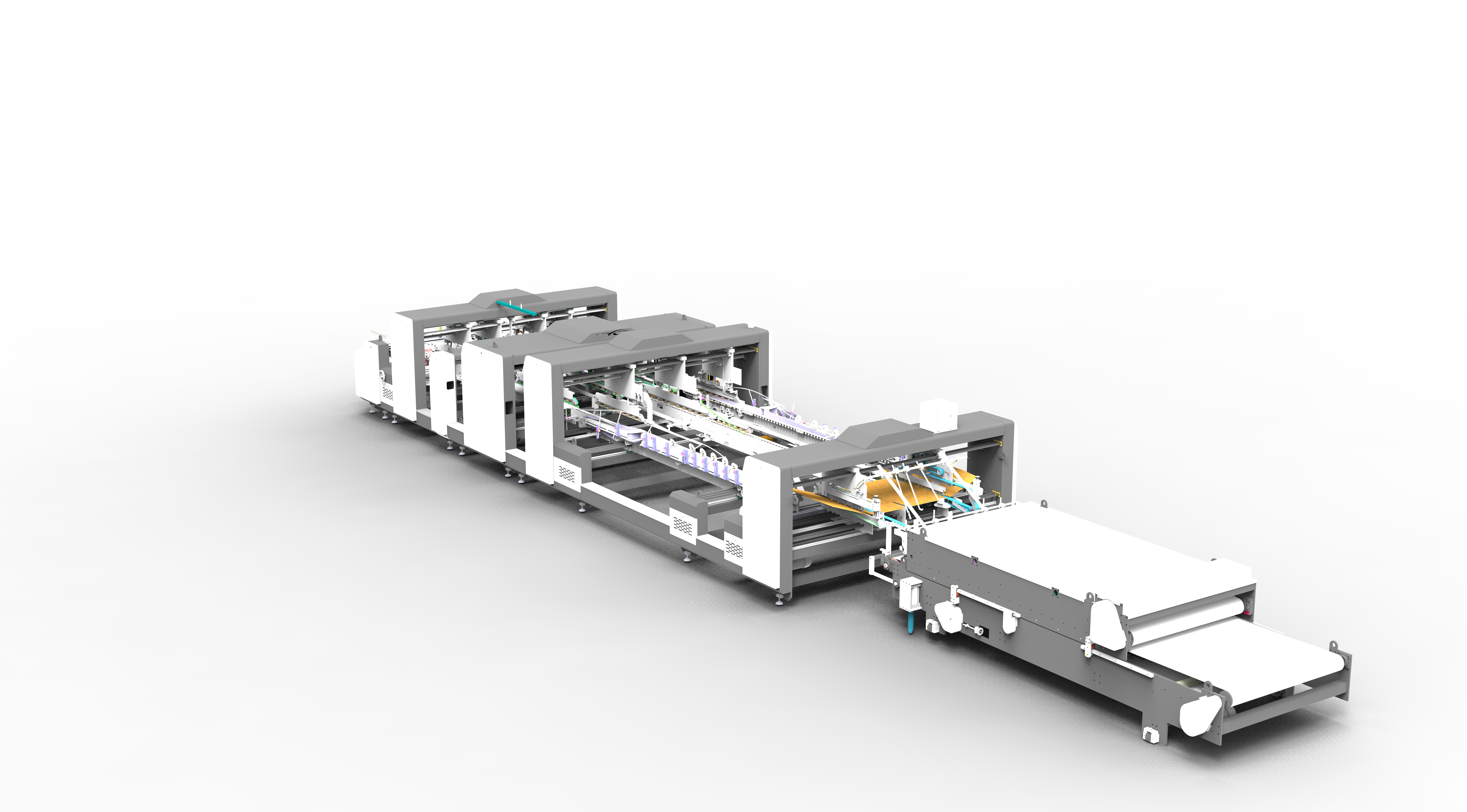
Considered individually, each of these six stations solves a distinct mechanical problem: controlling sheet movement, applying adhesive accurately, folding along the correct lines, squaring the carton, moving it without damage, and — where needed — joining two sheets into one. But we've found that a carton's actual finished quality is decided by how well these stations function together, not by any one station's individual specification.
That's why we coordinate feeding, gluing, folding, patting, conveying, and splicing through a shared servo and control architecture, so timing and positioning data can pass between stages rather than each station operating on its own fixed cycle. This coordination is what allows a carton produced at the start of a ten-thousand-unit run to match the dimensions and bond strength of a carton produced near the end of it.
We design, build, and validate each of these six sections — feeding, gluing, folding, patting, conveying, and splicing — as part of one connected production line, not as separate components assembled after the fact. Our production covers both single-sheet folder gluer machines and two-sheet spliced configurations, which lets us work directly with corrugated box manufacturers on the specific board grades, carton styles, and output targets their operations actually run.
If you're reviewing your current folding and gluing process, or evaluating new equipment for an upcoming production line, our engineering team is available to discuss how these six stages can be configured around your specific carton requirements.
'%3e%3cg%20id='Group%201315'%3e%3cg%20id='Group'%20opacity='0.5'%3e%3cpath%20id='Vector'%20d='M387.997%200L232.635%20265.605L58.6579%2086.8843L285.379%200H387.997Z'%20fill='url(%23paint0_linear_821_1490)'/%3e%3c/g%3e%3cg%20id='Group_2'%20opacity='0.5'%3e%3cg%20id='Group%201314'%3e%3cpath%20id='Vector_2'%20d='M376.103%2012.2625L298.38%20330L10.1988%20240.481L298.38%2012.2625H376.103Z'%20fill='url(%23paint1_linear_821_1490)'/%3e%3c/g%3e%3c/g%3e%3c/g%3e%3c/g%3e%3c/g%3e%3cdefs%3e%3clinearGradient%20id='paint0_linear_821_1490'%20x1='319.349'%20y1='11.6627'%20x2='157.133'%20y2='145.876'%20gradientUnits='userSpaceOnUse'%3e%3cstop%20stop-color='%23D2DFFF'/%3e%3cstop%20offset='1'%20stop-color='%23D2DFFF'%20stop-opacity='0.01'/%3e%3c/linearGradient%3e%3clinearGradient%20id='paint1_linear_821_1490'%20x1='253.685'%20y1='25.1395'%20x2='74.5789'%20y2='173.327'%20gradientUnits='userSpaceOnUse'%3e%3cstop%20stop-color='%23D2DFFF'/%3e%3cstop%20offset='1'%20stop-color='%23D2DFFF'%20stop-opacity='0.01'/%3e%3c/linearGradient%3e%3c/defs%3e%3c/svg%3e)
'/%3e%3cpath%20id='Rectangle%20455'%20d='M0%2012H6L24%2056H0V12Z'%20fill='%23CE221D'/%3e%3c/g%3e%3cdefs%3e%3clinearGradient%20id='paint0_linear_769_2773'%20x1='0'%20y1='28'%20x2='432.5'%20y2='28'%20gradientUnits='userSpaceOnUse'%3e%3cstop%20stop-color='%23153B8A'/%3e%3cstop%20offset='1'%20stop-color='%23153B8A'%20stop-opacity='0'/%3e%3c/linearGradient%3e%3c/defs%3e%3c/svg%3e) Adapt to packaging factories and ecommerce supporting carton processing factories.
Adapt to packaging factories and ecommerce supporting carton processing factories.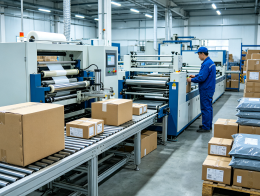 The printing and packaging factory produces molded paper boxes.
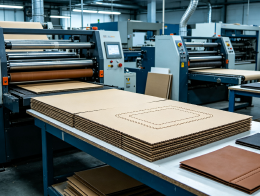 Production of two-piece packaging boxes for large household appliances with butt joint bonding.
 Pre-apply double-sided tape to the packaging of electronic products.
 Automatic Carton Forming Technology
 Double-sided tape applicator
Two-layer systems are designed for operational efficiency and ease of use. With automated synchronization and reduced ...
Each carton factory has different carton sizes, cardboard types, output capacity and workshop conditions. Please fill in the left form with your detailed production demands. Our technical team will tailor the most suitable machine configuration and professional production solution for you, providing free one-on-one technical guidance and customized support.