


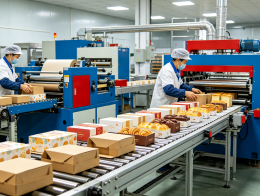
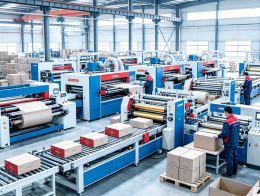
 Adapt to packaging factories and ecommerce supporting carton processing factories.
The paper feeding section is the first stage in a folder gluer's production sequence, and how reliably it performs has a direct effect on everything downstream — folding accuracy, glue application, and splicing consistency all depend on paper entering the machine at a steady, predictable rate. Friction feeding and suction feeding are the two primary approaches used across the industry today, and each comes with its own strengths and limitations depending on the paper being processed.
Friction feeding relies on friction wheels or friction pads making contact with the surface of the paper stack to pull individual sheets into the machine. It is a relatively straightforward mechanical approach, and for paper of consistent thickness and standard surface texture, it tends to perform reliably at a reasonable cost.
The limitation becomes apparent when paper thickness varies within a stack, when the paper surface is particularly smooth, or when the stack height itself creates inconsistent contact pressure. Under these conditions, friction feeding becomes more prone to pulling two or more sheets through at once rather than a single sheet. This double-feeding issue tends to become more noticeable as production speed increases, since there is less time for the mechanism to correct itself before the error reaches the folding or gluing stage — where a double-fed sheet can disrupt the entire sequence for that cycle.
Suction feeding takes a different approach, using a vacuum pump to create negative pressure that draws individual sheets away from the stack through suction nozzles before releasing them into the machine one at a time. This method tends to offer more precise sheet separation, which makes it a reasonable choice for thicker board or for paper with a surface finish that does not generate enough friction to be reliably separated by mechanical contact alone.
Suction feeding, however, depends heavily on the integrity of the air circuit and the consistency of suction pressure. If the sealing around the suction nozzles is imperfect, or if suction strength fluctuates during operation, sheets can fail to lift cleanly or the feeding rhythm can become uneven. There is also a practical limit at the other end of the spectrum — very thin paper can be pulled with excessive force under strong suction, which risks creasing or distorting the sheet before it even reaches the feeding rollers.
Looked at side by side, friction feeding and suction feeding each solve a different part of the same problem. Friction feeding offers mechanical simplicity and works well within a fairly narrow range of paper types, but struggles with double-sheet separation. Suction feeding offers more precise sheet separation but introduces its own sensitivity to air system performance and thinner paper handling. Neither approach, used in isolation, holds up equally well across the full range of paper thicknesses, surface finishes, and production speeds that a corrugated packaging facility is likely to encounter over time.
This is part of why feeding system design across the industry has moved toward combining elements of both methods rather than treating friction and suction as an either-or choice. A feeding structure that uses friction as its primary drive mechanism, supported by targeted suction where it matters most, can address the specific weaknesses of each approach rather than inheriting the limitations of whichever single method is chosen.
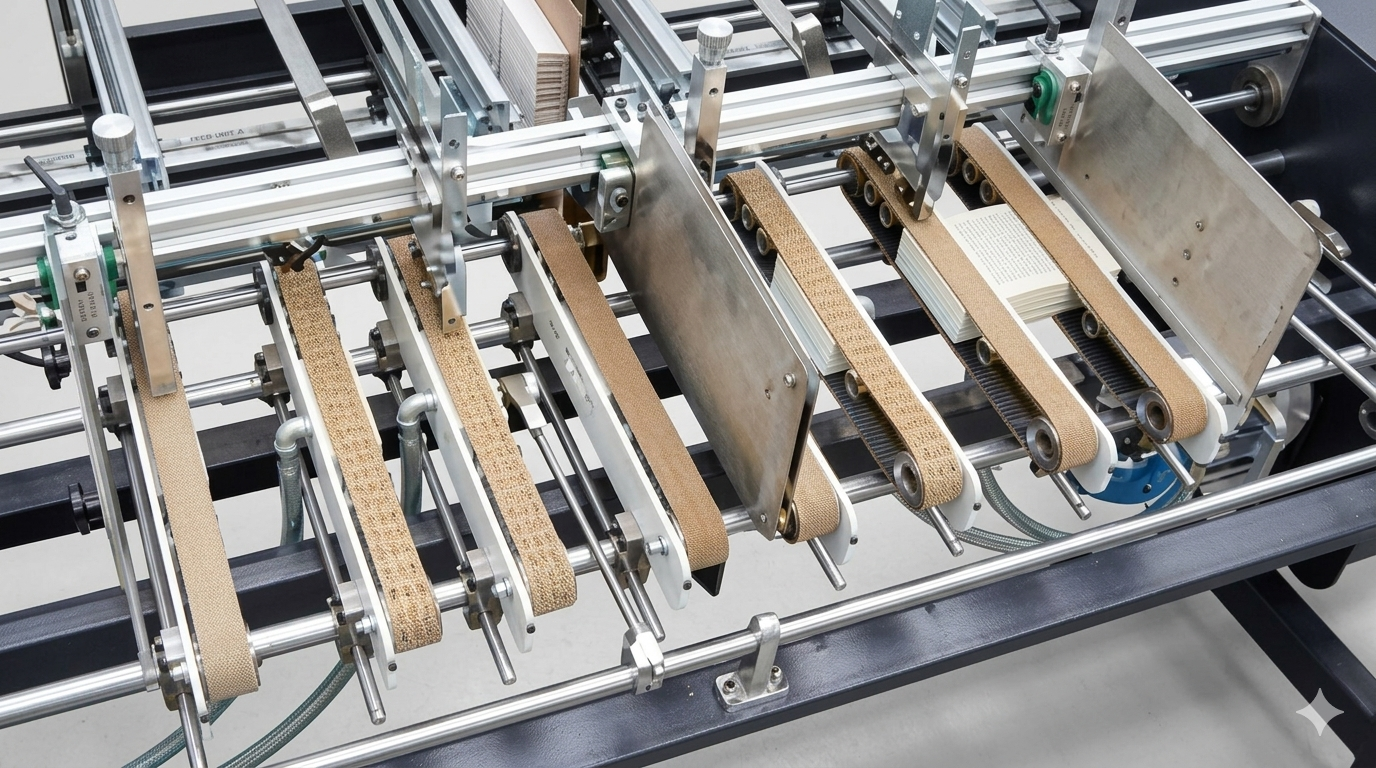
Our feeding section reflects this combined approach directly. It uses a friction-driven feeder as the primary mechanism for pulling paper into the machine, which keeps the structure straightforward and well suited to standard paper handling. Layered onto this friction drive is an air suction function specifically applied to double-sheet detection, which targets the most common failure point of friction feeding — multiple sheets being pulled through together — without requiring the entire feeding process to depend on suction alone. This division of labor allows each mechanism to do the part of the job it is best suited for, rather than asking a single system to handle sheet separation across every paper condition the machine might encounter.
Beyond the feeding mechanism itself, the section is configured with independent servo motor drive, which provides more precise and consistent feeding response compared with older linked-drive designs. The side flaps are independently adjustable in width direction to match different paper sizes, and the rear paper stack support is retractable to accommodate longer cassette-type stock. These adjustments matter because feeding stability is not only about how sheets are separated — it is also about how consistently the stack itself is positioned and supported as sheets are drawn from it, particularly as paper length and stack configuration change between production runs.
Supporting components such as the frequency converter and PLC control system contribute to this stability as well, keeping feeding speed synchronized with the rest of the machine's operating rhythm, though these systems work in the background rather than interacting with the paper directly.
None of this means that any feeding system eliminates double sheets or feeding errors entirely — paper is a variable material, and some degree of monitoring and adjustment will always be part of running a folder gluer well. What a combined friction-and-suction structure does offer is a meaningfully wider operating range, since the friction drive handles routine feeding while the suction function specifically addresses the failure mode friction feeding is most known for. This tends to reduce the frequency of feeding-related interruptions across a broader range of paper types and stack conditions than either method would manage on its own.
For a production facility, the practical value of this shows up in fewer unplanned stops caused by double sheets or misfeeds, and in less need to reconfigure or closely monitor the feeder when switching between paper specifications. Feeding reliability is easy to overlook when it works well, but its absence is immediately felt in downstream defects and lost production time.
Choosing between friction feeding and suction feeding is less a matter of picking the technically superior method and more a matter of understanding where each one performs well and where it does not. Our approach has been to combine friction-driven feeding with targeted suction-based double-sheet detection, supported by independent servo drive and adjustable stack positioning, so the feeding section can handle a broader range of paper types and production conditions without depending on a single mechanism to do all the work.
For packaging producers evaluating folder gluer equipment, feeding system design is worth examining closely, since it sets the reliability baseline for everything that happens further down the line. We work with businesses to configure feeding systems suited to their specific paper stock and production requirements, drawing on our experience in corrugated box folder gluer design to help keep production running with fewer feeding-related interruptions.
'%3e%3cg%20id='Group%201315'%3e%3cg%20id='Group'%20opacity='0.5'%3e%3cpath%20id='Vector'%20d='M387.997%200L232.635%20265.605L58.6579%2086.8843L285.379%200H387.997Z'%20fill='url(%23paint0_linear_821_1490)'/%3e%3c/g%3e%3cg%20id='Group_2'%20opacity='0.5'%3e%3cg%20id='Group%201314'%3e%3cpath%20id='Vector_2'%20d='M376.103%2012.2625L298.38%20330L10.1988%20240.481L298.38%2012.2625H376.103Z'%20fill='url(%23paint1_linear_821_1490)'/%3e%3c/g%3e%3c/g%3e%3c/g%3e%3c/g%3e%3c/g%3e%3cdefs%3e%3clinearGradient%20id='paint0_linear_821_1490'%20x1='319.349'%20y1='11.6627'%20x2='157.133'%20y2='145.876'%20gradientUnits='userSpaceOnUse'%3e%3cstop%20stop-color='%23D2DFFF'/%3e%3cstop%20offset='1'%20stop-color='%23D2DFFF'%20stop-opacity='0.01'/%3e%3c/linearGradient%3e%3clinearGradient%20id='paint1_linear_821_1490'%20x1='253.685'%20y1='25.1395'%20x2='74.5789'%20y2='173.327'%20gradientUnits='userSpaceOnUse'%3e%3cstop%20stop-color='%23D2DFFF'/%3e%3cstop%20offset='1'%20stop-color='%23D2DFFF'%20stop-opacity='0.01'/%3e%3c/linearGradient%3e%3c/defs%3e%3c/svg%3e)
'/%3e%3cpath%20id='Rectangle%20455'%20d='M0%2012H6L24%2056H0V12Z'%20fill='%23CE221D'/%3e%3c/g%3e%3cdefs%3e%3clinearGradient%20id='paint0_linear_769_2773'%20x1='0'%20y1='28'%20x2='432.5'%20y2='28'%20gradientUnits='userSpaceOnUse'%3e%3cstop%20stop-color='%23153B8A'/%3e%3cstop%20offset='1'%20stop-color='%23153B8A'%20stop-opacity='0'/%3e%3c/linearGradient%3e%3c/defs%3e%3c/svg%3e) Adapt to packaging factories and ecommerce supporting carton processing factories.
Adapt to packaging factories and ecommerce supporting carton processing factories.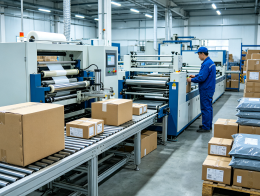 The printing and packaging factory produces molded paper boxes.
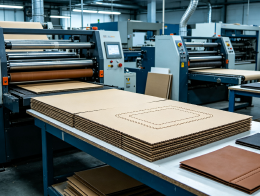 Production of two-piece packaging boxes for large household appliances with butt joint bonding.
 Pre-apply double-sided tape to the packaging of electronic products.
 Automatic Carton Forming Technology
 Double-sided tape applicator
Two-layer systems are designed for operational efficiency and ease of use. With automated synchronization and reduced ...
Each carton factory has different carton sizes, cardboard types, output capacity and workshop conditions. Please fill in the left form with your detailed production demands. Our technical team will tailor the most suitable machine configuration and professional production solution for you, providing free one-on-one technical guidance and customized support.