


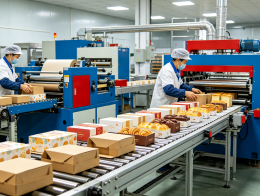
 Adapt to packaging factories and ecommerce supporting carton processing factories.
Electricity is one of those operating costs that rarely gets scrutinized the way labor or raw materials do, yet it accumulates steadily across every shift a folder gluer runs. What often gets overlooked is that total energy consumption on a folder gluer has less to do with the horsepower listed on a spec sheet and more to do with whether the drive system and control architecture actually match power output to real production demand.
Two design patterns tend to explain why traditional folder gluer machines consume more electricity than their output would suggest.
The first is centralized mechanical drive, where a single large motor powers multiple stations through belts, gears, or other mechanical linkages. In this kind of layout, power is lost at every transfer point along the drive chain, and because all stations are tied to the same source, the whole machine tends to run at a similar power level regardless of whether every station is under full load. A station running light or briefly idle still draws power indirectly through the shared mechanical system, which means the machine as a whole rarely operates as efficiently as its individual components could allow.
The second is the absence of fine-grained speed control. Without a frequency converter and PLC working together to adjust output in real time, a machine is largely limited to a fixed power level regardless of what is actually happening on the line. Paper thickness, production speed, and changeover adjustments all represent moments where actual power demand drops below full load, but a machine without dynamic control simply keeps running at a level set for worst-case conditions. Over months of operation, this gap between actual demand and delivered power adds up to a meaningful and largely avoidable portion of a facility's electricity bill.
A related factor worth mentioning briefly is motor sizing. A motor that is oversized relative to the load it drives wastes energy running well below its efficient operating range, while an undersized motor strains under load and shortens its own service life — both are less visible than the drive architecture itself, but they compound the same underlying problem of power not matching demand.
We think about energy efficiency less as a single spec to advertise and more as a design discipline that runs through how every station on the machine is powered and controlled. Two aspects of our approach are especially relevant here.
The first is station-by-station independent servo drive. Rather than routing power from one large motor through a mechanical chain to every station, key sections — feeding, folding, patting, conveying, and splicing — are each driven by their own independent servo motor. This means each station's power draw can be matched to its own actual workload rather than being tied to whatever the rest of the machine happens to be doing. A station running at partial load simply draws less power, instead of the whole machine being forced to "keep pace" with a shared mechanical drive.
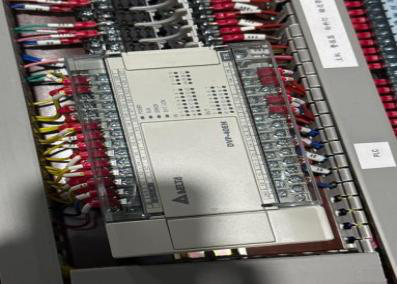
The second is precise control through our frequency converters and PLC system. Paired with SINEE frequency converters and a Delta PLC, our machines adjust motor output dynamically based on actual production speed and paper specifications, rather than holding a fixed power level regardless of conditions. This matters most during changeover, low-speed adjustment, and testing — the moments when a fixed-power machine continues drawing near-full power for no operational reason, and when a dynamically controlled system draws only what the current task requires.
This isn't a theoretical benefit — it shows up directly in our published specifications. Our smaller multi-station models run at a total power of roughly 11.6kW with a 2.2kW main motor, while our larger configurations scale up to 25.7kW total power with an 80A rated current. These figures aren't chosen to hit a marketing benchmark; they reflect power delivery sized to match each machine's actual production capacity, which is the same principle we apply at the individual station level.
None of this means energy consumption can be reduced to zero, or that any machine configuration eliminates electricity costs — running a folder gluer at production speed will always require a meaningful amount of power. What independent servo drive and dynamic frequency control actually achieve is a closer match between power delivered and power actually needed at any given moment, which is where the real savings accumulate over the life of the machine rather than in any single dramatic number.
For a facility evaluating equipment, this reframes what "energy efficient" should actually mean. A lower total power rating on a spec sheet isn't automatically more efficient if that power is delivered through a wasteful mechanical chain, and a higher-rated machine with independent servo drive and dynamic control may well consume less electricity in practice than a lower-rated machine running on fixed, centralized power. The number on the nameplate tells you the machine's ceiling; it doesn't tell you how efficiently that ceiling is used during a typical production day.
This is also where the value compounds across a facility's full operating calendar. A machine that only draws proportional power during changeovers, testing, and partial-load runs — rather than idling near full power during these windows — saves incrementally on every shift, and across a full year of multi-shift operation, that incremental saving becomes a real line item rather than a rounding error.
Choosing a genuinely efficient folder gluer means looking past the total power figure and asking how that power is actually delivered and controlled. A drive architecture built around independent servo motors at each station, combined with a frequency converter and PLC capable of adjusting output to real production conditions, tends to deliver more consistent energy savings than chasing a lower kW number on paper.
This is the standard we hold our own machines to. Every model we build pairs independent servo drive with SINEE frequency converters and Delta PLC control, and our power configurations are sized deliberately for each machine's production range rather than defaulting to oversized motors "just in case." For packaging producers weighing long-term operating costs alongside upfront equipment price, we'd encourage a closer look at drive architecture, not just nameplate wattage, when comparing folder gluer options. Our team is glad to walk through the specific power configuration and expected running costs for your production volume — reach out, and we can help you evaluate what efficient actually looks like for your line, not just for a spec sheet.
'%3e%3cg%20id='Group%201315'%3e%3cg%20id='Group'%20opacity='0.5'%3e%3cpath%20id='Vector'%20d='M387.997%200L232.635%20265.605L58.6579%2086.8843L285.379%200H387.997Z'%20fill='url(%23paint0_linear_821_1490)'/%3e%3c/g%3e%3cg%20id='Group_2'%20opacity='0.5'%3e%3cg%20id='Group%201314'%3e%3cpath%20id='Vector_2'%20d='M376.103%2012.2625L298.38%20330L10.1988%20240.481L298.38%2012.2625H376.103Z'%20fill='url(%23paint1_linear_821_1490)'/%3e%3c/g%3e%3c/g%3e%3c/g%3e%3c/g%3e%3c/g%3e%3cdefs%3e%3clinearGradient%20id='paint0_linear_821_1490'%20x1='319.349'%20y1='11.6627'%20x2='157.133'%20y2='145.876'%20gradientUnits='userSpaceOnUse'%3e%3cstop%20stop-color='%23D2DFFF'/%3e%3cstop%20offset='1'%20stop-color='%23D2DFFF'%20stop-opacity='0.01'/%3e%3c/linearGradient%3e%3clinearGradient%20id='paint1_linear_821_1490'%20x1='253.685'%20y1='25.1395'%20x2='74.5789'%20y2='173.327'%20gradientUnits='userSpaceOnUse'%3e%3cstop%20stop-color='%23D2DFFF'/%3e%3cstop%20offset='1'%20stop-color='%23D2DFFF'%20stop-opacity='0.01'/%3e%3c/linearGradient%3e%3c/defs%3e%3c/svg%3e)
'/%3e%3cpath%20id='Rectangle%20455'%20d='M0%2012H6L24%2056H0V12Z'%20fill='%23CE221D'/%3e%3c/g%3e%3cdefs%3e%3clinearGradient%20id='paint0_linear_769_2773'%20x1='0'%20y1='28'%20x2='432.5'%20y2='28'%20gradientUnits='userSpaceOnUse'%3e%3cstop%20stop-color='%23153B8A'/%3e%3cstop%20offset='1'%20stop-color='%23153B8A'%20stop-opacity='0'/%3e%3c/linearGradient%3e%3c/defs%3e%3c/svg%3e) Adapt to packaging factories and ecommerce supporting carton processing factories.
Adapt to packaging factories and ecommerce supporting carton processing factories.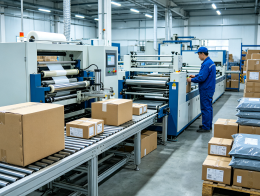 The printing and packaging factory produces molded paper boxes.
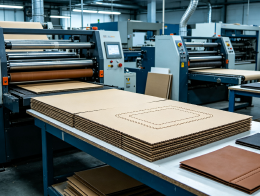 Production of two-piece packaging boxes for large household appliances with butt joint bonding.
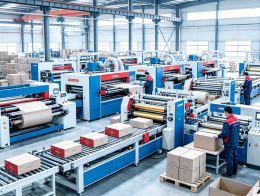 Pre-apply double-sided tape to the packaging of electronic products.
 Automatic Carton Forming Technology
 Double-sided tape applicator
Two-layer systems are designed for operational efficiency and ease of use. With automated synchronization and reduced ...
Each carton factory has different carton sizes, cardboard types, output capacity and workshop conditions. Please fill in the left form with your detailed production demands. Our technical team will tailor the most suitable machine configuration and professional production solution for you, providing free one-on-one technical guidance and customized support.