


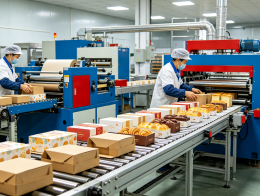
 Adapt to packaging factories and ecommerce supporting carton processing factories.
Corrugated box manufacturers increasingly need to produce cartons in a wide range of sizes, structures, and load capacities. To meet these varied requirements, two main folder gluer configurations have developed within the industry: single-piece machines, which fold and glue one sheet of corrugated board into a finished carton, and double-piece machines, which join two sheets together at a splicing section before folding is complete. Understanding how these two approaches differ helps packaging producers match their equipment choice to the boxes they actually manufacture.
The need for a double-piece process traces back to a practical limitation: printing presses and die-cutting equipment can only process board up to a certain sheet width. When a carton design exceeds that maximum sheet size, a single piece of board cannot form the complete box. Splicing two sheets together allows manufacturers to produce cartons that would otherwise be impossible to make from one blank.
At the same time, downstream demand for corrugated packaging is far from uniform. Food, personal care, and e-commerce packaging tend to favor small and mid-sized cartons produced at high volume, while appliances, furniture, machinery, and bulk logistics packaging often require larger, heavier-duty boxes. This divergence in end-use requirements is a major reason both single-piece and double-piece folder gluer technology continue to develop side by side, rather than one replacing the other.
While both machine types share the same general workflow — paper feeding, gluing, folding, and finished box output — the underlying mechanics differ in several respects.
Forming method. A single-piece machine folds one continuous sheet of corrugated board into a box shape without any intermediate joining step. A double-piece machine, by contrast, feeds two separate sheets that are aligned and bonded at a dedicated splicing station before the folding sequence is completed.
Paper feeding requirements. Single-piece feeding typically runs through a single feed path. Double-piece feeding requires two parallel feed paths that must stay synchronized, since any timing mismatch between the left and right sheets will affect splice alignment. This is why double-piece feeding sections commonly rely on independently driven servo feed wheels on each side, allowing the two sheets to be positioned and released in coordination with the gluing action.
Gluing pattern. On single-piece machines, adhesive is generally applied along the panel and flap edges that will form the box joint. Double-piece machines require this same edge gluing, plus an additional application of adhesive at the splice seam where the two sheets meet, since that seam needs to withstand the same structural stress as the rest of the finished carton.
Folding sequence. Folding on a single-piece machine follows a relatively direct path from flat blank to finished box. On a double-piece machine, folding takes place after the splicing step, meaning the folding section works with an already-joined blank rather than a single continuous one.
Alignment and squaring tolerance. Because a double-piece carton depends on two sheets being joined into one consistent structure, precise squaring and alignment before and during splicing carries more weight than it does on a single-piece line, where only one sheet needs to be kept in position.
Maximum carton size. Single-piece output is bound by the maximum sheet size the upstream printing or die-cutting equipment can produce. Double-piece construction removes that ceiling, making it possible to manufacture cartons that exceed standard single-sheet dimensions.
None of these differences make one configuration inherently superior to the other — they simply reflect two different engineering approaches suited to two different sets of production requirements.
| Comparison Item | Single-Piece Folder Gluer Machine | Double-Piece Folder Gluer Machine |
|---|---|---|
| Forming Method | Folds one continuous corrugated sheet into a carton | Joins two sheets through a splicing process before folding |
| Paper Feeding | Uses a single feeding path with simpler sheet handling | Uses dual feeding paths with synchronized sheet positioning |
| Gluing Process | Applies adhesive mainly on carton joints and flaps | Applies joint glue plus additional adhesive at the splice seam |
| Folding Process | Folds directly from a single flat blank | Folds after two sheets are combined into one blank |
| Alignment Requirements | Mainly controls the position of one sheet | Requires higher alignment accuracy for sheet joining and squaring |
| Carton Size Range | Limited by the maximum single-sheet size | Suitable for oversized cartons beyond standard sheet dimensions |
In practice, the choice between single-piece and double-piece folder gluer equipment tends to follow the type of carton being produced rather than a general preference for one technology over the other.
Single-piece folder gluer machines are commonly used for standard small and mid-sized cartons, including packaging for food products, household goods, personal care items, and e-commerce shipments. These production runs typically prioritize fast changeover between orders and consistent output at high cycle speeds, which aligns well with the more direct single-sheet forming process.
Double-piece folder gluer machines are more often found where carton dimensions or load requirements exceed what a single sheet can support. This includes outer packaging for household appliances, furniture packaging, machinery and equipment crates, and heavy-duty cartons used in bulk logistics and transport. In these applications, the ability to join two sheets into a larger, structurally sound carton is the deciding factor, rather than cycle speed alone.
It is also worth noting that many corrugated box manufacturers do not treat this as an either-or decision. Because product lines within a single packaging business often span both small retail cartons and large shipping or appliance boxes, it is common for a plant to operate single-piece and double-piece equipment side by side, assigning each order to the machine configuration best suited to its dimensions and structural needs.
For manufacturers assessing which configuration fits a given production line, a few technical factors are generally worth reviewing regardless of which type is under consideration: feeding accuracy and how it is maintained across different board thicknesses, the gluing system's ability to handle the board grades actually in use, folding section adjustability across different box styles, and how alignment or squaring is monitored during operation. For double-piece equipment specifically, the precision of the splicing station and the synchronization between the two feed paths are worth particular attention, since these directly affect the structural consistency of the finished carton.
Changeover behavior is another point worth reviewing, since order patterns differ between the two applications. Single-piece lines running smaller, higher-volume cartons tend to change over between orders more frequently, so how quickly the feeding, gluing, and folding sections can be reset for a new box style has a direct effect on daily output. Double-piece lines, which more often run larger or specialized cartons in longer batches, place relatively more weight on splice accuracy and structural repeatability across a run than on rapid changeover alone.
Board compatibility also deserves attention during equipment selection. Corrugated board grades range from lighter single-wall material used in retail packaging to heavier double-wall and triple-wall board used in industrial and export cartons. A folder gluer's feeding, gluing, and pressing components need to be matched to the board range a manufacturer actually runs, since a machine calibrated primarily for lighter board may not perform consistently on heavier double-wall stock, and the reverse can be true as well. This is particularly relevant for double-piece machines producing large appliance or equipment cartons, where board weight and splice strength both factor into the finished carton's ability to hold its shape under load.
Maintenance access and operator training requirements are practical factors that often get less attention than speed or sheet size, but they affect total cost of ownership over the life of the equipment. Folder gluers with modular sections for feeding, gluing, folding, and output tend to be easier to service and adjust without extended downtime, which matters for both single-piece lines running frequent changeovers and double-piece lines where splice quality needs to be checked and recalibrated periodically.
As a manufacturer specializing in corrugated box folder gluer machines, we provide both dedicated single-piece folder gluer machines and dual-purpose double-piece folder gluer machines to meet different carton production requirements. Our double-piece folder gluer machine is designed with flexible production capability, allowing manufacturers to produce both double-piece and single-piece cartons on the same machine, while our single-piece folder gluer machine offers a specialized solution for customers focused on standard single-piece carton applications.
With in-house engineering and manufacturing experience, we work closely with corrugated box producers to evaluate their carton structures, board specifications, production volumes, and future business plans. Rather than recommending a standard machine configuration, our engineering team analyzes each customer's actual production requirements to help select the most suitable equipment solution, whether for dedicated single-piece production, flexible mixed production, or expanded packaging capacity.
Manufacturers looking to upgrade or expand their carton production capabilities are welcome to contact our engineering team for a detailed discussion of their application needs and how our single-piece and double-piece folder gluer machines can support efficient, reliable, and flexible corrugated box manufacturing.
'%3e%3cg%20id='Group%201315'%3e%3cg%20id='Group'%20opacity='0.5'%3e%3cpath%20id='Vector'%20d='M387.997%200L232.635%20265.605L58.6579%2086.8843L285.379%200H387.997Z'%20fill='url(%23paint0_linear_821_1490)'/%3e%3c/g%3e%3cg%20id='Group_2'%20opacity='0.5'%3e%3cg%20id='Group%201314'%3e%3cpath%20id='Vector_2'%20d='M376.103%2012.2625L298.38%20330L10.1988%20240.481L298.38%2012.2625H376.103Z'%20fill='url(%23paint1_linear_821_1490)'/%3e%3c/g%3e%3c/g%3e%3c/g%3e%3c/g%3e%3c/g%3e%3cdefs%3e%3clinearGradient%20id='paint0_linear_821_1490'%20x1='319.349'%20y1='11.6627'%20x2='157.133'%20y2='145.876'%20gradientUnits='userSpaceOnUse'%3e%3cstop%20stop-color='%23D2DFFF'/%3e%3cstop%20offset='1'%20stop-color='%23D2DFFF'%20stop-opacity='0.01'/%3e%3c/linearGradient%3e%3clinearGradient%20id='paint1_linear_821_1490'%20x1='253.685'%20y1='25.1395'%20x2='74.5789'%20y2='173.327'%20gradientUnits='userSpaceOnUse'%3e%3cstop%20stop-color='%23D2DFFF'/%3e%3cstop%20offset='1'%20stop-color='%23D2DFFF'%20stop-opacity='0.01'/%3e%3c/linearGradient%3e%3c/defs%3e%3c/svg%3e)
'/%3e%3cpath%20id='Rectangle%20455'%20d='M0%2012H6L24%2056H0V12Z'%20fill='%23CE221D'/%3e%3c/g%3e%3cdefs%3e%3clinearGradient%20id='paint0_linear_769_2773'%20x1='0'%20y1='28'%20x2='432.5'%20y2='28'%20gradientUnits='userSpaceOnUse'%3e%3cstop%20stop-color='%23153B8A'/%3e%3cstop%20offset='1'%20stop-color='%23153B8A'%20stop-opacity='0'/%3e%3c/linearGradient%3e%3c/defs%3e%3c/svg%3e) Adapt to packaging factories and ecommerce supporting carton processing factories.
Adapt to packaging factories and ecommerce supporting carton processing factories.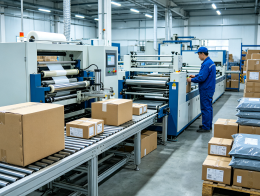 The printing and packaging factory produces molded paper boxes.
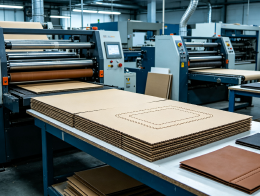 Production of two-piece packaging boxes for large household appliances with butt joint bonding.
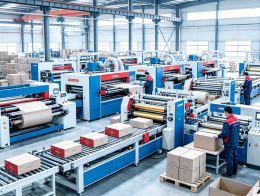 Pre-apply double-sided tape to the packaging of electronic products.
 Automatic Carton Forming Technology
 Double-sided tape applicator
Two-layer systems are designed for operational efficiency and ease of use. With automated synchronization and reduced ...
Each carton factory has different carton sizes, cardboard types, output capacity and workshop conditions. Please fill in the left form with your detailed production demands. Our technical team will tailor the most suitable machine configuration and professional production solution for you, providing free one-on-one technical guidance and customized support.