


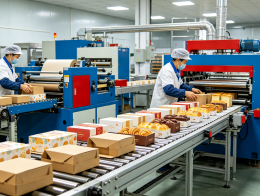
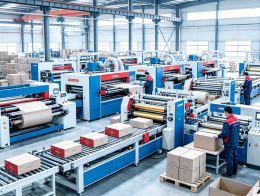
 Adapt to packaging factories and ecommerce supporting carton processing factories.
A line often runs cleanly during a low-speed test, then starts throwing off misaligned boxes the moment it's pushed up to normal production speed. The usual response is to back the speed down and treat it as a limitation of the machine. In most cases, though, the actual cause isn't that the corrugated box folder gluer machine can't handle higher speed — it's that a small amount of tracking error in the conveyor section, one that barely mattered at low speed, becomes visible once speed increases enough to amplify it.
Conveyor belts rarely start out perfectly centered, and a slight amount of drift is normal even on a well-maintained line. At low speed, that drift has time to correct itself or simply doesn't accumulate fast enough to matter. Once speed goes up, the same small error compounds over a shorter time window, and a box that would have tracked straight at reduced speed starts drifting toward one edge before it reaches the next station. This is a well-documented pattern in conveyor systems generally: small alignment errors that are harmless at low speed become magnified over distance and speed, particularly on longer conveyor runs. A folder gluer's conveyor section is exactly this kind of system, which is why misalignment so often appears only after a line is brought up to its intended running speed rather than during a slow test run.
A second contributor is how pressure is applied across the belt. Many conveyor sections rely on a single, undifferentiated pressure setting across the full width of the belt, regardless of box length or style. That works reasonably well for boxes that are short and stiff enough to stay stable on their own, but longer or thinner boxes can lose support in the middle of the belt run even when the leading and trailing edges are properly held. At low speed, that mid-section instability is minor. At high speed, it's often enough to let the box drift out of position before it clears the conveyor.
It helps to recognize the early signs before misalignment turns into a run of scrapped boxes. A belt that shows uneven wear along one edge, boxes that consistently drift toward the same side rather than randomly in either direction, or a slight vibration or noise change as speed increases are all indicators that tracking is starting to move rather than staying stable. These signs tend to appear gradually rather than all at once, which is why they're often noticed only after several batches have already been affected.
A third factor shows up specifically after a changeover. When conveyor pressure and positioning have to be reset manually for every new box style, there's room for small inconsistencies to carry into the next run, particularly if the previous settings weren't fully cleared. Misalignment issues frequently cluster in the first several hundred pieces after a changeover, which points less to a mechanical fault and more to leftover setup variance that hasn't been corrected yet.
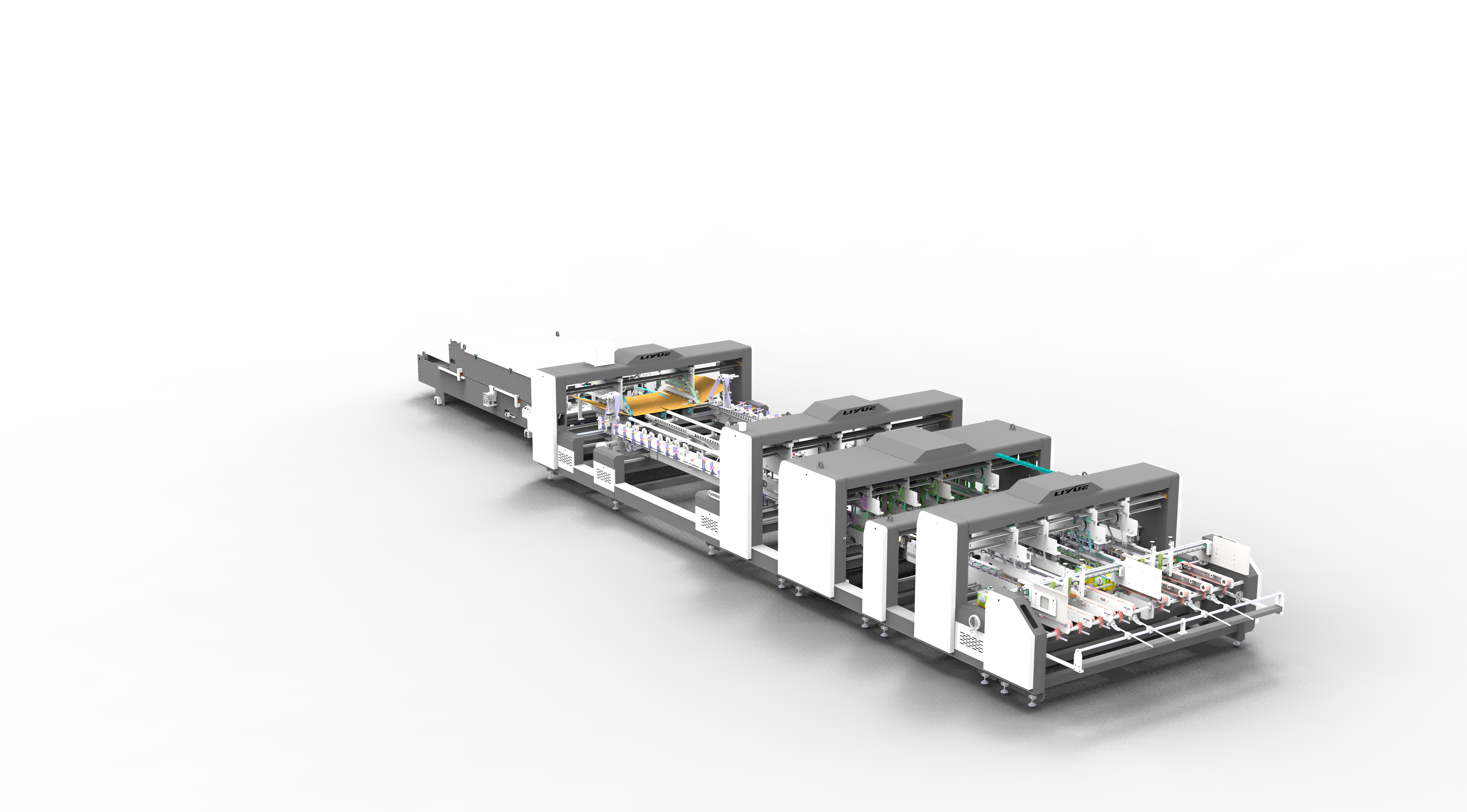
We designed the conveyor section on our corrugated box folder gluer machines around these specific failure points rather than treating high-speed stability as a byproduct of a faster motor.
The conveyor runs on a motor-driven system that supports both manual and automatic follow-up modes. In follow-up mode, the conveyor responds to how boxes are actually moving through the section rather than running at a fixed speed regardless of conditions, which reduces the kind of speed-independent drift that shows up once a line is pushed toward its rated output.
To address the mid-section instability that comes from a single, undifferentiated pressure setting, the conveyor section uses four independently controlled pressure zones rather than one blanket setting across the belt. This allows pressure to be adjusted according to box length and style, so a longer or thinner box gets support where it actually needs it instead of relying on edge pressure alone to keep it tracking straight. This zone-based control is where most of the difference between stable high-speed running and gradual drift actually comes from, since it directly addresses the point where boxes lose stability rather than compensating for it further down the line.
The third issue, leftover setup variance after a changeover, is addressed through a memory-recall function built into the pressure control system. Rather than resetting pressure and positioning by hand for every new box style, an operator can recall stored settings for a given style, which removes the manual guesswork that tends to introduce the small inconsistencies misalignment issues cluster around in the first pieces after a changeover. For plants running board types that vary in thickness or rigidity, an optional cylinder pressure adjustment system is also available to fine-tune conveyor pressure beyond what fixed zone settings alone can achieve.
Conveyor tracking accuracy holds up best when the stations feeding into it are already delivering a well-aligned box. A squaring section with independently driven upper and lower pallets keeps box positioning consistent before it reaches the conveyor, and a splicing section built around motor-adjusted guide belts helps ensure the box entering the conveyor is already square rather than compensating for misalignment introduced earlier in the line. None of these stations replace what the conveyor section does, but a conveyor working with well-aligned input holds its tracking far more reliably at speed than one trying to correct for problems it didn't cause.
The drive components behind this system matter here as much as the mechanical layout. Motor-driven pressure zones paired with programmable memory settings give operators a repeatable setup rather than a manual adjustment that has to be re-tuned by feel every time a box style changes. That repeatability is what keeps a line stable as it's pushed toward higher output, rather than requiring speed to be sacrificed to maintain tracking accuracy.
Box misalignment at high speed is rarely a sign that a corrugated box folder gluer machine has reached its limit. It's typically the result of tracking error that speed has made visible, pressure control that isn't adjusted for box length, or setup variance left over from the last changeover. Addressing those points directly, through follow-up conveyor control, zone-based pressure adjustment, and recallable settings, generally allows a line to reach its intended output speed without the drift that pushes operators to run slower than the machine is actually capable of.
As a manufacturer of corrugated box folder gluer machines, we build the conveyor section around exactly these causes, based on feedback from production lines running a range of box lengths and speeds. If your line is showing misalignment once you push toward higher output, our technical team can review your box range and current setup and help identify where the tracking issue is actually coming from.
'%3e%3cg%20id='Group%201315'%3e%3cg%20id='Group'%20opacity='0.5'%3e%3cpath%20id='Vector'%20d='M387.997%200L232.635%20265.605L58.6579%2086.8843L285.379%200H387.997Z'%20fill='url(%23paint0_linear_821_1490)'/%3e%3c/g%3e%3cg%20id='Group_2'%20opacity='0.5'%3e%3cg%20id='Group%201314'%3e%3cpath%20id='Vector_2'%20d='M376.103%2012.2625L298.38%20330L10.1988%20240.481L298.38%2012.2625H376.103Z'%20fill='url(%23paint1_linear_821_1490)'/%3e%3c/g%3e%3c/g%3e%3c/g%3e%3c/g%3e%3c/g%3e%3cdefs%3e%3clinearGradient%20id='paint0_linear_821_1490'%20x1='319.349'%20y1='11.6627'%20x2='157.133'%20y2='145.876'%20gradientUnits='userSpaceOnUse'%3e%3cstop%20stop-color='%23D2DFFF'/%3e%3cstop%20offset='1'%20stop-color='%23D2DFFF'%20stop-opacity='0.01'/%3e%3c/linearGradient%3e%3clinearGradient%20id='paint1_linear_821_1490'%20x1='253.685'%20y1='25.1395'%20x2='74.5789'%20y2='173.327'%20gradientUnits='userSpaceOnUse'%3e%3cstop%20stop-color='%23D2DFFF'/%3e%3cstop%20offset='1'%20stop-color='%23D2DFFF'%20stop-opacity='0.01'/%3e%3c/linearGradient%3e%3c/defs%3e%3c/svg%3e)
'/%3e%3cpath%20id='Rectangle%20455'%20d='M0%2012H6L24%2056H0V12Z'%20fill='%23CE221D'/%3e%3c/g%3e%3cdefs%3e%3clinearGradient%20id='paint0_linear_769_2773'%20x1='0'%20y1='28'%20x2='432.5'%20y2='28'%20gradientUnits='userSpaceOnUse'%3e%3cstop%20stop-color='%23153B8A'/%3e%3cstop%20offset='1'%20stop-color='%23153B8A'%20stop-opacity='0'/%3e%3c/linearGradient%3e%3c/defs%3e%3c/svg%3e) Adapt to packaging factories and ecommerce supporting carton processing factories.
Adapt to packaging factories and ecommerce supporting carton processing factories.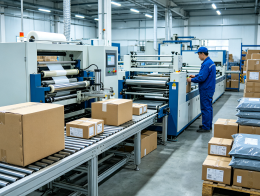 The printing and packaging factory produces molded paper boxes.
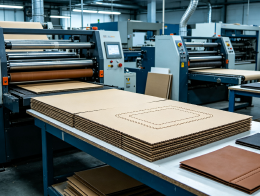 Production of two-piece packaging boxes for large household appliances with butt joint bonding.
 Pre-apply double-sided tape to the packaging of electronic products.
 Automatic Carton Forming Technology
 Double-sided tape applicator
Two-layer systems are designed for operational efficiency and ease of use. With automated synchronization and reduced ...
Each carton factory has different carton sizes, cardboard types, output capacity and workshop conditions. Please fill in the left form with your detailed production demands. Our technical team will tailor the most suitable machine configuration and professional production solution for you, providing free one-on-one technical guidance and customized support.