


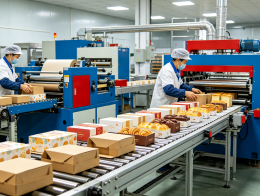
 Adapt to packaging factories and ecommerce supporting carton processing factories.
Box length is one of the most common variables a corrugated converter deals with, and it's also one of the easiest to underestimate when specifying a folder gluer machine. Every time the job on the line changes, the conveyor's upper pressure section has to reposition itself to match the new case length before production can resume. How that repositioning happens — by hand or automatically — has a bigger impact on changeover time and running stability than most buyers expect.
On a manually adjusted corrugated box folder gluer machine, the upper conveying pressure section is repositioned by hand every time the box length changes. An operator stops the line, loosens the section, slides it to roughly the right position for the new case length, and locks it back down before restarting.
This works, but it introduces a few recurring problems. The most obvious is time: every changeover now includes a manual repositioning step, and across a shift running several different box lengths, those minutes add up. The second issue is consistency. Getting the pressure section into exactly the right position depends on the operator's judgment and experience — a new hire or a tired operator near the end of a long shift is more likely to leave it slightly off, and a poorly positioned pressure section tends to show up downstream as uneven conveying pressure. That can mean boards tracking off-center through the line, occasional jams, or visible crush marks on the box surface where pressure was applied unevenly.
The third problem is flexibility, or the lack of it. Manual adjustment works reasonably well for plants running a narrow range of box sizes on repeat. It becomes a bigger liability for converters handling frequent changeovers across many different case lengths, where the repositioning step has to happen over and over, each time carrying the same risk of a slightly-off setting.
None of this makes manual adjustment a bad design — it's a straightforward, mechanically simple approach that has worked in corrugated plants for a long time. But as order patterns shift toward more box styles and shorter runs, the limitations of doing this step by hand become harder to ignore.
An automatic, or follow-up, conveyor section addresses the same task differently: the upper conveying pressure section is motor-driven and moves forward or backward on its own to match the case length currently running, without an operator stopping the line to reposition it manually.
The most immediate benefit is changeover speed. Because the pressure section adjusts itself as the job parameters change, there's no manual repositioning step to build into every changeover, which trims time out of each job switch without requiring a machine operator to make a judgment call under time pressure.
Pressure consistency improves for the same reason. A motor-driven system repositions to the same reference point every time, rather than relying on a visual estimate, which reduces the variability that tends to cause boards to track unevenly or show pressure marks after passing through the conveyor. On lines that run a wide mix of box lengths — which is increasingly the norm rather than the exception — that consistency matters more with each additional changeover.
Many follow-up conveyor sections can also be paired with an optional cylinder pressure regulation system, which lets the operator fine-tune how much pressure the section applies based on board thickness or flute type. Heavier double-wall board and lighter single-wall stock don't respond the same way to a fixed pressure setting, so being able to adjust that variable — on top of automating the length adjustment — gives a folder gluer more room to handle a broader range of jobs without manual recalibration between them.
There's also a training and staffing angle worth noting. Removing a manual judgment call from the changeover process means new operators can get up to speed faster, and running quality becomes less dependent on any individual operator's experience level on a given shift. For plants dealing with staff turnover or multiple shifts, that's a meaningful, if less visible, benefit.
This isn't a niche feature limited to top-tier machines. Motor-driven conveyor sections that automatically track box length have become a fairly standard design direction across mid-size and large corrugated folder gluer lines, particularly for converters serving customers who order a wide mix of box sizes rather than a handful of repeat SKUs.
Our corrugated box folder gluer machines use a motor-driven conveyor section that supports both manual and automatic, follow-up operation modes, so the configuration can match how a given production line actually runs rather than forcing every customer into the same setup.
Across our semi-automatic and fully automatic models, the conveyor section works the same way: the upper conveying pressure section is motor-driven and follows changes in box length automatically, without requiring an operator to stop the line and reposition it by hand. The difference between our semi-automatic and fully automatic machines shows up elsewhere in the production sequence, not in how this particular section handles length changes — a distinction we think is worth being upfront about, since it directly affects how a customer should compare configurations. Our manual configuration, by contrast, uses the same conveyor hardware set to manual positioning, which suits plants running a narrower range of box sizes at a lower initial cost.
For the automatic follow-up sections, we build in an optional cylinder pressure regulation system so the conveying pressure can be tuned for different board thicknesses and flute types rather than left at a single fixed setting. On the control side, we rely on components with a solid track record in industrial corrugated equipment — Delta motors and PLC systems, WECON human-machine interfaces, and electrical components from Omron and Schneider — because a conveyor section that adjusts automatically only delivers value if it does so reliably, shift after shift.
What this means in practice is that a plant running a wide mix of box lengths can rely on the conveyor section to keep pace with changeovers instead of becoming the step that slows everything else down, while a plant with more stable order patterns can still choose the manual configuration without paying for automation it won't use often.
How a corrugated box folder gluer machine handles changing box lengths says a lot about how well it will fit a plant's actual order mix, not just its top-line speed. A conveyor section that adjusts itself reduces the manual work built into every changeover and helps keep conveying pressure consistent across a wider range of case sizes, which becomes more valuable as the number of different box lengths running through a line increases.
If you're comparing manual and automatic follow-up conveyor configurations for your production line, our team can walk you through which setup in our folder gluer range fits your typical box length range, board thickness, and changeover frequency. Get in touch to request detailed specifications for our current models or to arrange a closer look at how the automatic follow-up conveyor section performs on our machines.
'%3e%3cg%20id='Group%201315'%3e%3cg%20id='Group'%20opacity='0.5'%3e%3cpath%20id='Vector'%20d='M387.997%200L232.635%20265.605L58.6579%2086.8843L285.379%200H387.997Z'%20fill='url(%23paint0_linear_821_1490)'/%3e%3c/g%3e%3cg%20id='Group_2'%20opacity='0.5'%3e%3cg%20id='Group%201314'%3e%3cpath%20id='Vector_2'%20d='M376.103%2012.2625L298.38%20330L10.1988%20240.481L298.38%2012.2625H376.103Z'%20fill='url(%23paint1_linear_821_1490)'/%3e%3c/g%3e%3c/g%3e%3c/g%3e%3c/g%3e%3c/g%3e%3cdefs%3e%3clinearGradient%20id='paint0_linear_821_1490'%20x1='319.349'%20y1='11.6627'%20x2='157.133'%20y2='145.876'%20gradientUnits='userSpaceOnUse'%3e%3cstop%20stop-color='%23D2DFFF'/%3e%3cstop%20offset='1'%20stop-color='%23D2DFFF'%20stop-opacity='0.01'/%3e%3c/linearGradient%3e%3clinearGradient%20id='paint1_linear_821_1490'%20x1='253.685'%20y1='25.1395'%20x2='74.5789'%20y2='173.327'%20gradientUnits='userSpaceOnUse'%3e%3cstop%20stop-color='%23D2DFFF'/%3e%3cstop%20offset='1'%20stop-color='%23D2DFFF'%20stop-opacity='0.01'/%3e%3c/linearGradient%3e%3c/defs%3e%3c/svg%3e)
'/%3e%3cpath%20id='Rectangle%20455'%20d='M0%2012H6L24%2056H0V12Z'%20fill='%23CE221D'/%3e%3c/g%3e%3cdefs%3e%3clinearGradient%20id='paint0_linear_769_2773'%20x1='0'%20y1='28'%20x2='432.5'%20y2='28'%20gradientUnits='userSpaceOnUse'%3e%3cstop%20stop-color='%23153B8A'/%3e%3cstop%20offset='1'%20stop-color='%23153B8A'%20stop-opacity='0'/%3e%3c/linearGradient%3e%3c/defs%3e%3c/svg%3e) Adapt to packaging factories and ecommerce supporting carton processing factories.
Adapt to packaging factories and ecommerce supporting carton processing factories.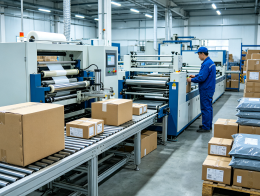 The printing and packaging factory produces molded paper boxes.
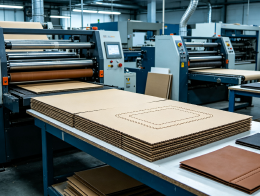 Production of two-piece packaging boxes for large household appliances with butt joint bonding.
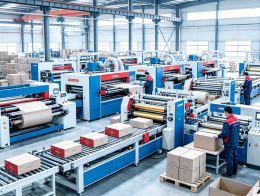 Pre-apply double-sided tape to the packaging of electronic products.
 Automatic Carton Forming Technology
 Double-sided tape applicator
Two-layer systems are designed for operational efficiency and ease of use. With automated synchronization and reduced ...
Each carton factory has different carton sizes, cardboard types, output capacity and workshop conditions. Please fill in the left form with your detailed production demands. Our technical team will tailor the most suitable machine configuration and professional production solution for you, providing free one-on-one technical guidance and customized support.